





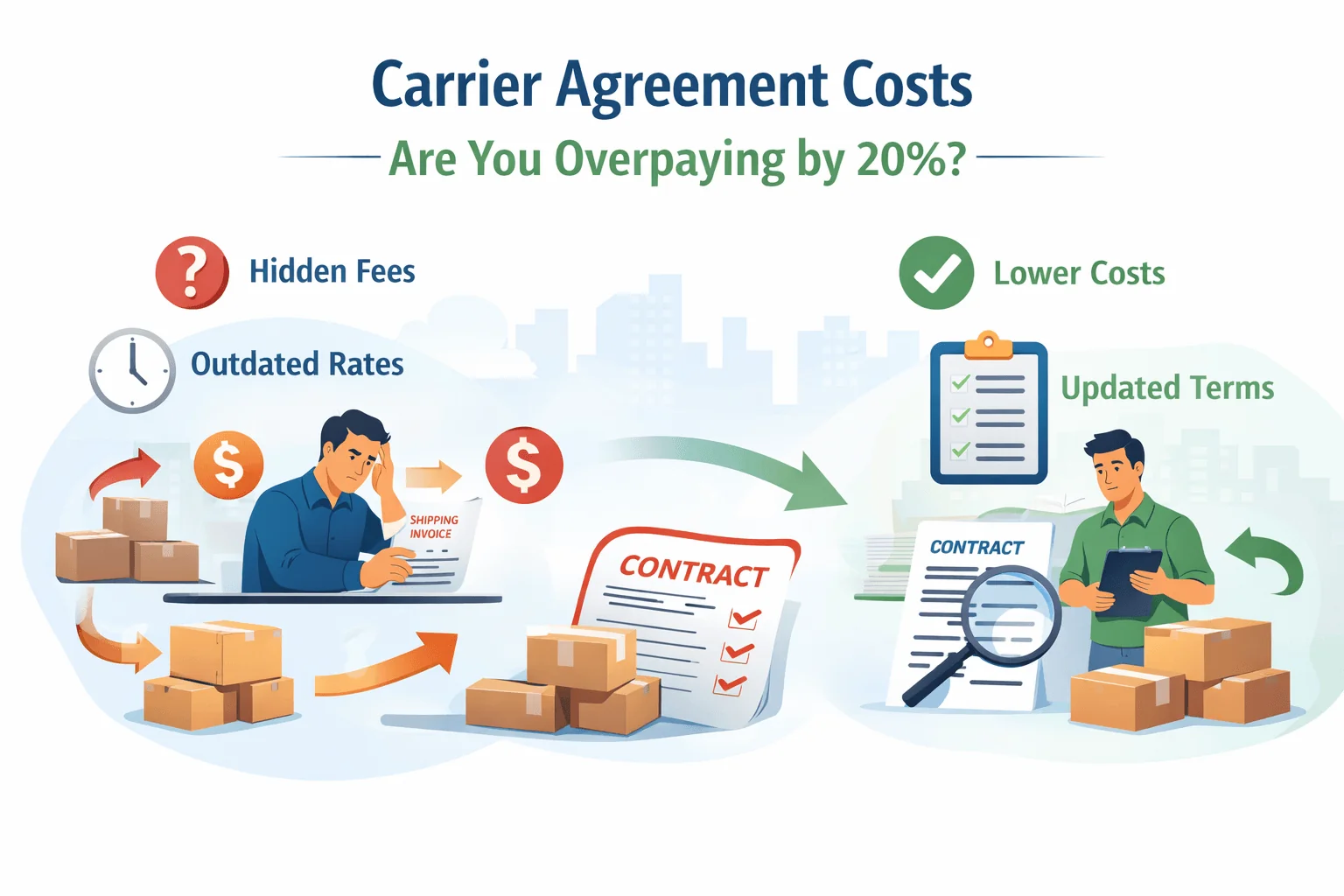
Carrier agreement costs: are you overpaying by 20%
Key takeaways
- Carrier agreements often include hidden fees that increase total shipping costs over time
- Outdated contracts may not reflect current shipping volumes or pricing conditions
- Small inefficiencies across many shipments can lead to significant overspending
- Regular reviews and simple adjustments can reduce costs without changing carriers
- Alternative delivery models, including pickup options, can complement existing agreements
Share:
The problem most teams don’t notice early
Many businesses assume their carrier agreement is working as intended. The rates were negotiated at some point, the service runs, and shipments go out on time. On the surface, everything looks fine.
The issue is that shipping costs rarely stay static. Order volumes change, customer locations shift, and delivery expectations evolve. Meanwhile, the agreement itself often stays the same. Over time, this gap can lead to consistent overspending without any obvious warning signs.
A 20% increase in cost does not usually come from one large mistake. It builds gradually through small inefficiencies, outdated terms, and fees that are easy to overlook.
The issue is that shipping costs rarely stay static. Order volumes change, customer locations shift, and delivery expectations evolve. Meanwhile, the agreement itself often stays the same. Over time, this gap can lead to consistent overspending without any obvious warning signs.
A 20% increase in cost does not usually come from one large mistake. It builds gradually through small inefficiencies, outdated terms, and fees that are easy to overlook.
What a carrier agreement actually covers
A carrier agreement is more than a list of shipping rates. It includes multiple components that affect your final cost per parcel.
These usually include:
Each of these elements can shift independently. If they are not reviewed regularly, they can move out of alignment with your actual shipping needs.
These usually include:
- Base shipping rates based on weight, size, and distance
- Fuel surcharges that change over time
- Accessorial fees for special handling, residential delivery, or missed deliveries
- Volume commitments that affect pricing tiers
- Service level agreements that define delivery speed and conditions
Each of these elements can shift independently. If they are not reviewed regularly, they can move out of alignment with your actual shipping needs.
Where the extra costs usually come from
The gap between expected and actual costs often comes from a combination of small issues rather than one major problem.
Hidden accessorial fees
Fees for address corrections, residential delivery, or failed delivery attempts can quietly add up. These charges are often not visible in headline rates but appear in invoices later.
Outdated volume assumptions
Carrier pricing often depends on volume. If your shipment volume has increased or decreased since the agreement was signed, your rates may no longer reflect your current position.
Inefficient delivery patterns
Frequent individual deliveries to similar locations increase last mile costs. Even with good rates, inefficient routing can drive up expenses.
Limited delivery options
If home delivery is the only option offered, you may be missing opportunities to reduce costs through alternatives like pickup points.
Hidden accessorial fees
Fees for address corrections, residential delivery, or failed delivery attempts can quietly add up. These charges are often not visible in headline rates but appear in invoices later.
Outdated volume assumptions
Carrier pricing often depends on volume. If your shipment volume has increased or decreased since the agreement was signed, your rates may no longer reflect your current position.
Inefficient delivery patterns
Frequent individual deliveries to similar locations increase last mile costs. Even with good rates, inefficient routing can drive up expenses.
Limited delivery options
If home delivery is the only option offered, you may be missing opportunities to reduce costs through alternatives like pickup points.
A simple breakdown of where money is lost
The table below shows how different factors can affect overall shipping costs.
| Cost factor | What happens in practice | Impact on total cost |
|---|---|---|
| Base rate | Fixed in contract | Moderate |
| Fuel surcharge | Changes regularly | Moderate to high |
| Failed deliveries | Requires repeat attempts | High |
| Accessorial fees | Added per shipment | High over time |
| Delivery density | Many separate stops | High |
| Contract age | Terms become outdated | Moderate to high |
This breakdown shows that the base rate is only one part of the total cost. The surrounding factors often have a larger long-term impact.
How to review your agreement step by step
A structured review can help you identify where costs are increasing and what can be adjusted.
Step 1: Gather recent invoices
Start by collecting invoices from the past few months. This gives you a realistic view of what you are actually paying, not just what the contract says.
Step 2: Identify recurring extra charges
Look for repeated fees such as address corrections, delivery attempts, or surcharges. These often reveal patterns that can be improved.
Step 3: Compare contracted rates to actual costs
Calculate the average cost per shipment and compare it to your expected rate. The difference shows how much is being added through other factors.
Step 4: Review your delivery mix
Check how many shipments go to similar areas and how often deliveries fail. This helps identify inefficiencies in your delivery model.
Step 5: Assess contract alignment
Consider whether your current agreement reflects your actual volume, shipping zones, and delivery needs.
Step 1: Gather recent invoices
Start by collecting invoices from the past few months. This gives you a realistic view of what you are actually paying, not just what the contract says.
Step 2: Identify recurring extra charges
Look for repeated fees such as address corrections, delivery attempts, or surcharges. These often reveal patterns that can be improved.
Step 3: Compare contracted rates to actual costs
Calculate the average cost per shipment and compare it to your expected rate. The difference shows how much is being added through other factors.
Step 4: Review your delivery mix
Check how many shipments go to similar areas and how often deliveries fail. This helps identify inefficiencies in your delivery model.
Step 5: Assess contract alignment
Consider whether your current agreement reflects your actual volume, shipping zones, and delivery needs.
Common mistakes that lead to overspending
Even well-managed operations can fall into a few common traps.
Relying only on negotiated rates
Focusing only on base rates can give a false sense of control. Most extra costs come from outside those rates.
Ignoring invoice details
Invoices often contain useful information about where money is being spent. Skipping this review means missing opportunities to improve.
Keeping the same contract for too long
Agreements that are not revisited can become outdated. Market conditions and business needs change over time.
Overlooking delivery alternatives
Sticking to a single delivery method limits flexibility. In many cases, alternative options can reduce costs without affecting service quality.
Not aligning operations with the agreement
Even a well-structured contract can lead to higher costs if day-to-day operations do not match its assumptions.
Relying only on negotiated rates
Focusing only on base rates can give a false sense of control. Most extra costs come from outside those rates.
Ignoring invoice details
Invoices often contain useful information about where money is being spent. Skipping this review means missing opportunities to improve.
Keeping the same contract for too long
Agreements that are not revisited can become outdated. Market conditions and business needs change over time.
Overlooking delivery alternatives
Sticking to a single delivery method limits flexibility. In many cases, alternative options can reduce costs without affecting service quality.
Not aligning operations with the agreement
Even a well-structured contract can lead to higher costs if day-to-day operations do not match its assumptions.
Quick checks to spot potential issues
A few quick checks can help you identify whether your agreement might be costing more than necessary.
If several of these apply, there is a good chance that costs can be reduced.
- Your average shipping cost is higher than expected based on your contract
- You see frequent extra charges on invoices
- Delivery failures are common
- You have not reviewed your agreement in over a year
- Most deliveries go to similar locations but are handled individually
If several of these apply, there is a good chance that costs can be reduced.
Looking beyond the contract
Reducing shipping costs is not only about renegotiating rates. It also involves changing how deliveries are handled.
For example, consolidating shipments to nearby locations can reduce the number of delivery stops. Offering pickup points can lower the risk of failed deliveries and reduce repeat attempts.
These operational adjustments often have a direct impact on cost without requiring major contract changes.
For example, consolidating shipments to nearby locations can reduce the number of delivery stops. Offering pickup points can lower the risk of failed deliveries and reduce repeat attempts.
These operational adjustments often have a direct impact on cost without requiring major contract changes.
Where Via.Delivery fits into this picture
Managing delivery options can become complex, especially when trying to balance cost and customer expectations. This is where technology can help structure the process.
Via.Delivery provides an IT solution that allows D2C brands to offer alternative delivery options, including pickup-based models. By introducing options beyond standard home delivery, businesses can reduce inefficiencies that are not addressed in traditional carrier agreements.
This does not replace the carrier relationship. Instead, it complements it by improving how deliveries are organized and executed.
Via.Delivery provides an IT solution that allows D2C brands to offer alternative delivery options, including pickup-based models. By introducing options beyond standard home delivery, businesses can reduce inefficiencies that are not addressed in traditional carrier agreements.
This does not replace the carrier relationship. Instead, it complements it by improving how deliveries are organized and executed.
Balancing cost, service, and flexibility
Lowering costs should not come at the expense of customer experience. The goal is to find a balance between efficiency and convenience.
Home delivery remains important for many customers, but not all shipments require the same level of service. Offering different delivery options allows businesses to match the method to the situation.
Some customers prefer flexibility over speed, especially if it reduces costs. Others will continue to choose home delivery. A mix of options allows both groups to be served effectively.
Home delivery remains important for many customers, but not all shipments require the same level of service. Offering different delivery options allows businesses to match the method to the situation.
Some customers prefer flexibility over speed, especially if it reduces costs. Others will continue to choose home delivery. A mix of options allows both groups to be served effectively.
Practical next steps
If you suspect your carrier agreement might be costing more than necessary, start with a simple review.
Begin by analyzing recent invoices and identifying where extra charges appear. Look for patterns in delivery failures and repeated costs. Compare your actual shipping expenses to your expected rates.
Next, consider small operational changes. Introducing pickup options can reduce delivery inefficiencies without major disruption.
Finally, review your agreement in the context of your current business. If your volume, locations, or delivery patterns have changed, your contract should reflect that.
Solutions like Via.Delivery can support this process by helping businesses manage alternative delivery options in a structured way. This allows you to improve efficiency alongside your existing carrier setup, rather than replacing it entirely.
Begin by analyzing recent invoices and identifying where extra charges appear. Look for patterns in delivery failures and repeated costs. Compare your actual shipping expenses to your expected rates.
Next, consider small operational changes. Introducing pickup options can reduce delivery inefficiencies without major disruption.
Finally, review your agreement in the context of your current business. If your volume, locations, or delivery patterns have changed, your contract should reflect that.
Solutions like Via.Delivery can support this process by helping businesses manage alternative delivery options in a structured way. This allows you to improve efficiency alongside your existing carrier setup, rather than replacing it entirely.