





Delivery Flexibility Is More Important Than Speed
Key takeaways
Speed still matters in delivery, but it is no longer the only thing shoppers care about. A fast delivery that arrives at the wrong time, sits outside too long, or requires a signature when nobody is home can still create a bad experience.
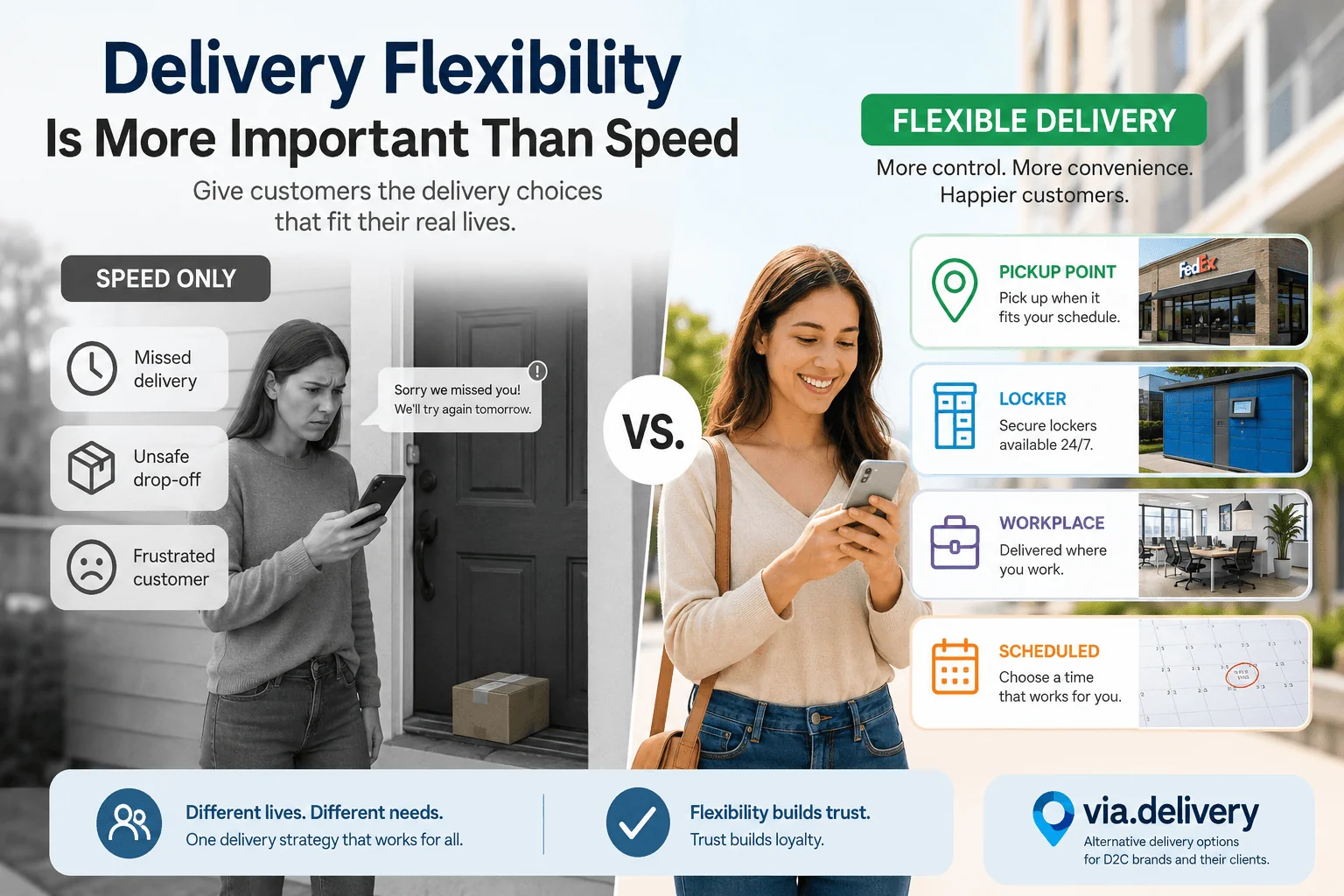
Delivery flexibility gives customers more control over how, where, and when they receive orders. This can include home delivery, pickup points, lockers, workplace delivery, scheduled delivery windows, or other out-of-home options.
For D2C brands, flexibility can reduce friction after checkout. It can also help brands serve shoppers with different routines, living situations, package security concerns, and delivery preferences.
The best delivery strategy is not always the fastest one. It is the one that gives shoppers a practical option they can actually use.
Delivery flexibility gives customers more control over how, where, and when they receive orders. This can include home delivery, pickup points, lockers, workplace delivery, scheduled delivery windows, or other out-of-home options.
For D2C brands, flexibility can reduce friction after checkout. It can also help brands serve shoppers with different routines, living situations, package security concerns, and delivery preferences.
The best delivery strategy is not always the fastest one. It is the one that gives shoppers a practical option they can actually use.
Share:
The real delivery problem is not always speed
Many ecommerce teams still treat faster delivery as the main way to improve customer experience. Two-day shipping, next-day shipping, and same-day shipping are often seen as the gold standard.
Speed is easy to understand, easy to market, and easy to compare.
But real delivery problems usually happen after the order leaves the warehouse. A package may arrive when the customer is at work. It may be left outside an apartment building. It may need a signature. It may be delayed because the carrier could not access the building. In these cases, faster shipping does not solve the issue.
A shopper does not only ask, “How fast can I get this?” They also ask, “Will I be home?” “Will it be safe?” “Can I pick it up later?” “Can I avoid another missed delivery?” These questions are about control, not speed.
Speed is easy to understand, easy to market, and easy to compare.
But real delivery problems usually happen after the order leaves the warehouse. A package may arrive when the customer is at work. It may be left outside an apartment building. It may need a signature. It may be delayed because the carrier could not access the building. In these cases, faster shipping does not solve the issue.
A shopper does not only ask, “How fast can I get this?” They also ask, “Will I be home?” “Will it be safe?” “Can I pick it up later?” “Can I avoid another missed delivery?” These questions are about control, not speed.
What delivery flexibility actually means
Delivery flexibility means giving shoppers a choice that fits their real routine. It does not mean offering every possible option. It means offering enough practical choices so the customer is not forced into a delivery method that creates stress.
For one shopper, flexibility may mean home delivery. For another, it may mean pickup at a nearby FedEx or UPS location. For another, it may mean sending the order somewhere close to work, school, or errands.
For one shopper, flexibility may mean home delivery. For another, it may mean pickup at a nearby FedEx or UPS location. For another, it may mean sending the order somewhere close to work, school, or errands.
Common flexible delivery options
Flexible delivery can include several ordinary options:
The point is not to make delivery complicated. The point is to make it easier for the shopper to choose the option with the lowest risk.
- Home delivery for shoppers who are usually available
- Pickup points for shoppers who are not home during the day
- Lockers where available
- Delivery to a workplace or alternate address
- Signature-required delivery when product type or value demands it
- Notifications that help the customer plan pickup or receipt
The point is not to make delivery complicated. The point is to make it easier for the shopper to choose the option with the lowest risk.
Speed can fail when the delivery does not fit the shopper
A fast package can still create a poor experience if it arrives at the wrong place or time. This is common in apartments, gated buildings, offices, student housing, and neighborhoods where package theft is a concern.
A shopper may prefer a slower pickup option if it means the package is held safely until they can collect it. Someone who works long hours may not benefit from next-day delivery if the package arrives during work and disappears from a lobby.
Speed answers one question: “When will it arrive?” Flexibility answers a broader question: “Will this delivery work for me?”
A shopper may prefer a slower pickup option if it means the package is held safely until they can collect it. Someone who works long hours may not benefit from next-day delivery if the package arrives during work and disappears from a lobby.
Speed answers one question: “When will it arrive?” Flexibility answers a broader question: “Will this delivery work for me?”
The common trap: treating all shoppers the same
One mistake brands make is assuming every customer wants the same delivery experience. Some shoppers do want the fastest option available. Others care more about predictability, privacy, security, or avoiding missed deliveries.
A single delivery option may work well for part of the customer base and poorly for another part. This is especially true for brands shipping to different housing types, states, weather conditions, product sizes, or customer schedules.
A single delivery option may work well for part of the customer base and poorly for another part. This is especially true for brands shipping to different housing types, states, weather conditions, product sizes, or customer schedules.
Mistakes that create delivery friction
| Mistake | What happens | Better approach |
|---|---|---|
| Offering only home delivery | Some shoppers miss packages or worry about theft | Add a pickup option where practical |
| Promoting speed above all else | Customers expect fast delivery even when it is not useful | Present speed and control together |
| Hiding delivery choices until late | Shoppers may abandon checkout | Show clear options before payment |
| Using vague delivery language | Customers do not know what will happen next | Explain pickup, tracking, and notifications clearly |
| Ignoring signature issues | Deliveries fail when nobody is home | Offer a pickup option for suitable orders |
Pickup points make flexibility practical
Pickup points are one of the simplest ways to offer flexibility without forcing customers to manage a special process. The customer chooses a location, the package is delivered there, and the customer collects it when it fits their schedule.
This can be useful for shoppers who live in apartments, travel often, work during delivery hours, or do not want packages left outside. It can also help brands offer an option that feels more controlled than unattended home delivery.
For a D2C brand, pickup points are not about replacing home delivery completely. They are about adding another path for customers who need it.
This can be useful for shoppers who live in apartments, travel often, work during delivery hours, or do not want packages left outside. It can also help brands offer an option that feels more controlled than unattended home delivery.
For a D2C brand, pickup points are not about replacing home delivery completely. They are about adding another path for customers who need it.
How flexibility supports customer confidence
Delivery problems often become customer service problems. When shoppers feel they had no control, frustration grows. They may contact support, request a replacement, complain about the carrier, or hesitate before ordering again.
Flexible options help reduce that feeling of helplessness. A shopper who chooses pickup understands where the package will go and when they can collect it. A shopper who chooses home delivery does so because it fits their routine.
This creates a better match between expectation and outcome. That match matters more than speed alone.
Flexible options help reduce that feeling of helplessness. A shopper who chooses pickup understands where the package will go and when they can collect it. A shopper who chooses home delivery does so because it fits their routine.
This creates a better match between expectation and outcome. That match matters more than speed alone.
Where Via.Delivery fits into the delivery choice
For brands that want to add out-of-home delivery, the operational details matter. The shopper needs to see the option clearly, the order needs the right label, and notifications need to keep the customer informed.
Via.Delivery is an IT solution that provides D2C brands and their clients with an alternative delivery option. In this context, it can be part of a broader delivery strategy where pickup points sit alongside standard home delivery.
The value is not in replacing every existing shipping method. The value is in giving shoppers another practical choice when home delivery is not the best fit.
Via.Delivery is an IT solution that provides D2C brands and their clients with an alternative delivery option. In this context, it can be part of a broader delivery strategy where pickup points sit alongside standard home delivery.
The value is not in replacing every existing shipping method. The value is in giving shoppers another practical choice when home delivery is not the best fit.
How to present flexible delivery at checkout
Flexible delivery should be easy to understand. Customers should not need to guess what a pickup point is or whether it is different from a store pickup.
Use plain language. Explain that the order can be sent to a nearby carrier pickup location and collected when ready. Make the location, expected timing, and notification process clear before the shopper pays.
Avoid overloading checkout with too much text. The goal is to give customers confidence, not slow them down.
Use plain language. Explain that the order can be sent to a nearby carrier pickup location and collected when ready. Make the location, expected timing, and notification process clear before the shopper pays.
Avoid overloading checkout with too much text. The goal is to give customers confidence, not slow them down.
Practical next steps
Start by reviewing where delivery problems happen most often. Look at missed deliveries, support tickets, stolen package complaints, signature problems, and customers who ask for alternate shipping options.
Then test flexible delivery options where they make the most sense. This could be certain regions, products, customer segments, or orders where unattended home delivery creates more risk.
Make the option clear in checkout, explain it in simple language, and track how customers use it. A solution such as Via.Delivery can fit into this process as a way for D2C brands to offer an alternative delivery option without turning the delivery experience into a complicated project.
The goal is not to make delivery slower. The goal is to make delivery fit real life.
Then test flexible delivery options where they make the most sense. This could be certain regions, products, customer segments, or orders where unattended home delivery creates more risk.
Make the option clear in checkout, explain it in simple language, and track how customers use it. A solution such as Via.Delivery can fit into this process as a way for D2C brands to offer an alternative delivery option without turning the delivery experience into a complicated project.
The goal is not to make delivery slower. The goal is to make delivery fit real life.
FAQ
Is fast delivery still important?
Yes. Fast delivery is still useful, especially when customers need a product quickly. But speed alone does not guarantee a good experience if the package is missed, stolen, delayed, or sent somewhere inconvenient.
What is delivery flexibility?
Delivery flexibility means giving shoppers practical choices for receiving their orders. This may include home delivery, pickup points, lockers, alternate addresses, or other options that better match the customer’s schedule and situation.
Why would a shopper choose pickup instead of home delivery?
A shopper may choose pickup if they are not home during the day, live in an apartment, worry about package theft, need more privacy, or want to collect the order on their own schedule.
Does flexible delivery replace home delivery?
No. Flexible delivery works best as an added option. Many shoppers still prefer home delivery, while others need a safer or more convenient alternative.
How can brands start offering more flexible delivery?
Brands can begin by identifying common delivery problems, testing pickup options for selected orders or regions, and making the checkout explanation clear. The best starting point is often the area where delivery friction is already visible.