





Cutting Logistics Costs: The Difference Between Delivery and Destination Shipping
Key takeaways
- Delivery shipping and destination shipping solve different logistics problems.
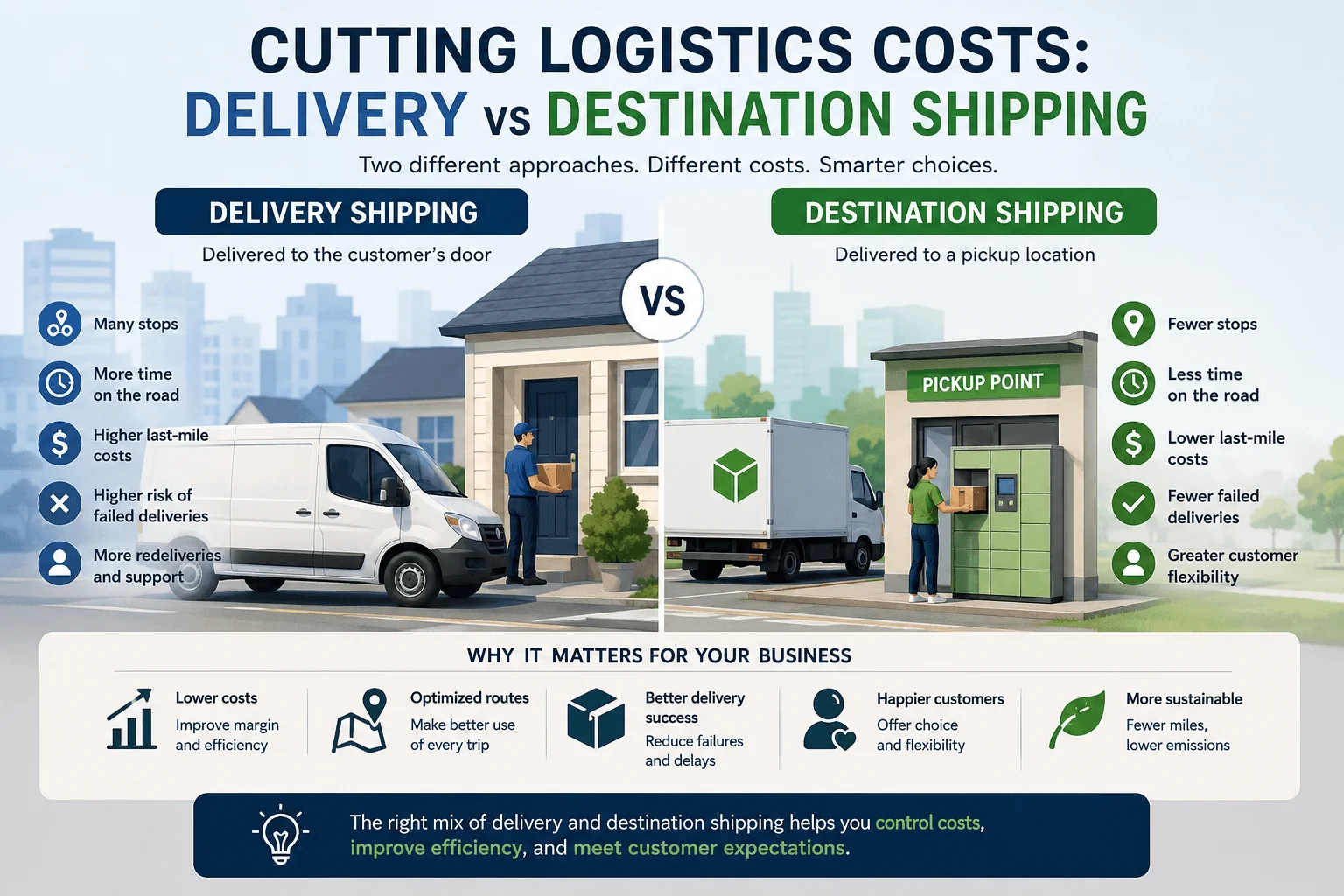
- Traditional delivery focuses on bringing each order directly to the customer's address.
- Destination shipping groups deliveries around a pickup point or destination location rather than individual homes.
- Transportation, failed deliveries, and last-mile operations often account for a large share of logistics expenses.
- The right approach depends on customer expectations, product type, geography, and order volume.
- Many brands use a combination of both models to balance cost and convenience.
Share:
The shipping cost problem most brands face
Shipping costs rarely stay still. Fuel prices change, labor costs rise, customer expectations increase, and businesses are expected to deliver quickly without charging more.
For many direct-to-consumer brands, the most expensive part of fulfillment is not storing inventory or packing orders. It is getting products from a distribution point to the final customer.
The challenge becomes even greater when customers are spread across different neighborhoods, cities, or regions. Every additional stop, delivery attempt, and mile traveled can increase costs.
When businesses look for ways to reduce logistics expenses, they often focus on carrier rates.
While negotiating rates can help, it is only part of the picture. The structure of the delivery network itself can have a significant effect on overall costs.
This is where the distinction between delivery shipping and destination shipping becomes important.
Although the two approaches may seem similar at first glance, they operate differently and can produce very different cost outcomes.
For many direct-to-consumer brands, the most expensive part of fulfillment is not storing inventory or packing orders. It is getting products from a distribution point to the final customer.
The challenge becomes even greater when customers are spread across different neighborhoods, cities, or regions. Every additional stop, delivery attempt, and mile traveled can increase costs.
When businesses look for ways to reduce logistics expenses, they often focus on carrier rates.
While negotiating rates can help, it is only part of the picture. The structure of the delivery network itself can have a significant effect on overall costs.
This is where the distinction between delivery shipping and destination shipping becomes important.
Although the two approaches may seem similar at first glance, they operate differently and can produce very different cost outcomes.
What traditional delivery shipping means
In a traditional delivery model, each order is transported directly to the customer's specified address.
Most online shoppers are familiar with this process. A customer places an order, receives tracking information, and waits for the package to arrive at home, work, or another chosen address.
The logistics flow typically looks like this:
The model is built around individual deliveries.
Most online shoppers are familiar with this process. A customer places an order, receives tracking information, and waits for the package to arrive at home, work, or another chosen address.
The logistics flow typically looks like this:
- Order is processed.
- Product is packed.
- Carrier receives the shipment.
- Package travels through transportation hubs.
- Driver delivers directly to the customer.
The model is built around individual deliveries.
Residential delivery
Direct delivery creates convenience for customers, but it also creates several cost drivers:
These costs become more noticeable when order density is low. If a driver must travel across a large area to deliver only a few packages, transportation efficiency decreases.
- Individual stops for every package
- Longer delivery routes
- Driver labor costs
- Fuel consumption
- Failed delivery attempts
- Redelivery requirements
- Customer service inquiries related to delivery issues
These costs become more noticeable when order density is low. If a driver must travel across a large area to deliver only a few packages, transportation efficiency decreases.
Why businesses continue to use it
Despite the costs, direct delivery remains popular because customers value convenience.
For many products, especially urgent purchases or items that customers expect to receive at home, direct delivery is often the preferred option.
Businesses also benefit from a familiar process that customers already understand.
For many products, especially urgent purchases or items that customers expect to receive at home, direct delivery is often the preferred option.
Businesses also benefit from a familiar process that customers already understand.
What destination shipping means
Destination shipping takes a different approach. Instead of delivering every order directly to a customer's home or office, shipments are directed toward a shared destination where customers can collect their packages.
The destination could be:
Rather than sending drivers to dozens of individual addresses, multiple packages are transported to the same destination. Customers then retrieve their orders at a time that works for them. This changes the economics of the last mile.
The destination could be:
- A pickup location
- A parcel collection point
- A retail partner location
- A designated locker system
- Another approved collection site
Rather than sending drivers to dozens of individual addresses, multiple packages are transported to the same destination. Customers then retrieve their orders at a time that works for them. This changes the economics of the last mile.
How the process works
A simplified destination shipping flow looks like this:
Because many deliveries are grouped together, transportation resources can be used more efficiently.
- Customer places an order.
- Customer selects a destination point.
- Orders are consolidated for transport.
- Packages arrive at the selected location.
- Customer collects the order.
Because many deliveries are grouped together, transportation resources can be used more efficiently.
Comparing the two approaches
The differences become easier to understand when viewed side by side.
| Area | Delivery shipping | Destination shipping |
|---|---|---|
| Final delivery point | Customer address | Shared collection point |
| Number of stops | High | Lower |
| Failed delivery risk | Higher | Lower |
| Route efficiency | Variable | Often more predictable |
| Customer convenience | Very high for home delivery | Requires customer pickup |
| Transportation costs | Often higher | Often lower |
| Scalability in dense areas | Moderate | Strong |
| Driver workload | Higher | Lower per package |
Neither model is automatically better. The best choice depends on the business situation and customer expectations.
The last mile is where costs grow fastest
The phrase "last mile" refers to the final stage of delivery, when a package travels from a local distribution point to the customer. This portion of the journey often creates the greatest operational complexity.
Drivers may encounter:
Each issue increases time and expense. In a traditional delivery model, these factors affect every package individually. In a destination shipping model, many of these challenges are reduced because packages are delivered to a centralized location rather than multiple residences.
For businesses looking closely at transportation costs, this distinction can have a meaningful impact.
Drivers may encounter:
- Traffic congestion
- Apartment access issues
- Parking limitations
- Incorrect addresses
- Customers who are unavailable
- Multiple delivery attempts
Each issue increases time and expense. In a traditional delivery model, these factors affect every package individually. In a destination shipping model, many of these challenges are reduced because packages are delivered to a centralized location rather than multiple residences.
For businesses looking closely at transportation costs, this distinction can have a meaningful impact.
Customer expectations are changing
A few years ago, many shoppers expected only home delivery. Today, customers are more familiar with alternative fulfillment options.
Consumers regularly use:
Several factors contribute to this shift. Some customers want more flexibility. Others prefer not to leave packages unattended at home. Many simply want a delivery option that fits their schedule.
As a result, destination-based delivery methods have become more acceptable in many markets.
That does not mean home delivery is disappearing. Instead, customers increasingly expect a choice between different fulfillment options.
Consumers regularly use:
- Store pickup
- Parcel lockers
- Pickup points
- Click-and-collect services
Several factors contribute to this shift. Some customers want more flexibility. Others prefer not to leave packages unattended at home. Many simply want a delivery option that fits their schedule.
As a result, destination-based delivery methods have become more acceptable in many markets.
That does not mean home delivery is disappearing. Instead, customers increasingly expect a choice between different fulfillment options.
Situations where direct delivery makes sense
Traditional delivery remains the better choice in many circumstances.
Time-sensitive purchases
Customers who need products quickly often prefer direct delivery. Medical supplies, urgent replacement items, or essential household products may not be ideal candidates for collection-point fulfillment.
Large or difficult-to-carry products
Bulky products can be inconvenient for customers to transport from a pickup location. Furniture, large electronics, and oversized items often fit better within direct delivery networks.
Premium customer experiences
Some brands position convenience as part of their value proposition. For these businesses, direct delivery may support customer expectations even if it comes with higher logistics costs.
Regions with limited pickup infrastructure
Destination shipping depends on accessible collection locations. Where that infrastructure is limited, direct delivery may remain the most practical option.
Situations where destination shipping can reduce costs
There are also many scenarios where destination shipping can provide meaningful savings.
Repeat-purchase businesses
Brands with recurring customer relationships often find that shoppers become comfortable using collection points after their first experience. For example, wine subscription businesses.
Markets with established pickup networks
Where customers already use lockers and collection points, adoption barriers are lower. In these environments, destination shipping may become a natural extension of existing customer behavior.
Signature-required shipments
Destination shipping can be particularly useful for products that require a customer signature upon delivery. With traditional home delivery, signature-required orders often lead to missed delivery attempts when customers are not available. Each additional attempt increases transportation costs, driver time, and customer service workload. In some cases, packages may need to be held at a carrier facility, creating further delays and inconvenience.
Common mistakes when evaluating shipping costs
Many businesses underestimate logistics expenses because they focus only on carrier invoices.
This can create an incomplete picture.
This can create an incomplete picture.
Looking only at transportation rates
A lower transportation rate does not always mean lower total costs. Failed deliveries, customer service interactions, and operational inefficiencies may offset apparent savings.
Ignoring redelivery costs
Every unsuccessful delivery attempt consumes labor, fuel, and time. These expenses can accumulate quickly across large order volumes.
Measuring only delivery speed
Fast delivery is valuable, but speed should be evaluated alongside reliability and cost. The fastest option is not always the most sustainable one.
Treating every customer the same
Different customers have different preferences. Some prioritize convenience. Others care more about flexibility. Offering only one fulfillment method can limit opportunities to improve efficiency.
Building a blended fulfillment strategy
For many organizations, the answer is not choosing one model over the other. A blended strategy can provide greater flexibility. Under this approach, customers can select between:
This allows businesses to match fulfillment methods with customer needs and operational realities.
For example:
By providing options, businesses can shift some order volume toward more cost-efficient fulfillment channels while maintaining customer choice.
- Home delivery
- Pickup locations
- Parcel lockers
- Other collection options
This allows businesses to match fulfillment methods with customer needs and operational realities.
For example:
- Urban customers may prefer pickup points close to public transportation.
- Families may continue choosing home delivery.
- Office workers may select collection points near workplaces.
By providing options, businesses can shift some order volume toward more cost-efficient fulfillment channels while maintaining customer choice.
How technology supports alternative delivery models
Managing multiple delivery options can become difficult without the right systems.
Businesses must coordinate:
Technology platforms help organize these moving parts and present delivery choices clearly during checkout. For direct-to-consumer brands, the customer experience remains important regardless of which fulfillment option is selected. Customers want transparency, accurate tracking information, and confidence that their order will arrive as expected.
Solutions that simplify these processes can help businesses introduce alternative delivery methods without creating confusion. One example is Via.Delivery, an IT solution that provides D2C brands and their clients with an alternative delivery option. In a broader fulfillment strategy, solutions like this can help businesses expand delivery choices beyond traditional home delivery while maintaining a smooth customer experience.
Businesses must coordinate:
- Order management
- Inventory visibility
- Carrier operations
- Customer communications
- Pickup point selection
- Delivery tracking
Technology platforms help organize these moving parts and present delivery choices clearly during checkout. For direct-to-consumer brands, the customer experience remains important regardless of which fulfillment option is selected. Customers want transparency, accurate tracking information, and confidence that their order will arrive as expected.
Solutions that simplify these processes can help businesses introduce alternative delivery methods without creating confusion. One example is Via.Delivery, an IT solution that provides D2C brands and their clients with an alternative delivery option. In a broader fulfillment strategy, solutions like this can help businesses expand delivery choices beyond traditional home delivery while maintaining a smooth customer experience.
Questions to ask before changing your shipping model
Before making major logistics changes, it is useful to evaluate several practical factors.
What products are being shipped?
Product size, weight, and handling requirements affect fulfillment decisions.
Not every item is suitable for collection-point delivery.
What delivery issues occur most often?
Patterns in failed deliveries, customer complaints, and transportation costs can reveal opportunities for improvement.
How important is delivery flexibility?
Some customer groups value choice more than speed. Understanding these preferences can guide fulfillment planning.
Can operations support multiple delivery methods?
A blended model may create additional complexity if systems and processes are not prepared for it.
Evaluating readiness before implementation helps avoid operational disruptions.
What products are being shipped?
Product size, weight, and handling requirements affect fulfillment decisions.
Not every item is suitable for collection-point delivery.
What delivery issues occur most often?
Patterns in failed deliveries, customer complaints, and transportation costs can reveal opportunities for improvement.
How important is delivery flexibility?
Some customer groups value choice more than speed. Understanding these preferences can guide fulfillment planning.
Can operations support multiple delivery methods?
A blended model may create additional complexity if systems and processes are not prepared for it.
Evaluating readiness before implementation helps avoid operational disruptions.
FAQ
Is destination shipping the same as home delivery?
No. Home delivery sends packages directly to the customer's address. Destination shipping directs packages to a shared collection point where customers pick them up.
Does destination shipping always cost less?
Not always. Cost savings depend on customer density, transportation routes, infrastructure availability, and operational design. In many situations, consolidation can reduce costs, but results vary by business.
Do customers prefer delivery or destination shipping?
Customer preferences differ. Some value the convenience of home delivery, while others prefer the flexibility of collecting packages when it suits their schedule.
Can businesses offer both options?
Yes. Many organizations use a blended fulfillment strategy that allows customers to choose between home delivery and collection-based alternatives.
What industries benefit most from destination shipping?
Businesses shipping small and easy-to-carry products, especially in areas with strong pickup-point infrastructure, may find destination shipping particularly useful.
How can a company decide which model is right?
The best approach is to analyze customer behavior, product characteristics, geographic distribution, delivery costs, and operational capabilities before making changes.