





Fuel Surcharges Impact on Residential vs Commercial Delivery
Key takeaways
- Fuel surcharges affect residential delivery and commercial pickup in different ways due to route density and stop efficiency.
- Residential delivery tends to carry higher fuel-related costs per package.
- Commercial pickup benefits from consolidated stops and predictable routes.
- Many businesses underestimate how fuel pricing changes their last-mile economics.
- Adjusting delivery strategies can reduce exposure to fuel volatility.
Share:
The problem in plain terms
Fuel prices change often. When they rise, carriers apply fuel surcharges to offset the cost. For businesses shipping goods, these surcharges can quietly increase expenses without obvious warning.
The issue becomes more complicated when comparing residential delivery and commercial pickup. At first glance, both involve moving packages from point A to point B. But the way routes are built, stops are scheduled, and packages are grouped makes a big difference in how fuel costs add up.
A delivery van dropping off one package at a suburban home uses more fuel per package than a truck delivering dozens of packages to a single business location. This difference is where fuel surcharges start to have uneven effects.
For brands that rely on direct-to-consumer shipping, these costs can become a steady drain. Without a clear understanding of how fuel surcharges apply, it is easy to absorb rising costs without adjusting operations.
The issue becomes more complicated when comparing residential delivery and commercial pickup. At first glance, both involve moving packages from point A to point B. But the way routes are built, stops are scheduled, and packages are grouped makes a big difference in how fuel costs add up.
A delivery van dropping off one package at a suburban home uses more fuel per package than a truck delivering dozens of packages to a single business location. This difference is where fuel surcharges start to have uneven effects.
For brands that rely on direct-to-consumer shipping, these costs can become a steady drain. Without a clear understanding of how fuel surcharges apply, it is easy to absorb rising costs without adjusting operations.
How fuel surcharges actually work
Fuel surcharges are variable fees added to shipping costs. They are tied to fuel price indexes and fluctuate regularly.
What triggers a surcharge
Carriers track fuel price benchmarks that are updated on a regular schedule, often weekly. When fuel prices move past certain thresholds, surcharges increase in response. When prices drop, surcharges may also decrease, but the timing and scale are not always symmetrical.
Because of this lag and variability, businesses may notice that surcharge reductions do not immediately follow fuel price declines. This creates a planning challenge when trying to forecast shipping costs.
Because of this lag and variability, businesses may notice that surcharge reductions do not immediately follow fuel price declines. This creates a planning challenge when trying to forecast shipping costs.
How they are applied
Fuel surcharges are usually calculated as a percentage of the base shipping rate. This means the higher the base rate, the higher the surcharge amount in absolute terms.
Distance also plays a role. Longer routes naturally consume more fuel, increasing the total surcharge applied. At the same time, inefficient routing or low delivery density can magnify these costs because fuel is spread across fewer packages.
Distance also plays a role. Longer routes naturally consume more fuel, increasing the total surcharge applied. At the same time, inefficient routing or low delivery density can magnify these costs because fuel is spread across fewer packages.
Residential delivery: why fuel costs hit harder
Residential delivery involves delivering packages directly to individual homes. While this model supports convenience for customers, it introduces several cost factors.
Lower stop density
In residential areas, drivers often travel longer distances between delivery points. Suburban layouts and dispersed housing mean fewer stops per mile compared to commercial zones.
This leads to higher fuel consumption per package. Even if total route mileage is similar, the number of completed deliveries is lower, which raises the cost assigned to each shipment.
This leads to higher fuel consumption per package. Even if total route mileage is similar, the number of completed deliveries is lower, which raises the cost assigned to each shipment.
More time per delivery
Each residential stop typically requires more time. Drivers may need to find parking, walk to the door, and sometimes deal with access issues such as gated communities or apartment complexes.
This added time increases idle periods where vehicles are still consuming fuel. Over the course of a full route, these small delays accumulate into a meaningful cost difference.
This added time increases idle periods where vehicles are still consuming fuel. Over the course of a full route, these small delays accumulate into a meaningful cost difference.
Missed deliveries and reattempts
Residential delivery carries a higher risk of failed attempts. If no one is available to receive the package, carriers may need to return later or reroute the item.
Each additional attempt increases fuel usage and labor. These repeated trips are not always visible in pricing but contribute directly to higher fuel-related costs.
Each additional attempt increases fuel usage and labor. These repeated trips are not always visible in pricing but contribute directly to higher fuel-related costs.
Delivery windows and expectations
Customer expectations around delivery speed and flexibility also affect efficiency. Tight delivery windows or same-day service requirements can force less efficient routing.
Instead of optimizing for distance and density, carriers may prioritize speed, which increases fuel consumption and amplifies surcharge impact.
Instead of optimizing for distance and density, carriers may prioritize speed, which increases fuel consumption and amplifies surcharge impact.
Commercial pickup: built for efficiency
Commercial pickup refers to delivering goods at business locations. Compared to residential delivery, it is generally more efficient.
High package concentration
At a commercial location, a single stop can involve many packages.
This concentration allows fuel costs to be distributed across a larger number of items, reducing the cost per package even when fuel prices are high.
This concentration allows fuel costs to be distributed across a larger number of items, reducing the cost per package even when fuel prices are high.
Predictable schedules
Businesses usually operate within consistent hours, which allows carriers to plan routes in advance. Predictability reduces unnecessary detours and helps maintain efficient sequencing of stops.
With stable schedules, drivers spend less time waiting or rerouting, which contributes to lower fuel consumption overall.
With stable schedules, drivers spend less time waiting or rerouting, which contributes to lower fuel consumption overall.
Easier access
Commercial properties are often designed for logistics. Loading docks, designated delivery zones, and clear access points reduce the time needed for each stop.
This efficiency minimizes idle time and shortens delivery durations, both of which help control fuel usage.
This efficiency minimizes idle time and shortens delivery durations, both of which help control fuel usage.
Fewer reattempts
Unlike residential deliveries, commercial pickups rarely require multiple attempts. Staff are typically available during operating hours to receive or hand off packages.
This reliability eliminates extra trips and keeps fuel usage more predictable and controlled.
This reliability eliminates extra trips and keeps fuel usage more predictable and controlled.
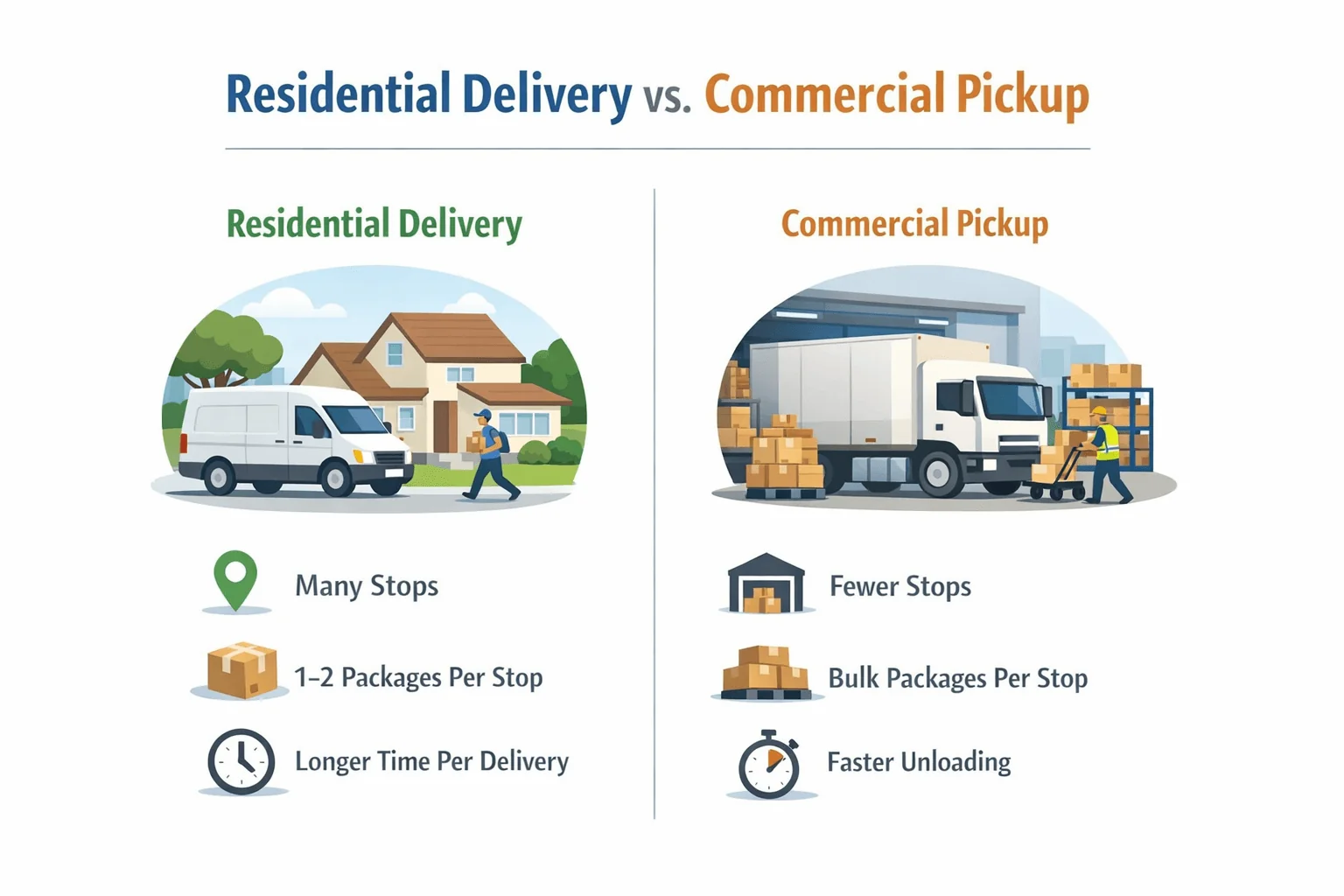
Side-by-side comparison
| Factor | Residential Delivery | Commercial Pickup |
|---|---|---|
| Stops per route | High | Low |
| Packages per stop | 1-3 | Dozens or more |
| Route predictability | Variable | Stable |
| Delivery time per stop | Shorter | Longer |
| Fuel cost per package | Higher | Lower |
| Reattempt risk | Common | Rare |
This comparison shows why businesses focused on residential delivery feel fuel surcharges more sharply.
Where businesses often get it wrong
Many companies treat fuel surcharges as a fixed overhead rather than a variable cost influenced by their own decisions.
Assuming all deliveries cost the same
It is common to treat shipping as a uniform expense, regardless of delivery type. In reality, the difference between residential and commercial delivery can significantly change cost structures.
Failing to separate these categories can lead to inaccurate pricing and missed opportunities to optimize.
Ignoring route efficiency
Route planning has a direct impact on fuel usage. Small inefficiencies, such as unnecessary detours or poorly grouped stops, can increase costs over time.
Without tracking and improving route performance, businesses may end up paying more in fuel surcharges than necessary.
Over-relying on one delivery model
Relying entirely on residential delivery can increase exposure to fuel volatility. When fuel prices rise, there are fewer ways to offset the impact.
Diversifying delivery methods can provide more flexibility and reduce overall risk.
Not reviewing carrier pricing structures
Different carriers apply fuel surcharges in different ways. Some may have higher base rates but lower surcharge percentages, or vice versa.
Without regular review, businesses may miss more cost-effective options.
Treating fuel surcharges as temporary
Fuel price fluctuations are ongoing. Planning as if surcharges will disappear can result in strategies that are not sustainable.
Long-term planning should account for continued variability in fuel costs.
The hidden effect on margins
Fuel surcharges do not just increase shipping costs. They also affect pricing strategy, customer expectations, and profitability.
Pressure on free shipping offers
Free shipping is often used to attract customers, but rising fuel costs make it harder to sustain. Businesses may need to absorb these costs or adjust their pricing models.
Reduced pricing flexibility
Higher logistics costs limit the ability to offer discounts or adjust product pricing. This can affect competitiveness in price-sensitive markets.
Impact on customer experience
Passing higher shipping costs to customers can lead to friction during checkout. Unexpected fees may reduce conversion rates.
Difficulty forecasting costs
Frequent changes in fuel surcharges make it harder to predict expenses. This uncertainty can complicate budgeting and financial planning.
Assuming all deliveries cost the same
It is common to treat shipping as a uniform expense, regardless of delivery type. In reality, the difference between residential and commercial delivery can significantly change cost structures.
Failing to separate these categories can lead to inaccurate pricing and missed opportunities to optimize.
Ignoring route efficiency
Route planning has a direct impact on fuel usage. Small inefficiencies, such as unnecessary detours or poorly grouped stops, can increase costs over time.
Without tracking and improving route performance, businesses may end up paying more in fuel surcharges than necessary.
Over-relying on one delivery model
Relying entirely on residential delivery can increase exposure to fuel volatility. When fuel prices rise, there are fewer ways to offset the impact.
Diversifying delivery methods can provide more flexibility and reduce overall risk.
Not reviewing carrier pricing structures
Different carriers apply fuel surcharges in different ways. Some may have higher base rates but lower surcharge percentages, or vice versa.
Without regular review, businesses may miss more cost-effective options.
Treating fuel surcharges as temporary
Fuel price fluctuations are ongoing. Planning as if surcharges will disappear can result in strategies that are not sustainable.
Long-term planning should account for continued variability in fuel costs.
The hidden effect on margins
Fuel surcharges do not just increase shipping costs. They also affect pricing strategy, customer expectations, and profitability.
Pressure on free shipping offers
Free shipping is often used to attract customers, but rising fuel costs make it harder to sustain. Businesses may need to absorb these costs or adjust their pricing models.
Reduced pricing flexibility
Higher logistics costs limit the ability to offer discounts or adjust product pricing. This can affect competitiveness in price-sensitive markets.
Impact on customer experience
Passing higher shipping costs to customers can lead to friction during checkout. Unexpected fees may reduce conversion rates.
Difficulty forecasting costs
Frequent changes in fuel surcharges make it harder to predict expenses. This uncertainty can complicate budgeting and financial planning.
Practical ways to reduce exposure
Businesses cannot control fuel prices, but they can adjust how they ship.
Consolidate deliveries where possible
Grouping shipments reduces the number of stops and improves efficiency. Higher density routes lower fuel usage per package.
Offer alternative delivery options
Providing pickup points or centralized delivery locations can reduce the need for individual residential stops.
Review carrier agreements
Comparing carriers and negotiating terms can lead to better handling of fuel surcharges.
Use data to track patterns
Monitoring delivery performance reveals inefficiencies and helps guide improvements.
Consolidate deliveries where possible
Grouping shipments reduces the number of stops and improves efficiency. Higher density routes lower fuel usage per package.
Offer alternative delivery options
Providing pickup points or centralized delivery locations can reduce the need for individual residential stops.
Review carrier agreements
Comparing carriers and negotiating terms can lead to better handling of fuel surcharges.
Use data to track patterns
Monitoring delivery performance reveals inefficiencies and helps guide improvements.
A different approach to last-mile delivery
Some businesses are exploring alternatives to traditional residential delivery to manage rising costs.
One approach is to offer customers the option to pick up their orders from centralized locations instead of home delivery. This reduces the number of stops required and allows for more efficient routing.
Via.Delivery, as an IT solution, supports D2C brands by enabling alternative delivery options for their customers. By shifting part of the delivery flow away from individual homes, brands can reduce the impact of fuel surcharges while still offering flexibility.
This approach does not replace residential delivery entirely. Instead, it adds another layer that helps balance cost control with customer convenience.
One approach is to offer customers the option to pick up their orders from centralized locations instead of home delivery. This reduces the number of stops required and allows for more efficient routing.
Via.Delivery, as an IT solution, supports D2C brands by enabling alternative delivery options for their customers. By shifting part of the delivery flow away from individual homes, brands can reduce the impact of fuel surcharges while still offering flexibility.
This approach does not replace residential delivery entirely. Instead, it adds another layer that helps balance cost control with customer convenience.
Practical next steps
Start by reviewing your current delivery data. Focus on metrics such as average cost per residential delivery, fuel surcharge trends, delivery success rates, and route efficiency.
From there, identify areas where costs are highest and test small adjustments. This might include introducing a pickup option in one region, consolidating deliveries on specific days, or comparing different carriers.
Over time, these changes can reduce the overall impact of fuel surcharges without disrupting the customer experience.
For D2C brands, tools that support flexible delivery models can make these adjustments easier to implement. Solutions like those offered by Via.Delivery can help integrate alternative options while maintaining operational control.
From there, identify areas where costs are highest and test small adjustments. This might include introducing a pickup option in one region, consolidating deliveries on specific days, or comparing different carriers.
Over time, these changes can reduce the overall impact of fuel surcharges without disrupting the customer experience.
For D2C brands, tools that support flexible delivery models can make these adjustments easier to implement. Solutions like those offered by Via.Delivery can help integrate alternative options while maintaining operational control.
FAQ
Why are fuel surcharges higher for residential delivery?
Residential delivery involves more travel between stops and fewer packages per stop. This increases fuel usage per package, which raises the surcharge impact.
Do fuel surcharges change often?
Yes. They are usually updated regularly based on fuel price indexes, which makes them a variable cost.
Can businesses avoid fuel surcharges?
They cannot avoid them entirely, but they can reduce their impact by improving delivery efficiency and offering alternative delivery options.
Is commercial pickup always cheaper?
Per package, it is generally more cost-efficient due to higher volume at each stop. However, total costs depend on the overall shipping strategy.
How can D2C brands manage rising delivery costs?
They can diversify delivery methods, optimize routes, review carrier agreements, and consider alternatives like centralized pickup options to reduce fuel-related expenses.