





Heavy Item Shipping Strategy: Reduce Costs for Bulky Deliveries
Shipping heavy or bulky items quickly becomes expensive and hard to manage.
If you sell furniture, appliances, fitness gear, or large home goods, you’ve likely seen shipping costs rise faster than your margins. Deliveries take longer, damage risks increase, and customer expectations stay high.
A strong heavy item shipping strategy is not just about negotiating better rates. It’s about rethinking how items move from warehouse to customer. That includes packaging, carrier selection, and even considering alternative delivery options that don’t rely entirely on traditional shipping networks.
This article breaks down practical ways to reduce costs and improve delivery outcomes without adding unnecessary complexity.
If you sell furniture, appliances, fitness gear, or large home goods, you’ve likely seen shipping costs rise faster than your margins. Deliveries take longer, damage risks increase, and customer expectations stay high.
A strong heavy item shipping strategy is not just about negotiating better rates. It’s about rethinking how items move from warehouse to customer. That includes packaging, carrier selection, and even considering alternative delivery options that don’t rely entirely on traditional shipping networks.
This article breaks down practical ways to reduce costs and improve delivery outcomes without adding unnecessary complexity.
Share:
Why bulky shipping creates more problems than standard delivery
Once your products go beyond standard parcel limits, the rules change.
Carriers start charging based on size as much as weight. Large boxes take up space in trucks, which makes them more expensive to transport. Some shipments require liftgates, scheduled delivery, or even two-person handling.
There is also a higher chance of damage. Larger items are harder to secure and easier to mishandle. Returns become more costly and harder to process.
Customers still expect a smooth experience. They want clear delivery windows, accurate tracking, and no surprises at the door.
This gap between operational complexity and customer expectations is where many businesses struggle.
Carriers start charging based on size as much as weight. Large boxes take up space in trucks, which makes them more expensive to transport. Some shipments require liftgates, scheduled delivery, or even two-person handling.
There is also a higher chance of damage. Larger items are harder to secure and easier to mishandle. Returns become more costly and harder to process.
Customers still expect a smooth experience. They want clear delivery windows, accurate tracking, and no surprises at the door.
This gap between operational complexity and customer expectations is where many businesses struggle.
What actually drives the cost of heavy item shipping
To reduce costs, you need to understand what is causing them.
Dimensional weight pricing
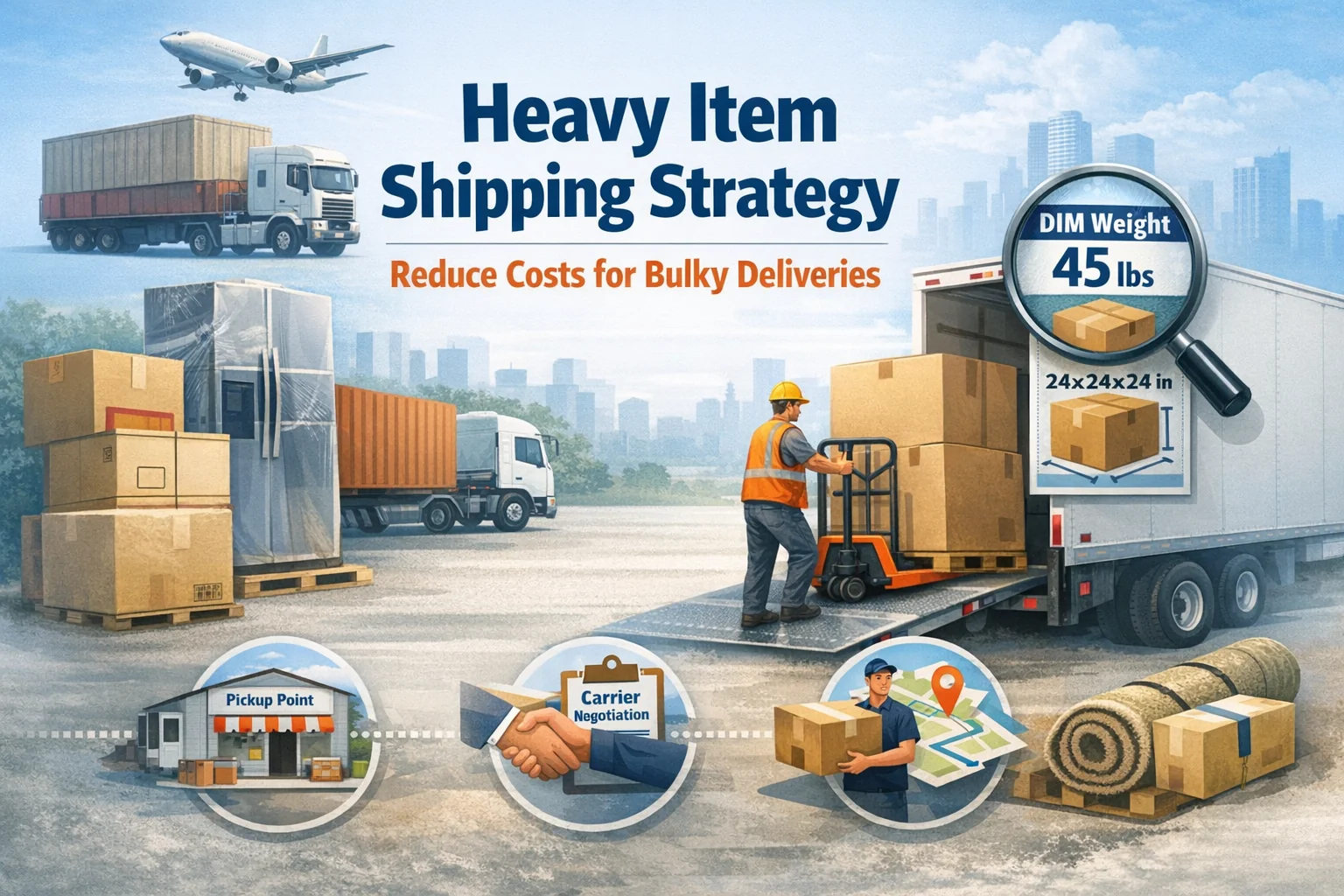
Carriers calculate shipping costs based on both weight and size. If your package is large, you may pay more even if it is relatively light.
Excess packaging
Oversized boxes increase dimensional weight and waste space. This leads to higher charges with no real benefit.
Long-distance shipping
The farther an item travels, the more it costs. Shipping across multiple zones adds both cost and risk.
Special handling
Bulky items often require extra services like scheduled delivery or lift assistance. Each service adds fees.
Failed delivery attempts
Missed deliveries or incorrect scheduling can double costs. Redelivery is especially expensive for large items.
Understanding these factors helps you focus on changes that matter.
Understanding these factors helps you focus on changes that matter.
Step-by-step: improving your heavy item shipping strategy
A better approach starts with small, practical changes.
Step 1: review your current shipping data
Look at recent orders and identify patterns:
- Which items cost the most to ship
- Where delays happen
- How often damage occurs
Step 2: reduce package size wherever possible
Smaller packaging lowers dimensional weight costs.
Focus on:
Focus on:
- Removing empty space
- Using tighter-fitting materials
- Standardizing box sizes
Step 3: match shipping method to product type
Not all bulky items should be handled the same way.
Choosing the right method prevents overpaying.
- Medium items may still work with parcel carriers
- Larger items may need freight
- Some items benefit from scheduled or assisted delivery
Choosing the right method prevents overpaying.
Step 4: combine traditional and alternative delivery options
Relying only on standard carriers limits your flexibility.
Alternative delivery options, such as those enabled by platforms like Via.Delivery, allow brands to route shipments differently. Instead of sending every bulky item through long, expensive carrier networks, some deliveries can be handled through more direct or localized options.
This can reduce transportation distance, avoid certain handling fees, and improve delivery efficiency, especially for last-mile delivery.
Alternative delivery options, such as those enabled by platforms like Via.Delivery, allow brands to route shipments differently. Instead of sending every bulky item through long, expensive carrier networks, some deliveries can be handled through more direct or localized options.
This can reduce transportation distance, avoid certain handling fees, and improve delivery efficiency, especially for last-mile delivery.
Step 5: improve delivery coordination
Clear communication reduces failed deliveries.
Fewer missed deliveries means fewer repeat costs.
- Confirm delivery availability
- Provide realistic time windows
- Keep tracking accurate and simple
Fewer missed deliveries means fewer repeat costs.
Step 6: keep adjusting based on results
Shipping performance changes over time.
Track:
Regular reviews help you stay efficient.
Track:
- Cost per shipment
- Delivery success rates
- Customer feedback
Regular reviews help you stay efficient.
Parcel, freight, or alternative delivery: choosing the right mix
There is no single best method for bulky shipping. Most businesses need a mix.
Parcel shipping
Works best for moderately large items that still fit carrier limits.
Pros:
Pros:
- Faster delivery
- Easier tracking
- Expensive for oversized packages
Freight shipping
Better for very large or heavy items.
Pros:
Pros:
- Lower cost for large loads
- Suitable for palletized shipments
- Slower and less flexible
Alternative delivery options
This is where many businesses are starting to see real improvements.
Alternative delivery models, like those supported by Via.Delivery, can offer different ways to complete deliveries without relying entirely on traditional carrier systems. For bulky items, this can mean fewer handoffs, more direct routes, and lower last-mile costs.
Instead of forcing every shipment into parcel or freight categories, you create more flexibility in how items reach customers.
Alternative delivery models, like those supported by Via.Delivery, can offer different ways to complete deliveries without relying entirely on traditional carrier systems. For bulky items, this can mean fewer handoffs, more direct routes, and lower last-mile costs.
Instead of forcing every shipment into parcel or freight categories, you create more flexibility in how items reach customers.
Packaging decisions that directly affect your costs
Packaging is one of the simplest ways to reduce shipping expenses.
Use the smallest effective box
Avoid oversized packaging. It increases both cost and risk of damage.
Choose lighter materials
Heavy padding adds weight. Use materials that protect without adding bulk.
Make packages easier to handle
Awkward shapes lead to mishandling.
Simple improvements:
Use the smallest effective box
Avoid oversized packaging. It increases both cost and risk of damage.
Choose lighter materials
Heavy padding adds weight. Use materials that protect without adding bulk.
Make packages easier to handle
Awkward shapes lead to mishandling.
Simple improvements:
- Balanced weight distribution
- Clear labeling
- Easy-to-grip designs
Common mistakes that increase shipping expenses
Many businesses lose money on bulky shipping without realizing it.
Treating all products the same
Different items need different shipping methods. One-size-fits-all rarely works.
Ignoring alternative delivery models
Relying only on traditional carriers can limit cost-saving opportunities, especially for last-mile delivery.
Overpacking
Extra materials increase both size and weight without clear benefits.
Poor delivery coordination
Missed deliveries are expensive and avoidable.
Not reviewing performance regularly
Costs and carrier performance change. Without regular checks, inefficiencies build up.
Treating all products the same
Different items need different shipping methods. One-size-fits-all rarely works.
Ignoring alternative delivery models
Relying only on traditional carriers can limit cost-saving opportunities, especially for last-mile delivery.
Overpacking
Extra materials increase both size and weight without clear benefits.
Poor delivery coordination
Missed deliveries are expensive and avoidable.
Not reviewing performance regularly
Costs and carrier performance change. Without regular checks, inefficiencies build up.
A simple example of improving bulky shipping
Consider a brand selling large home furniture.
Initially, they ship everything through a single parcel carrier. Costs are high, and oversized fees are common.
They make a few adjustments:
By routing some deliveries through a more direct, flexible model, they reduce last-mile costs and avoid repeated handling.
Over time:
Initially, they ship everything through a single parcel carrier. Costs are high, and oversized fees are common.
They make a few adjustments:
- Redesign packaging to reduce box size
- Use freight for larger items
- Introduce an alternative delivery option for certain regions
By routing some deliveries through a more direct, flexible model, they reduce last-mile costs and avoid repeated handling.
Over time:
- Shipping costs stabilize
- Delivery success improves
- Fewer items arrive damaged
Quick checklist before shipping a bulky item
Before sending any large shipment, run through this quick check:
A short check can prevent costly mistakes.
- Is the package as compact as possible?
- Does the shipping method match the item size?
- Are you using the most efficient delivery route?
- Has the customer confirmed availability?
- Is the item clearly labeled for handling?
A short check can prevent costly mistakes.
Delivery experience matters more with large items
Bulky deliveries are more noticeable to customers.
They often involve:
Improving delivery is not just about cost control. It affects customer trust and repeat business.
They often involve:
- Scheduling
- Physical effort
- Higher-value purchases
Improving delivery is not just about cost control. It affects customer trust and repeat business.
Practical next steps to reduce bulky shipping costs
Start with a focused approach.
Review your recent shipments and identify where costs are highest. Look for patterns in packaging size, delivery failures, or long-distance routes.
Test one improvement at a time. For example, reduce packaging size for a specific product or introduce a different delivery method in one region.
Expand your delivery options. Combining traditional carriers with alternative delivery solutions can give you more control over cost and performance.
For brands looking to go further, platforms like Via.Delivery provide an additional layer of flexibility. By offering alternative delivery options alongside standard shipping, businesses can reduce reliance on expensive routes and find more efficient ways to handle bulky items.
Over time, these small adjustments add up. A better heavy item shipping strategy is built step by step, with clear decisions that reduce cost while keeping delivery reliable.
Review your recent shipments and identify where costs are highest. Look for patterns in packaging size, delivery failures, or long-distance routes.
Test one improvement at a time. For example, reduce packaging size for a specific product or introduce a different delivery method in one region.
Expand your delivery options. Combining traditional carriers with alternative delivery solutions can give you more control over cost and performance.
For brands looking to go further, platforms like Via.Delivery provide an additional layer of flexibility. By offering alternative delivery options alongside standard shipping, businesses can reduce reliance on expensive routes and find more efficient ways to handle bulky items.
Over time, these small adjustments add up. A better heavy item shipping strategy is built step by step, with clear decisions that reduce cost while keeping delivery reliable.