





Lower E-commerce Shipping Costs Without Cutting Quality
Key takeaways
- Lower shipping costs do not have to mean slower delivery or worse service.
- Small operational changes often reduce costs more effectively than large pricing cuts.
- Residential delivery is one of the biggest drivers of shipping expenses in the US.
- Alternative delivery options can reduce last-mile costs while maintaining convenience.
- Reviewing delivery data regularly helps identify hidden inefficiencies.
Share:
The problem many brands run into
Shipping costs tend to increase gradually. A small fuel surcharge here, a residential fee there, and over time the total becomes much larger than expected. Many e-commerce brands try to solve this by cutting service levels, slowing delivery times, or reducing packaging quality.
The problem is that customers still expect a reliable experience. In the US market, shoppers expect fast updates and convenient delivery options. Cutting too much can hurt customer trust and repeat purchases.
The better approach is to improve efficiency instead of lowering standards. In many cases, shipping costs rise because of operational habits that can be adjusted without affecting the customer experience.
The problem is that customers still expect a reliable experience. In the US market, shoppers expect fast updates and convenient delivery options. Cutting too much can hurt customer trust and repeat purchases.
The better approach is to improve efficiency instead of lowering standards. In many cases, shipping costs rise because of operational habits that can be adjusted without affecting the customer experience.
Where shipping costs usually grow fastest
Before reducing expenses, it helps to understand what is driving them. Most shipping costs are tied to the last mile, where deliveries become less efficient and more expensive.
Residential delivery
Delivering to individual homes requires more stops and more time per package. In suburban areas across the US, drivers may travel long distances between deliveries.
This increases fuel use and labor costs. Residential surcharges are often added automatically, making home delivery one of the largest cost drivers.
This increases fuel use and labor costs. Residential surcharges are often added automatically, making home delivery one of the largest cost drivers.
Failed delivery attempts
When a customer is not available, carriers may attempt delivery again or reroute the package. Each additional attempt increases operational expenses.
Missed deliveries also create support requests and delays. Over time, these issues affect both cost and customer satisfaction.
Missed deliveries also create support requests and delays. Over time, these issues affect both cost and customer satisfaction.
Packaging inefficiencies
Oversized boxes increase dimensional weight charges and waste space during transportation. Poor packaging choices can increase costs even when the product itself is lightweight.
Packaging materials also contribute to fulfillment expenses. Small adjustments often make a noticeable difference.
Packaging materials also contribute to fulfillment expenses. Small adjustments often make a noticeable difference.
Inefficient carrier usage
Not every carrier performs equally well in every region. Some routes may be more expensive simply because the wrong carrier is being used.
Without reviewing performance regularly, businesses may continue paying higher costs unnecessarily.
Without reviewing performance regularly, businesses may continue paying higher costs unnecessarily.
A quick comparison of cost-saving approaches
| Approach | Cost Impact | Effect on Customer Experience |
|---|---|---|
| Slower shipping | Moderate savings | Often negative |
| Better packaging | Moderate savings | Usually neutral |
| Alternative delivery | High savings potential | Often neutral or positive |
| Carrier optimization | Moderate to high savings | Usually neutral |
| Delivery consolidation | Moderate savings | Minimal impact |
This comparison shows that reducing quality is not the only option. In many cases, operational improvements provide better long-term results.
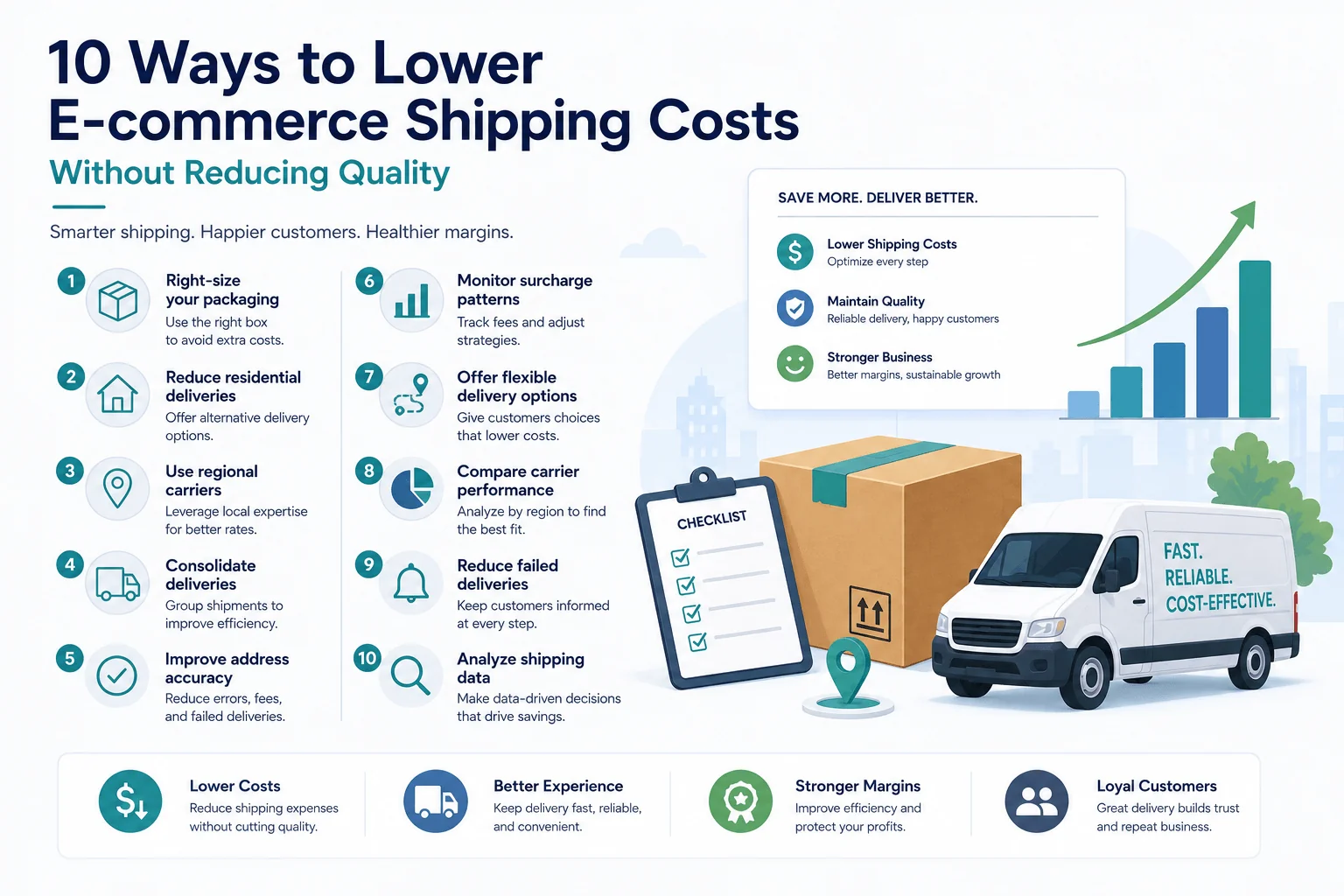
1. Review packaging sizes carefully
Packaging affects more than material costs. Many carriers use dimensional pricing, which means larger packages cost more even if they are not heavy. Reducing unnecessary space inside boxes lowers shipping costs and improves transportation efficiency. Smaller packages also allow more orders to fit into delivery vehicles.
This does not mean switching to weaker packaging. The goal is to match packaging size more closely to the product being shipped.
This does not mean switching to weaker packaging. The goal is to match packaging size more closely to the product being shipped.
2. Reduce residential delivery dependency
Home delivery is convenient, but it is also one of the most expensive forms of last-mile delivery in the US. Residential surcharges, failed attempts, and low stop density all increase costs.
Introducing alternative delivery options can reduce this dependency. Pickup locations or consolidated delivery points allow multiple packages to be delivered in one stop. This improves efficiency while still giving customers flexibility.
Introducing alternative delivery options can reduce this dependency. Pickup locations or consolidated delivery points allow multiple packages to be delivered in one stop. This improves efficiency while still giving customers flexibility.
3. Use regional carriers where possible
National carriers provide broad coverage, but they are not always the most cost-effective choice in every area. Regional carriers often perform better within specific service zones. Because they focus on smaller areas, they may offer better route efficiency and lower costs. This is especially useful in regions where delivery density is high.
Testing regional carriers in selected areas can reveal savings opportunities without requiring major operational changes.
Testing regional carriers in selected areas can reveal savings opportunities without requiring major operational changes.
4. Consolidate deliveries when possible
Sending multiple orders together reduces the number of shipments and delivery stops. This lowers fuel usage and operational costs. Some brands encourage customers to combine purchases into fewer shipments. Others consolidate deliveries to pickup points or local hubs.
The goal is to improve delivery density rather than increase delivery frequency.
The goal is to improve delivery density rather than increase delivery frequency.
5. Improve address accuracy at checkout
Incorrect or incomplete addresses often lead to correction fees and delivery delays. These small charges add up quickly when order volumes increase. Address validation tools help reduce these errors before orders are processed. Better data improves delivery success rates and lowers operational costs. It also creates a smoother experience for customers.
6. Monitor surcharge patterns regularly
Many businesses review shipping costs only at a high level. This makes it difficult to see which fees are increasing over time. Tracking fuel surcharges, residential fees, and delivery area adjustments helps identify patterns. Once these trends are visible, it becomes easier to adjust delivery strategies.
Regular reviews also help during carrier negotiations.
Regular reviews also help during carrier negotiations.
7. Offer flexible delivery options
Not every customer needs home delivery. Some are open to pickup options if the process is convenient and clearly explained. Providing different delivery methods gives customers more choice while reducing pressure on residential delivery. Pickup locations also reduce the likelihood of failed deliveries.
Via.Delivery provides an IT solution that helps D2C brands introduce alternative delivery options into their existing delivery flow. By supporting pickup-based delivery methods, brands can reduce last-mile costs while maintaining convenience for customers.
Via.Delivery provides an IT solution that helps D2C brands introduce alternative delivery options into their existing delivery flow. By supporting pickup-based delivery methods, brands can reduce last-mile costs while maintaining convenience for customers.
8. Compare carrier performance by region
Carrier performance often varies depending on location. One carrier may perform well in urban areas but less efficiently in suburban or rural regions.
Comparing delivery times, surcharge frequency, and total costs by region helps identify better options. A mixed carrier strategy can improve efficiency without affecting service quality. Using one carrier for every shipment may not always be the best approach.
Comparing delivery times, surcharge frequency, and total costs by region helps identify better options. A mixed carrier strategy can improve efficiency without affecting service quality. Using one carrier for every shipment may not always be the best approach.
9. Reduce failed deliveries with better communication
Customers expect accurate tracking and delivery updates. Without clear communication, missed deliveries become more common.
Providing real-time notifications helps customers prepare for delivery or choose alternative options when needed. This reduces repeat delivery attempts and support requests. Clear communication improves both efficiency and customer satisfaction.
Providing real-time notifications helps customers prepare for delivery or choose alternative options when needed. This reduces repeat delivery attempts and support requests. Clear communication improves both efficiency and customer satisfaction.
10. Analyze shipping data before making changes
Cost reduction efforts work best when they are based on real data. Assumptions about shipping costs are often incomplete or outdated.
Reviewing delivery zones, surcharge frequency, packaging usage, and carrier performance provides a clearer picture of where costs originate. This makes it easier to prioritize the right improvements.
Small adjustments based on data often produce better results than broad cost-cutting measures.
Reviewing delivery zones, surcharge frequency, packaging usage, and carrier performance provides a clearer picture of where costs originate. This makes it easier to prioritize the right improvements.
Small adjustments based on data often produce better results than broad cost-cutting measures.
Common mistakes that increase shipping costs
Many shipping expenses are tied to habits that develop over time. Businesses may continue using inefficient processes simply because they have not reviewed them recently.
Treating all deliveries the same
Different delivery types have different costs. Residential shipments, pickup deliveries, and regional routes all behave differently.
Using the same strategy everywhere often creates unnecessary expenses.
Using the same strategy everywhere often creates unnecessary expenses.
Focusing only on base rates
The cheapest base rate does not always produce the lowest total cost. Surcharges and failed deliveries can outweigh small pricing differences.
A full cost view provides more accurate comparisons.
A full cost view provides more accurate comparisons.
Ignoring customer behavior
Customer preferences affect shipping efficiency. Some customers may prefer pickup options or slower delivery in exchange for convenience or flexibility. Understanding these patterns helps reduce unnecessary costs.
Making large changes too quickly
Switching carriers or delivery methods too aggressively can create operational problems. Testing changes gradually usually produces better outcomes. Small adjustments are easier to measure and refine.
Practical next steps
Start by reviewing your shipping data in detail. Look for recurring surcharges, high residential delivery rates, and regions where costs are increasing faster than expected. These areas often reveal the biggest opportunities for improvement.
Next, test small operational changes instead of making broad cuts. This could include adjusting packaging sizes, introducing pickup options in one region, or comparing carrier performance for specific delivery zones. Small tests provide measurable insights with less operational risk.
Over time, build a shipping strategy that focuses on efficiency rather than simply reducing service levels. Many brands find that improving delivery structure lowers costs more effectively than cutting quality. For businesses exploring alternative delivery methods, solutions like Via.Delivery can help integrate pickup options into existing systems while keeping the customer experience consistent.
Next, test small operational changes instead of making broad cuts. This could include adjusting packaging sizes, introducing pickup options in one region, or comparing carrier performance for specific delivery zones. Small tests provide measurable insights with less operational risk.
Over time, build a shipping strategy that focuses on efficiency rather than simply reducing service levels. Many brands find that improving delivery structure lowers costs more effectively than cutting quality. For businesses exploring alternative delivery methods, solutions like Via.Delivery can help integrate pickup options into existing systems while keeping the customer experience consistent.
FAQ
What is the biggest driver of shipping costs in e-commerce?
Residential delivery is often one of the largest cost drivers because it requires more stops and higher operational effort.
Can shipping costs be reduced without slowing delivery?
Yes. Improving packaging, delivery density, and carrier selection can lower costs without reducing service quality.
Are pickup options cheaper than home delivery?
In many cases, yes. Consolidated deliveries to pickup locations are generally more efficient than individual residential stops.
Should businesses use multiple carriers?
Often, yes. Different carriers perform better in different regions, so a mixed approach can improve efficiency.
How often should shipping costs be reviewed?
Shipping data should be reviewed regularly, especially surcharge trends and carrier performance. Frequent reviews help identify issues before costs grow significantly.