





Lifetime Value (LTV) Through a Frictionless Delivery Experience
Takeaways at a glance
- Customers continue judging a purchase long after they press the checkout button. Delivery is one of the last parts of the order that shapes that judgment.
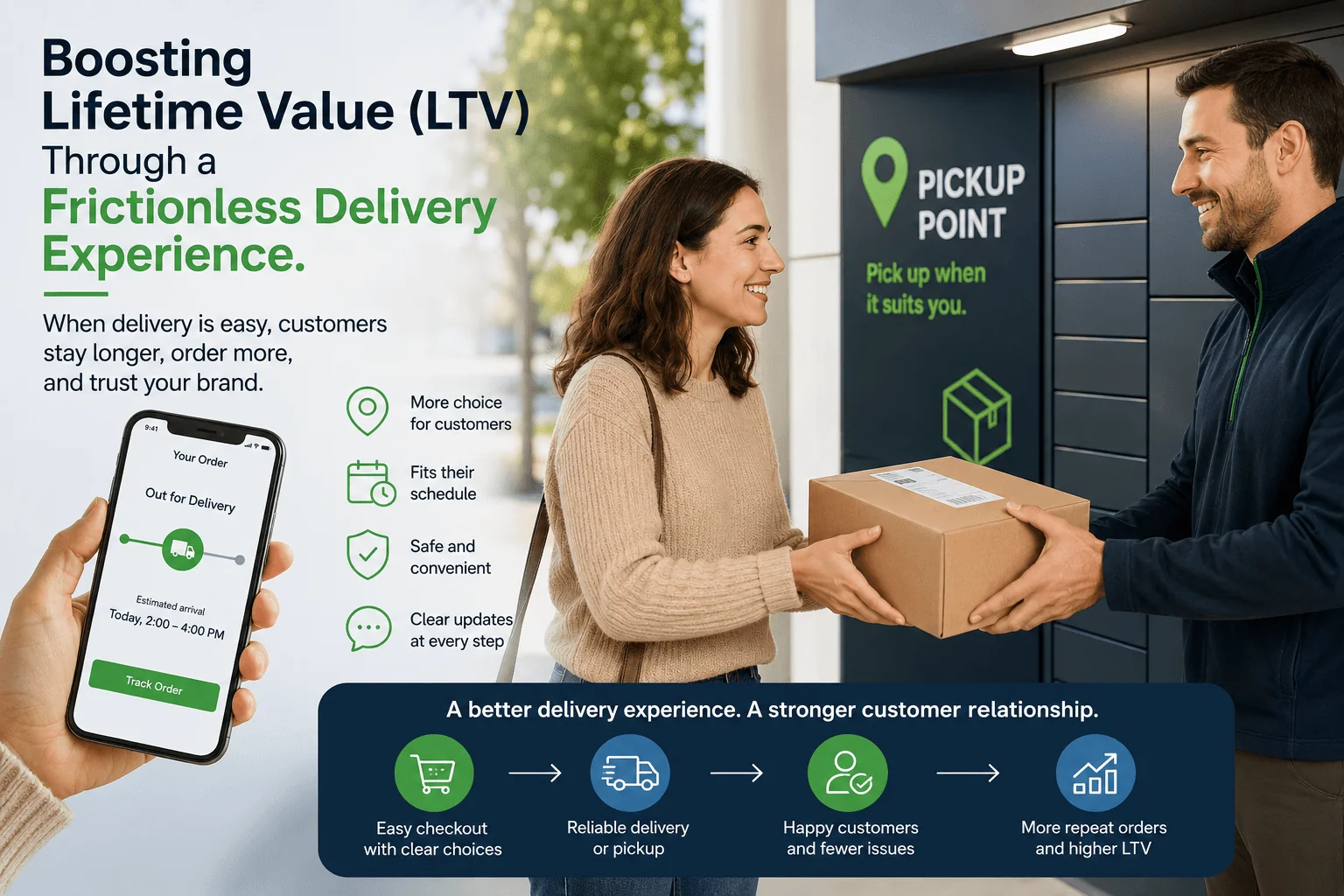
- A frictionless delivery experience removes avoidable uncertainty and effort. Customers should understand their options, know what is happening with an order, and have a practical way to receive it.
- Faster shipping is not always the answer. A customer may care more about receiving a parcel safely, collecting it at a convenient time, or avoiding a missed delivery.
- Delivery performance should be viewed alongside repeat purchases, customer service contacts, refunds, failed deliveries, and customer feedback.
- Brands seeking higher lifetime value (LTV) should treat delivery as part of the customer relationship, not only as a logistics expense.
Share:
The purchase is not finished at checkout
A customer places an order at 9 p.m. The payment succeeds, the confirmation email arrives, and from the retailer's point of view the transaction is complete.
For the customer, it is only partly complete.
They still need to know when the parcel will ship, where it will arrive, whether somebody needs to be present, and what happens if they are away. If the package is being delivered to an apartment building, the customer may wonder whether it will be left outside or placed in a shared mail area. If the order is valuable or private, unattended delivery may create another concern.
These are ordinary questions, but each one adds friction when the answers are unclear.
The problem becomes more visible when something goes wrong. A parcel that arrives later than expected can generate a support request. A missed signature can mean another delivery attempt. A package left somewhere the customer considers unsafe can turn an otherwise successful order into a frustrating experience.
Customers rarely separate these moments neatly into categories such as "carrier experience" and "brand experience." They placed the order with the retailer, so the retailer remains part of the experience until the product is in their hands.
That makes delivery relevant to retention.
A company can invest heavily in product pages, checkout design, promotions, and acquisition, yet still make the second purchase harder if the first order creates unnecessary stress. Conversely, an uneventful delivery can leave the customer with a simple impression: ordering from this brand works.
That impression matters when the customer is deciding where to buy next.
For the customer, it is only partly complete.
They still need to know when the parcel will ship, where it will arrive, whether somebody needs to be present, and what happens if they are away. If the package is being delivered to an apartment building, the customer may wonder whether it will be left outside or placed in a shared mail area. If the order is valuable or private, unattended delivery may create another concern.
These are ordinary questions, but each one adds friction when the answers are unclear.
The problem becomes more visible when something goes wrong. A parcel that arrives later than expected can generate a support request. A missed signature can mean another delivery attempt. A package left somewhere the customer considers unsafe can turn an otherwise successful order into a frustrating experience.
Customers rarely separate these moments neatly into categories such as "carrier experience" and "brand experience." They placed the order with the retailer, so the retailer remains part of the experience until the product is in their hands.
That makes delivery relevant to retention.
A company can invest heavily in product pages, checkout design, promotions, and acquisition, yet still make the second purchase harder if the first order creates unnecessary stress. Conversely, an uneventful delivery can leave the customer with a simple impression: ordering from this brand works.
That impression matters when the customer is deciding where to buy next.
How delivery experience connects to lifetime value
Lifetime value (LTV) describes the value associated with a customer relationship over time rather than the revenue from a single transaction.
Delivery cannot determine LTV by itself. Product quality, price, customer service, merchandising, availability, and many other factors influence whether someone returns.
Delivery does affect something simpler: how much effort and uncertainty customers associate with ordering from the brand again.
Suppose two stores sell products a shopper likes equally. With the first store, the customer remembers checking tracking repeatedly, worrying about where the parcel would be left, and contacting support when the arrival date changed. With the second, delivery was straightforward and fit the customer's routine.
When it is time to place another order, that difference can influence the decision.
Delivery cannot determine LTV by itself. Product quality, price, customer service, merchandising, availability, and many other factors influence whether someone returns.
Delivery does affect something simpler: how much effort and uncertainty customers associate with ordering from the brand again.
Suppose two stores sell products a shopper likes equally. With the first store, the customer remembers checking tracking repeatedly, worrying about where the parcel would be left, and contacting support when the arrival date changed. With the second, delivery was straightforward and fit the customer's routine.
When it is time to place another order, that difference can influence the decision.
Reliability builds confidence
Customers do not need every order to arrive at record speed. They do need expectations that make sense.
If a delivery estimate says Tuesday, the customer may arrange their plans around Tuesday. If the order requires someone to be present and that information is unclear, the practical inconvenience can become much larger than a one-day delay.
Reliability begins with promises the business can reasonably meet. It continues through understandable status information and a clear process when plans change.
The goal is not to make delivery invisible. It is to make it predictable enough that customers do not have to manage the process themselves.
That confidence reduces one reason to hesitate before another purchase.
If a delivery estimate says Tuesday, the customer may arrange their plans around Tuesday. If the order requires someone to be present and that information is unclear, the practical inconvenience can become much larger than a one-day delay.
Reliability begins with promises the business can reasonably meet. It continues through understandable status information and a clear process when plans change.
The goal is not to make delivery invisible. It is to make it predictable enough that customers do not have to manage the process themselves.
That confidence reduces one reason to hesitate before another purchase.
Control makes repeat ordering easier
Different customers have different delivery constraints.
One person works from home and prefers doorstep delivery. Another lives in an apartment where packages are frequently left in a shared area. Someone else may commute and would rather collect an order during an existing trip.
Forcing all three customers into the same delivery pattern can create friction even if the shipping operation performs exactly as designed.
Giving shoppers useful choices lets them decide which tradeoff works for them.
The word "useful" matters. Five options with vague names and unclear differences do not necessarily create a better experience. Two clearly explained options may be more valuable if customers immediately understand where the package will go, what it costs, and what they need to do.
Choice supports LTV when it gives customers more confidence that future orders can fit into their normal lives.
One person works from home and prefers doorstep delivery. Another lives in an apartment where packages are frequently left in a shared area. Someone else may commute and would rather collect an order during an existing trip.
Forcing all three customers into the same delivery pattern can create friction even if the shipping operation performs exactly as designed.
Giving shoppers useful choices lets them decide which tradeoff works for them.
The word "useful" matters. Five options with vague names and unclear differences do not necessarily create a better experience. Two clearly explained options may be more valuable if customers immediately understand where the package will go, what it costs, and what they need to do.
Choice supports LTV when it gives customers more confidence that future orders can fit into their normal lives.
Where friction appears in the delivery journey
Delivery friction is not limited to late packages. It can begin before an order has even been placed.
At checkout, the customer may see shipping methods that are difficult to compare. The delivery estimate may be vague. A charge might appear late in the process. A customer worried about unattended delivery may have no practical alternative.
After checkout, another set of questions begins. Has the order shipped? Has the carrier received it? When should the customer expect it? What happens if nobody is available?
Even a successful delivery can contain unnecessary effort if the customer has to search through emails, carrier pages, and support information to understand what is happening.
The table below shows several common points of friction and what a retailer can examine.
At checkout, the customer may see shipping methods that are difficult to compare. The delivery estimate may be vague. A charge might appear late in the process. A customer worried about unattended delivery may have no practical alternative.
After checkout, another set of questions begins. Has the order shipped? Has the carrier received it? When should the customer expect it? What happens if nobody is available?
Even a successful delivery can contain unnecessary effort if the customer has to search through emails, carrier pages, and support information to understand what is happening.
The table below shows several common points of friction and what a retailer can examine.
| Delivery moment | Possible customer friction | Practical response |
|---|---|---|
| Checkout | Delivery options are difficult to understand | Use plain descriptions that explain destination, timing, and customer action |
| Shipping cost | Fees appear unexpectedly | Show delivery costs early enough for customers to make an informed choice |
| Delivery selection | Home delivery does not fit the customer's situation | Consider alternative delivery choices where appropriate |
| Order processing | Customer does not know whether the order has shipped | Send clear status information at useful milestones |
| In transit | Tracking information is hard to interpret | Explain what the current status means rather than only displaying carrier events |
| Arrival | Customer cannot safely receive an unattended parcel | Give suitable customers another receiving option where available |
| Delivery exception | Customer has to discover the problem independently | Communicate the issue and explain what happens next |
| Pickup | Customer is unsure where or how to collect the order | Provide location and collection instructions before the customer arrives |
| After delivery | Brand never checks whether delivery caused a problem | Include delivery in customer feedback and retention analysis |
Not every business will experience all of these problems. The useful exercise is to follow the journey from the customer's point of view rather than from the warehouse's point of view.
Operations may consider an order successful when a carrier records delivery. The customer may define success differently: "I received my order easily and knew what was happening."
That difference is where many retention opportunities appear.
Operations may consider an order successful when a carrier records delivery. The customer may define success differently: "I received my order easily and knew what was happening."
That difference is where many retention opportunities appear.
Delivery choice can solve problems speed cannot
Delivery discussions often center on speed. Faster options certainly matter in some purchases, particularly when timing is part of the reason the customer is buying.
But speed solves only one kind of problem.
Consider a shopper who knows they will not be home during normal delivery hours. Moving the expected arrival from Thursday to Wednesday does not solve the underlying issue. The problem is where the parcel will be when the customer is unavailable.
The same applies to someone uncomfortable with a package being left near the entrance of an apartment building. Earlier delivery may simply mean the parcel sits unattended for longer.
For these customers, control over the destination may matter more than reducing transit time.
Alternative delivery can provide another path. A customer might choose to have an order sent somewhere they can collect it rather than having it delivered to their residence.
Via.Delivery, for example, is an IT solution that provides D2C brands and their customers with an alternative delivery option. Its public positioning centers on allowing shoppers to select pickup locations as another checkout choice rather than treating pickup as a replacement for home delivery.
The broader principle is useful regardless of provider: delivery design should reflect the problem a customer is trying to solve.
A customer choosing home delivery may value not making an extra trip. Someone choosing collection may value control over timing or destination. Neither preference is inherently better.
A retailer's job is to make suitable choices understandable and easy to use.
But speed solves only one kind of problem.
Consider a shopper who knows they will not be home during normal delivery hours. Moving the expected arrival from Thursday to Wednesday does not solve the underlying issue. The problem is where the parcel will be when the customer is unavailable.
The same applies to someone uncomfortable with a package being left near the entrance of an apartment building. Earlier delivery may simply mean the parcel sits unattended for longer.
For these customers, control over the destination may matter more than reducing transit time.
Alternative delivery can provide another path. A customer might choose to have an order sent somewhere they can collect it rather than having it delivered to their residence.
Via.Delivery, for example, is an IT solution that provides D2C brands and their customers with an alternative delivery option. Its public positioning centers on allowing shoppers to select pickup locations as another checkout choice rather than treating pickup as a replacement for home delivery.
The broader principle is useful regardless of provider: delivery design should reflect the problem a customer is trying to solve.
A customer choosing home delivery may value not making an extra trip. Someone choosing collection may value control over timing or destination. Neither preference is inherently better.
A retailer's job is to make suitable choices understandable and easy to use.
Communication should answer the customer's next question
Customers usually do not want more delivery messages. They want fewer unanswered questions.
That distinction should shape post-purchase communication.
Immediately after checkout, the customer's question is often, "Did my order go through?" The confirmation should answer that clearly.
Later, the question becomes, "Has it shipped?" Once the package is moving, the customer wants to know when it is likely to arrive and whether anything is required from them.
If a delivery plan changes, the question becomes, "What do I need to do now?"
Good communication follows that sequence.
A status message such as "exception occurred" may be technically accurate but still leave the customer confused. A more useful message explains what changed, whether the estimated arrival is affected, and whether the customer needs to take action.
Pickup orders create their own communication needs. A customer needs to know when the parcel is ready rather than merely when it has reached a carrier facility. They may also need clear instructions about where to go and what is required to collect it.
Consistency matters here.
Customers should not receive one set of expectations at checkout, another in a brand email, and a third on a carrier tracking page without understanding how they relate.
Reducing those gaps makes delivery feel easier even when the physical transportation process itself has not changed.
That distinction should shape post-purchase communication.
Immediately after checkout, the customer's question is often, "Did my order go through?" The confirmation should answer that clearly.
Later, the question becomes, "Has it shipped?" Once the package is moving, the customer wants to know when it is likely to arrive and whether anything is required from them.
If a delivery plan changes, the question becomes, "What do I need to do now?"
Good communication follows that sequence.
A status message such as "exception occurred" may be technically accurate but still leave the customer confused. A more useful message explains what changed, whether the estimated arrival is affected, and whether the customer needs to take action.
Pickup orders create their own communication needs. A customer needs to know when the parcel is ready rather than merely when it has reached a carrier facility. They may also need clear instructions about where to go and what is required to collect it.
Consistency matters here.
Customers should not receive one set of expectations at checkout, another in a brand email, and a third on a carrier tracking page without understanding how they relate.
Reducing those gaps makes delivery feel easier even when the physical transportation process itself has not changed.
Common traps that weaken the customer relationship
Some delivery improvements create new problems when they are implemented without considering the full customer journey.
One common trap is adding choices without explaining them. A checkout filled with unfamiliar service names can make customers work harder rather than giving them useful control. Delivery choices should be written in terms customers understand.
Another is treating tracking as a complete communication strategy. A tracking number is useful, but it does not automatically answer what a customer cares about. People want to know what is happening and whether they need to do anything.
Brands can also promise more than their operations can consistently deliver. An aggressive delivery estimate may help an order look attractive before purchase, but repeated missed expectations can weaken trust.
Cost optimization presents another trap. The least expensive shipping method for the business is not necessarily the lowest-cost outcome overall. A method that regularly causes support contacts, replacements, refunds, or customer dissatisfaction can carry costs outside the shipping line item.
The opposite mistake is possible too. Spending more on every shipment does not automatically create higher LTV. Customers may not value an expensive delivery feature if it does not solve a real problem for them.
Finally, many teams review shipping metrics and retention metrics separately. Logistics watches transit performance while marketing studies repeat purchase rates. Customer service tracks complaints somewhere else.
That separation can hide useful patterns.
If customers using one delivery method contact support more frequently or return less often, the business should be able to investigate. If another option produces fewer delivery-related complaints among a particular customer group, that is useful information as well.
The goal is not to assume causation from every pattern. It is to stop treating delivery as disconnected from the rest of the customer relationship.
One common trap is adding choices without explaining them. A checkout filled with unfamiliar service names can make customers work harder rather than giving them useful control. Delivery choices should be written in terms customers understand.
Another is treating tracking as a complete communication strategy. A tracking number is useful, but it does not automatically answer what a customer cares about. People want to know what is happening and whether they need to do anything.
Brands can also promise more than their operations can consistently deliver. An aggressive delivery estimate may help an order look attractive before purchase, but repeated missed expectations can weaken trust.
Cost optimization presents another trap. The least expensive shipping method for the business is not necessarily the lowest-cost outcome overall. A method that regularly causes support contacts, replacements, refunds, or customer dissatisfaction can carry costs outside the shipping line item.
The opposite mistake is possible too. Spending more on every shipment does not automatically create higher LTV. Customers may not value an expensive delivery feature if it does not solve a real problem for them.
Finally, many teams review shipping metrics and retention metrics separately. Logistics watches transit performance while marketing studies repeat purchase rates. Customer service tracks complaints somewhere else.
That separation can hide useful patterns.
If customers using one delivery method contact support more frequently or return less often, the business should be able to investigate. If another option produces fewer delivery-related complaints among a particular customer group, that is useful information as well.
The goal is not to assume causation from every pattern. It is to stop treating delivery as disconnected from the rest of the customer relationship.
Measuring whether delivery supports repeat purchases
The most useful measurement starts with a question: what behavior would indicate that delivery is making the next purchase easier or harder?
Repeat purchase rate is an obvious place to begin. Brands can compare customers with similar characteristics who used different delivery methods and look for meaningful patterns over time.
Customer service data adds another view. How many contacts concern order location, delivery timing, missing packages, collection instructions, or failed attempts? Which issues create repeated contacts rather than one simple interaction?
Refunds and replacement orders can also reveal delivery friction. A product return caused by preference is different from a refund caused because a parcel did not reach the customer as expected.
Where pickup or another alternative delivery method is available, completion matters too. A delivery option is not successful simply because customers select it. Customers must be able to complete the receiving process without unnecessary difficulty.
Qualitative feedback is equally useful.
A short comment such as "I order here because I can collect near work" explains something that a delivery-time report cannot. So does "I stopped ordering because packages are left outside my building."
Teams do not need an enormous measurement program to start. A practical review can connect a small group of indicators:
The purpose is not to produce a single delivery score. It is to find moments where the experience may be adding friction to the next purchase.
Repeat purchase rate is an obvious place to begin. Brands can compare customers with similar characteristics who used different delivery methods and look for meaningful patterns over time.
Customer service data adds another view. How many contacts concern order location, delivery timing, missing packages, collection instructions, or failed attempts? Which issues create repeated contacts rather than one simple interaction?
Refunds and replacement orders can also reveal delivery friction. A product return caused by preference is different from a refund caused because a parcel did not reach the customer as expected.
Where pickup or another alternative delivery method is available, completion matters too. A delivery option is not successful simply because customers select it. Customers must be able to complete the receiving process without unnecessary difficulty.
Qualitative feedback is equally useful.
A short comment such as "I order here because I can collect near work" explains something that a delivery-time report cannot. So does "I stopped ordering because packages are left outside my building."
Teams do not need an enormous measurement program to start. A practical review can connect a small group of indicators:
- repeat purchase behavior by delivery method
- delivery-related customer service contacts
- failed or incomplete deliveries
- refunds or replacements connected to delivery problems
- customer comments about convenience, clarity, timing, and receiving location
The purpose is not to produce a single delivery score. It is to find moments where the experience may be adding friction to the next purchase.
Practical next steps for improving delivery and LTV
Start by placing a test order as if you were a new customer.
Do not review only the warehouse workflow. Go through checkout, read every delivery description, open every confirmation, follow the tracking experience, and examine what happens when the parcel arrives.
Write down every question a customer might reasonably have.
Can they tell where the order will be delivered? Is the expected timing understandable? Are costs visible before the final payment step? Does the customer know what to do if they will not be home? If pickup is offered, is the collection process clear?
Next, review customer service contacts. Delivery questions that appear repeatedly usually point to a process or communication problem rather than a series of unrelated customer mistakes.
Then separate the problems by type.
Some are communication problems. A clearer message may solve them.
Some are expectation problems. Checkout wording or delivery estimates may need adjustment.
Others are choice problems. Customers may understand the process perfectly but still lack an option that fits their circumstances.
For D2C brands examining that last category, an alternative delivery solution can be one option to evaluate. Via.Delivery provides D2C brands and their clients with an alternative delivery option, making it relevant when the customer problem concerns where an order should be received rather than simply how quickly it moves.
Test changes in controlled steps rather than rebuilding the entire delivery journey at once. A retailer might begin with clearer checkout descriptions, then review exception messages, then examine whether another delivery choice addresses recurring customer concerns.
After each change, look beyond shipping performance. Check support contacts, delivery-related refunds, customer feedback, and repeat purchasing.
The goal is straightforward: make ordering again feel easy because receiving the previous order was easy.
That is how delivery can contribute to lifetime value. Not through a single dramatic feature, but by removing the small reasons customers have to hesitate before returning.
Do not review only the warehouse workflow. Go through checkout, read every delivery description, open every confirmation, follow the tracking experience, and examine what happens when the parcel arrives.
Write down every question a customer might reasonably have.
Can they tell where the order will be delivered? Is the expected timing understandable? Are costs visible before the final payment step? Does the customer know what to do if they will not be home? If pickup is offered, is the collection process clear?
Next, review customer service contacts. Delivery questions that appear repeatedly usually point to a process or communication problem rather than a series of unrelated customer mistakes.
Then separate the problems by type.
Some are communication problems. A clearer message may solve them.
Some are expectation problems. Checkout wording or delivery estimates may need adjustment.
Others are choice problems. Customers may understand the process perfectly but still lack an option that fits their circumstances.
For D2C brands examining that last category, an alternative delivery solution can be one option to evaluate. Via.Delivery provides D2C brands and their clients with an alternative delivery option, making it relevant when the customer problem concerns where an order should be received rather than simply how quickly it moves.
Test changes in controlled steps rather than rebuilding the entire delivery journey at once. A retailer might begin with clearer checkout descriptions, then review exception messages, then examine whether another delivery choice addresses recurring customer concerns.
After each change, look beyond shipping performance. Check support contacts, delivery-related refunds, customer feedback, and repeat purchasing.
The goal is straightforward: make ordering again feel easy because receiving the previous order was easy.
That is how delivery can contribute to lifetime value. Not through a single dramatic feature, but by removing the small reasons customers have to hesitate before returning.
FAQ
What does delivery have to do with lifetime value (LTV)?
Delivery is part of the customer's experience with an order. If receiving a purchase requires repeated tracking checks, support contacts, missed attempts, or concern about where the parcel will be left, the customer may remember that effort when deciding whether to order again.
A straightforward delivery experience can remove some of those objections. It is one part of retention rather than the sole cause of higher lifetime value.
A straightforward delivery experience can remove some of those objections. It is one part of retention rather than the sole cause of higher lifetime value.
Does faster delivery always increase customer retention?
No. Speed matters when customers care about receiving an item quickly, but other customers may care more about predictability, cost, destination, safety, or control over collection time.
Retailers should identify what problem the customer is trying to solve instead of assuming that faster is always better.
Retailers should identify what problem the customer is trying to solve instead of assuming that faster is always better.
What makes a delivery experience frictionless?
A frictionless delivery experience is one in which customers can understand their options, select a method that fits their needs, follow the order without unnecessary effort, and receive it through a clear process.
It does not mean that every shipment must be instant or that delivery will never encounter an exception. It means unnecessary confusion and effort are removed wherever possible.
It does not mean that every shipment must be instant or that delivery will never encounter an exception. It means unnecessary confusion and effort are removed wherever possible.
How many delivery options should an online store offer?
There is no universal number. More options are useful only when they solve distinct customer needs and can be explained clearly.
A smaller set of understandable options may create less friction than a long list of carrier services or shipping terms that customers cannot easily compare.
A smaller set of understandable options may create less friction than a long list of carrier services or shipping terms that customers cannot easily compare.
Can alternative delivery support customer retention?
It can help when home delivery creates a practical problem for some customers. For example, a shopper may not be available during delivery hours or may prefer not to have an order left unattended.
Giving that customer another receiving option removes one possible barrier to future orders. The effect should still be measured rather than assumed.
Giving that customer another receiving option removes one possible barrier to future orders. The effect should still be measured rather than assumed.
Which delivery metrics should a brand review alongside LTV?
Useful measures include repeat purchase behavior, delivery-related customer service contacts, failed deliveries, refunds or replacements connected to delivery problems, and customer feedback.
Brands offering more than one delivery method can also compare these measures by method to identify patterns that deserve closer investigation.
Brands offering more than one delivery method can also compare these measures by method to identify patterns that deserve closer investigation.
Should delivery be treated as a marketing responsibility or an operations responsibility?
It touches both.
Operations determines whether the physical delivery process works. Marketing and customer experience teams influence how choices and expectations are communicated. Customer service sees where those processes create confusion.
Because delivery affects several parts of the business, reviewing these signals together gives a more complete picture of how the experience may influence repeat purchasing.
Operations determines whether the physical delivery process works. Marketing and customer experience teams influence how choices and expectations are communicated. Customer service sees where those processes create confusion.
Because delivery affects several parts of the business, reviewing these signals together gives a more complete picture of how the experience may influence repeat purchasing.