





Out-of-Home Delivery ROI for Small Businesses Explained
The delivery problem small businesses face today
For many small businesses, delivery has become both a necessity and a strain. Customers expect fast, flexible options, but fulfilling those expectations often leads to rising costs, missed deliveries, and operational headaches.
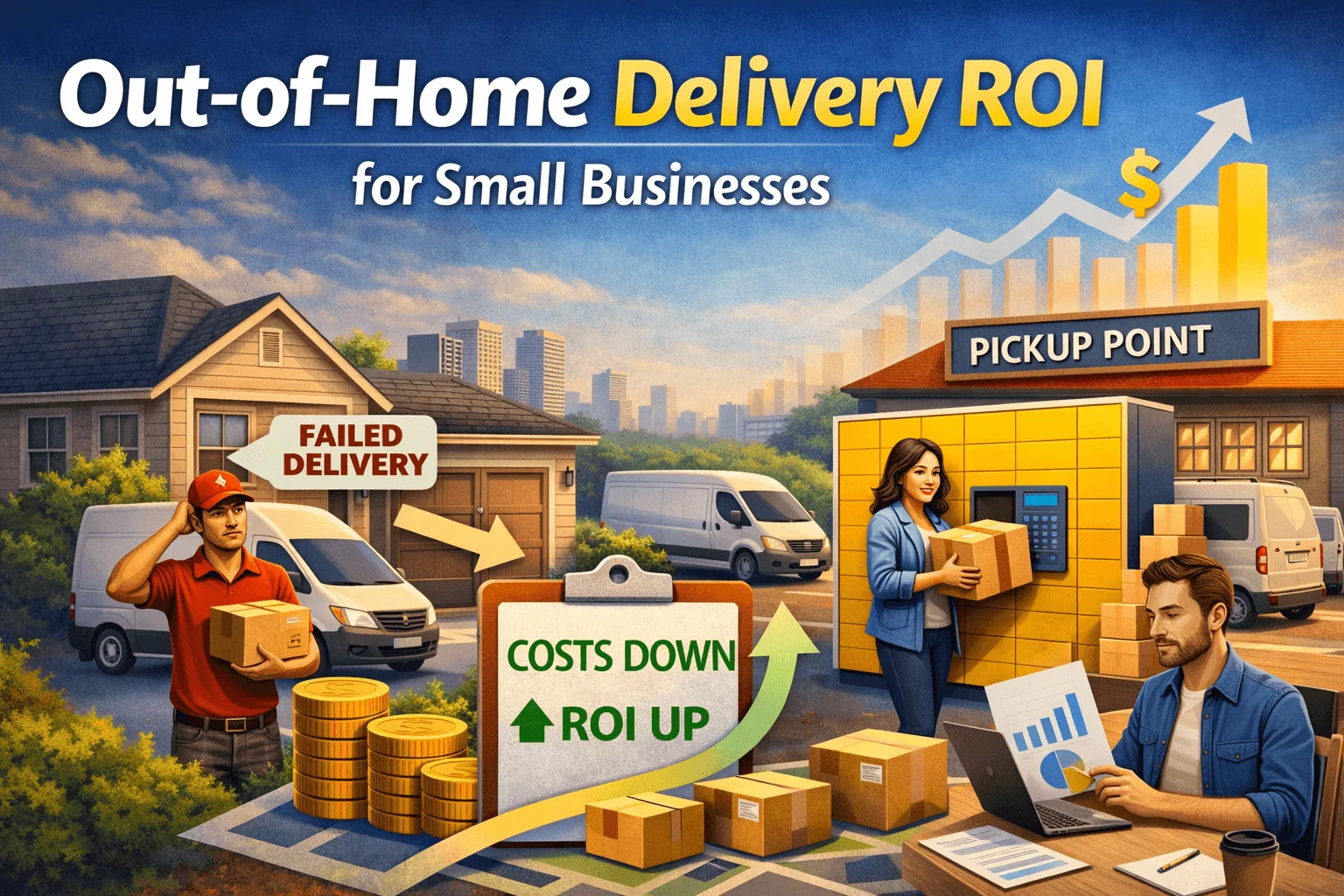
Traditional home delivery sounds simple, but in practice it creates friction. Drivers spend time searching for addresses, dealing with traffic, and handling failed delivery attempts when customers are not home. Each of these issues adds cost and reduces efficiency.
Small businesses feel this more than large companies. They do not have the same scale, infrastructure, or margin to absorb inefficiencies. As a result, delivery can quietly eat into profits, even when sales are growing.
This is where out-of-home delivery offers a different approach.
Traditional home delivery sounds simple, but in practice it creates friction. Drivers spend time searching for addresses, dealing with traffic, and handling failed delivery attempts when customers are not home. Each of these issues adds cost and reduces efficiency.
Small businesses feel this more than large companies. They do not have the same scale, infrastructure, or margin to absorb inefficiencies. As a result, delivery can quietly eat into profits, even when sales are growing.
This is where out-of-home delivery offers a different approach.
Share:
What out-of-home delivery actually means
Out-of-home delivery refers to sending packages to a fixed location instead of a customer’s doorstep. These locations can include parcel lockers, retail pickup points, or partner stores.
Instead of waiting at home for a delivery, customers collect their orders at a time that suits them. This small shift changes how the entire delivery process works.
For businesses, it reduces the number of individual stops and increases delivery density. For customers, it offers flexibility and fewer missed deliveries.
Instead of waiting at home for a delivery, customers collect their orders at a time that suits them. This small shift changes how the entire delivery process works.
For businesses, it reduces the number of individual stops and increases delivery density. For customers, it offers flexibility and fewer missed deliveries.
Where the return on investment comes from
When people talk about ROI in delivery, they often think only about shipping costs. But the return from out-of-home delivery is broader and shows up in several areas.
Lower delivery costs per order
Delivering to one central point is cheaper than delivering to multiple individual homes. Drivers can drop off many parcels at once, which reduces time, fuel, and labor.
Fewer failed deliveries
Missed deliveries are expensive. They require redelivery attempts, extra communication, and sometimes refunds. With pickup points or lockers, the package waits for the customer, not the other way around.
Better route efficiency
Drivers can plan simpler routes with fewer stops. This leads to more predictable operations and less wasted time.
Reduced customer service workload
Fewer delivery issues mean fewer support requests. Customers are less likely to ask where their package is or request rescheduling.
Increased customer choice
Offering an alternative to home delivery can improve the buying experience. Some customers prefer pickup locations, especially if they are not home during the day.
Lower delivery costs per order
Delivering to one central point is cheaper than delivering to multiple individual homes. Drivers can drop off many parcels at once, which reduces time, fuel, and labor.
Fewer failed deliveries
Missed deliveries are expensive. They require redelivery attempts, extra communication, and sometimes refunds. With pickup points or lockers, the package waits for the customer, not the other way around.
Better route efficiency
Drivers can plan simpler routes with fewer stops. This leads to more predictable operations and less wasted time.
Reduced customer service workload
Fewer delivery issues mean fewer support requests. Customers are less likely to ask where their package is or request rescheduling.
Increased customer choice
Offering an alternative to home delivery can improve the buying experience. Some customers prefer pickup locations, especially if they are not home during the day.
Comparing delivery models at a glance
Here is a simple comparison of how traditional home delivery and out-of-home delivery differ in practice:
| Factor | Home Delivery | Out-of-Home Delivery |
|---|---|---|
| Delivery stops | Many individual addresses | Fewer centralized locations |
| Failed deliveries | Common | Rare |
| Cost per delivery | Higher | Lower |
| Route complexity | High | Lower |
| Customer flexibility | Limited to delivery window | Flexible pickup time |
| Operational predictability | Variable | More consistent |
This table shows why many small businesses start to see cost savings once they introduce an alternative delivery option.
A simple example from a small online store
Imagine a small clothing brand that ships 100 orders per day.
With home delivery:
With out-of-home delivery added as an option:
With home delivery:
- 15 to 20 deliveries fail on the first attempt
- Drivers spend time revisiting addresses
- Customer support handles delivery complaints daily
With out-of-home delivery added as an option:
- A portion of customers choose pickup points
- Drivers deliver multiple parcels to the same location
- Failed deliveries drop significantly
How to introduce out-of-home delivery step by step
Switching to a new delivery model does not require a full overhaul. Small businesses can start gradually.
Step 1: Offer it as an option, not a replacement
Keep home delivery available, but introduce pickup points or lockers at checkout. This allows customers to choose what works for them.
Step 2: Start with high-density areas
Focus on regions where you already have many orders. This increases the efficiency of consolidated deliveries.
Step 3: Communicate clearly with customers
Explain how pickup works. Let customers know where the location is, how long their package will be stored, and what they need to collect it.
Step 4: Monitor operational changes
Track delivery times, failed deliveries, and support requests. Compare performance before and after introducing the option.
Step 5: Adjust based on usage
If customers respond well, expand the network of pickup locations or promote the option more visibly during checkout.
Common mistakes to avoid
Even though the model is simpler in many ways, there are still pitfalls to watch for.
Treating it as a niche feature
Some businesses add out-of-home delivery but hide it during checkout. If customers do not see it, they will not use it.
Poor communication
Customers need clear instructions. Confusion about pickup times or processes can lead to frustration.
Ignoring customer preferences
Not every customer wants the same thing. Removing home delivery entirely can backfire. The goal is to offer choice.
Not tracking performance
Without tracking metrics, it is hard to understand whether the new option is actually improving efficiency and costs.
Treating it as a niche feature
Some businesses add out-of-home delivery but hide it during checkout. If customers do not see it, they will not use it.
Poor communication
Customers need clear instructions. Confusion about pickup times or processes can lead to frustration.
Ignoring customer preferences
Not every customer wants the same thing. Removing home delivery entirely can backfire. The goal is to offer choice.
Not tracking performance
Without tracking metrics, it is hard to understand whether the new option is actually improving efficiency and costs.
Quick checklist before you roll it out
Use this checklist to make sure your setup is ready:
If you can answer yes to these questions, you are in a good position to test the model.
- Is the option clearly visible during checkout?
- Do customers receive clear pickup instructions?
- Are you tracking delivery success rates?
- Do you have a process for handling uncollected parcels?
If you can answer yes to these questions, you are in a good position to test the model.
How this fits into a broader delivery strategy
Out-of-home delivery is not meant to replace everything. It works best as part of a mixed approach.
Some customers will always prefer home delivery. Others will choose pickup for convenience or reliability. Offering both creates flexibility without forcing a single solution.
For small businesses, this flexibility can make operations more stable. It spreads demand across different delivery methods and reduces pressure on any one system.
Some customers will always prefer home delivery. Others will choose pickup for convenience or reliability. Offering both creates flexibility without forcing a single solution.
For small businesses, this flexibility can make operations more stable. It spreads demand across different delivery methods and reduces pressure on any one system.
A note on tools and platforms
Implementing this model often requires coordination between your store, your logistics setup, and your delivery network.
Solutions like Via.Delivery focus on giving D2C brands an alternative to traditional home delivery. By connecting businesses with out-of-home options, they make it easier to offer pickup points without building everything from scratch.
The idea is not to replace your existing setup, but to extend it in a practical way.
Solutions like Via.Delivery focus on giving D2C brands an alternative to traditional home delivery. By connecting businesses with out-of-home options, they make it easier to offer pickup points without building everything from scratch.
The idea is not to replace your existing setup, but to extend it in a practical way.
Practical next steps to get started
If you are considering out-of-home delivery, start small and focus on learning.
From there, you can decide whether to expand.
Out-of-home delivery works best when it solves a real problem. For many small businesses, that problem is the growing cost and complexity of last-mile delivery. By shifting part of the process to centralized locations, you can reduce friction without making things harder for your customers.
If your current delivery setup feels expensive or unpredictable, testing this model is a practical place to start.
- Identify a region with consistent order volume
- Roll it out for a limited number of states or products.
- Offer the option clearly at checkout
- Track results over a few weeks
- Compare costs, delivery success, and customer feedback
From there, you can decide whether to expand.
Out-of-home delivery works best when it solves a real problem. For many small businesses, that problem is the growing cost and complexity of last-mile delivery. By shifting part of the process to centralized locations, you can reduce friction without making things harder for your customers.
If your current delivery setup feels expensive or unpredictable, testing this model is a practical place to start.