





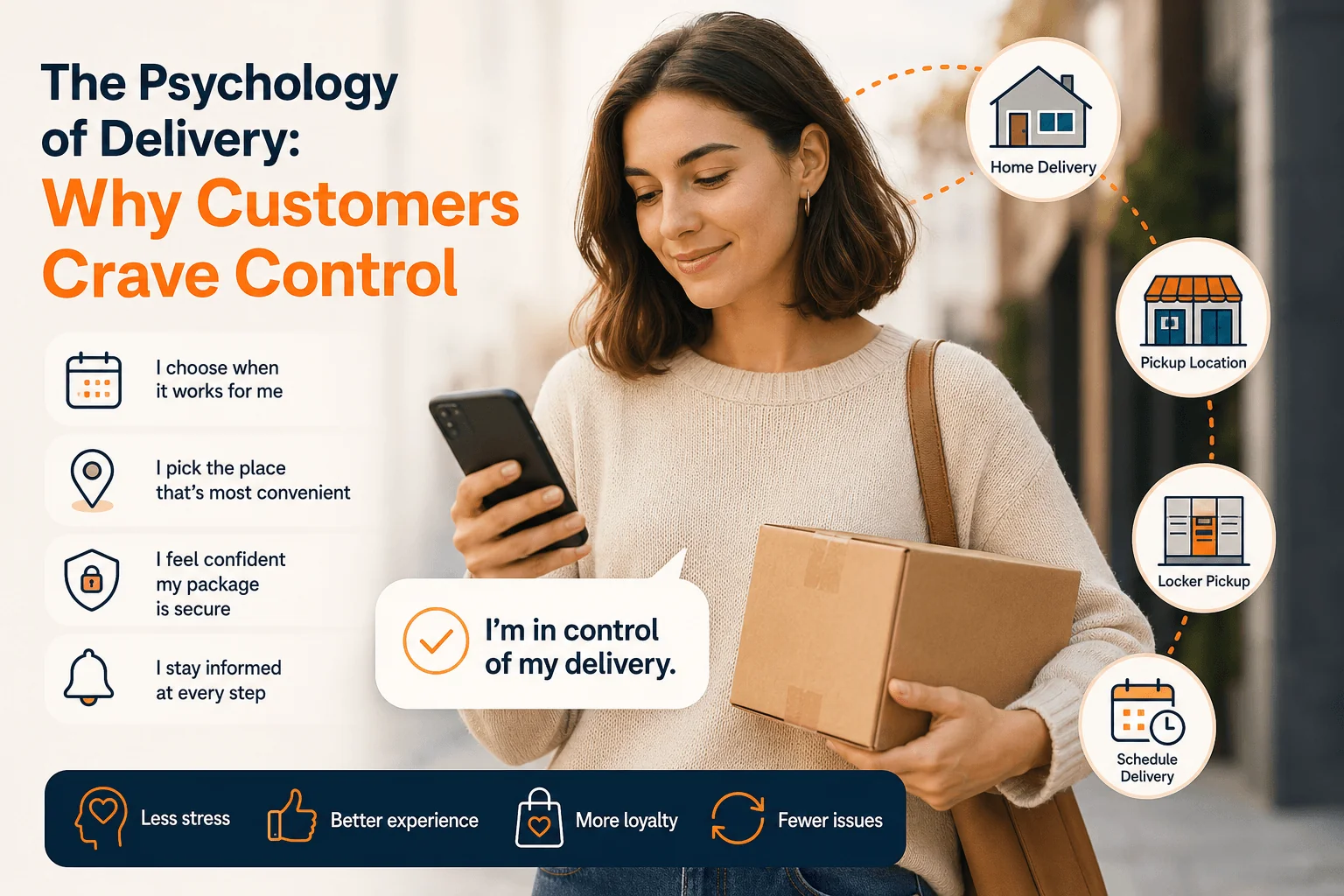
The Psychology of Delivery: Why Customers Crave Control.
Key takeaways
Customers do not only care about when a package arrives. They care about whether the delivery fits their day, feels predictable, and gives them a clear choice.
Control reduces stress because shoppers can plan around work, travel, weather, building access, theft risk, and signature needs. A delivery experience that gives people options often feels more reliable than one that only promises speed.
For D2C brands, delivery control is not just a shipping feature. It affects checkout confidence, support volume, repeat purchases, and how customers remember the whole buying experience.
Control reduces stress because shoppers can plan around work, travel, weather, building access, theft risk, and signature needs. A delivery experience that gives people options often feels more reliable than one that only promises speed.
For D2C brands, delivery control is not just a shipping feature. It affects checkout confidence, support volume, repeat purchases, and how customers remember the whole buying experience.
Share:
The delivery problem customers feel but do not always explain
A customer places an order because they want the product. Then the delivery process starts, and the customer’s attention shifts from excitement to uncertainty.
Will the package arrive while they are at work? Will it be left outside? Will it need a signature? Will the driver find the building entrance? Will the tracking page update on time? These questions may seem small, but they shape how safe and predictable the purchase feels.
This is where the psychology of delivery becomes useful for merchants. Delivery is not only a logistics task. It is also a trust moment. The customer has already paid, but the product is not yet in their hands. That gap creates tension.
When the customer has no control, every delay or unclear update feels bigger. When the customer has options, the same wait can feel more manageable. A package arriving tomorrow may feel acceptable if the shopper chose the delivery method and knows where it will be.
Will the package arrive while they are at work? Will it be left outside? Will it need a signature? Will the driver find the building entrance? Will the tracking page update on time? These questions may seem small, but they shape how safe and predictable the purchase feels.
This is where the psychology of delivery becomes useful for merchants. Delivery is not only a logistics task. It is also a trust moment. The customer has already paid, but the product is not yet in their hands. That gap creates tension.
When the customer has no control, every delay or unclear update feels bigger. When the customer has options, the same wait can feel more manageable. A package arriving tomorrow may feel acceptable if the shopper chose the delivery method and knows where it will be.
Why control feels better than speed alone
Fast shipping is attractive, but speed does not solve every delivery concern. A package that arrives quickly at the wrong time can still create a bad experience.
For example, a shopper may prefer pickup after work over a home delivery at noon. A parent may prefer a secure pickup location instead of a porch drop-off during school pickup. A customer in an apartment building may prefer a carrier location because missed deliveries are common.
Control works because it gives the shopper a role in the outcome. They are not waiting passively. They are choosing what fits their routine.
For example, a shopper may prefer pickup after work over a home delivery at noon. A parent may prefer a secure pickup location instead of a porch drop-off during school pickup. A customer in an apartment building may prefer a carrier location because missed deliveries are common.
Control works because it gives the shopper a role in the outcome. They are not waiting passively. They are choosing what fits their routine.
Predictability lowers anxiety
Customers are more patient when they understand what is happening. A clear delivery choice, a clear location, and clear notifications reduce the need to keep checking tracking pages.
This does not mean every delivery has to be instant. It means the delivery promise should feel believable and easy to follow.
This does not mean every delivery has to be instant. It means the delivery promise should feel believable and easy to follow.
Choice creates ownership
When customers choose a delivery option, they are more likely to accept the tradeoff. If they select pickup, they understand that they will collect the order. If they choose home delivery, they accept the timing and location risk.
This sense of ownership can reduce frustration because the shopper feels the process was built around their preference, not forced on them.
This sense of ownership can reduce frustration because the shopper feels the process was built around their preference, not forced on them.
What customers want to control
Customers usually want control over practical parts of delivery, not complicated shipping settings. They want simple choices that match real life.
| Customer concern | What they want to control | Why it matters |
|---|---|---|
| Work schedule | Delivery timing or pickup option | Packages should not arrive when no one is home |
| Package safety | Home delivery or pickup location | Some shoppers do not want items left outside |
| Travel plans | Where the order is delivered | Customers may be away from home during delivery |
| Signature needs | A place and time they can manage | Missed signatures can create delays |
| Building access | Delivery destination | Apartments and gated buildings can be hard for drivers |
| Weather exposure | Whether the package sits outside | Some products should not be left unattended |
These concerns are ordinary, but they affect the full customer experience. A shopper may not say, “I need psychological control over delivery.” They will say, “Can I pick it up somewhere?” or “I do not want this left outside.”
The hidden cost of making customers wait passively
When delivery feels uncertain, customers often contact support. They ask where the package is, whether the address can be changed, or what happens if they miss the delivery.
Some of these questions are avoidable. They happen because the shopper does not feel informed or in control.
A passive delivery experience can also affect future purchases. Even if the product is good, the memory of the order may include stress. The customer may think twice before buying again, especially for higher-value items, gifts, repeat purchases, or products that are sensitive to timing.
Some of these questions are avoidable. They happen because the shopper does not feel informed or in control.
A passive delivery experience can also affect future purchases. Even if the product is good, the memory of the order may include stress. The customer may think twice before buying again, especially for higher-value items, gifts, repeat purchases, or products that are sensitive to timing.
Common mistakes that reduce delivery confidence
Many delivery problems start before the order ships. They begin at checkout, where the customer sees limited options or vague language.
Offering speed without context
“Fast shipping” sounds good, but it is incomplete. Customers still need to know where the package will go, what happens if they are not home, and whether they can choose another delivery method.
Speed is helpful when it fits the customer’s life. Without choice, it can create pressure instead of comfort.
Speed is helpful when it fits the customer’s life. Without choice, it can create pressure instead of comfort.
Hiding delivery limits until after purchase
Customers dislike surprises after checkout. If a delivery needs a signature, cannot go to certain places, or may be left unattended, the customer should understand that early.
A clear choice at checkout is better than a support issue later.
A clear choice at checkout is better than a support issue later.
Treating pickup as a backup only
Pickup should not feel like a second-best option. For many shoppers, it is the preferred option because it offers security and flexibility.
When pickup is shown clearly, customers can choose it for their own reasons. That may include privacy, convenience, package safety, or schedule control.
When pickup is shown clearly, customers can choose it for their own reasons. That may include privacy, convenience, package safety, or schedule control.
How delivery control affects trust
Trust is built when the customer feels the brand has thought through the full order journey. A good product page may win the first click, but the delivery experience helps decide whether the shopper comes back.
Control supports trust in three ways. It makes the promise clearer, gives the shopper a practical choice, and reduces the feeling that something could go wrong without warning.
The best delivery experiences are not complicated. They are easy to understand. The shopper sees the options, chooses what works, receives updates, and knows where to get the order.
Control supports trust in three ways. It makes the promise clearer, gives the shopper a practical choice, and reduces the feeling that something could go wrong without warning.
The best delivery experiences are not complicated. They are easy to understand. The shopper sees the options, chooses what works, receives updates, and knows where to get the order.
The role of pickup locations in customer control
Pickup locations give customers another way to receive orders without depending only on home delivery. This can be useful for shoppers who work during delivery hours, live in buildings with access issues, or worry about packages being left outside.
For D2C brands, pickup can also make the delivery offer feel more flexible. The customer is not limited to one destination. They can select a location that better matches their routine.
Via.Delivery fits into this area as an IT solution that gives D2C brands and their customers an alternative delivery option. In a delivery strategy, that type of option can help brands offer more control without turning checkout into a complicated process.
For D2C brands, pickup can also make the delivery offer feel more flexible. The customer is not limited to one destination. They can select a location that better matches their routine.
Via.Delivery fits into this area as an IT solution that gives D2C brands and their customers an alternative delivery option. In a delivery strategy, that type of option can help brands offer more control without turning checkout into a complicated process.
Practical next steps for brands
Start by looking at the moments where customers lose control. Review checkout, order confirmation emails, tracking updates, failed delivery messages, and support tickets.
Ask simple questions. Do customers know their delivery choices before they pay? Can they choose a safer or more convenient option? Are pickup options explained in plain language? Do notifications tell customers what to do next?
Then test changes in a controlled way. Add clearer delivery language at checkout. Explain when pickup may be useful. Make tracking messages more direct. Review support questions after the change to see whether confusion drops.
The goal is not to add more complexity. The goal is to give customers enough control to feel calm, informed, and ready to buy again.
Ask simple questions. Do customers know their delivery choices before they pay? Can they choose a safer or more convenient option? Are pickup options explained in plain language? Do notifications tell customers what to do next?
Then test changes in a controlled way. Add clearer delivery language at checkout. Explain when pickup may be useful. Make tracking messages more direct. Review support questions after the change to see whether confusion drops.
The goal is not to add more complexity. The goal is to give customers enough control to feel calm, informed, and ready to buy again.
FAQ
What is the psychology of delivery?
The psychology of delivery is the way customers feel and behave during the time between purchase and receiving an order. It includes trust, anxiety, control, expectations, and how clearly the delivery process is explained.
Why do customers want control over delivery?
Customers want control because delivery affects their daily routine. They may be working, traveling, worried about theft, managing a signature, or trying to avoid missed deliveries.
Is fast delivery always better?
Not always. Fast delivery is helpful when it fits the customer’s schedule and location. A slightly slower option can feel better if it gives the shopper more control and reduces risk.
How can brands give customers more delivery control?
Brands can offer clear delivery choices, explain pickup options, improve notifications, set realistic expectations, and make delivery details easy to understand before checkout.
Why do pickup locations help customers feel more in control?
Pickup locations let customers collect orders when it works for them, instead of waiting at home or worrying about unattended packages. This can make the delivery experience feel safer and more predictable.