





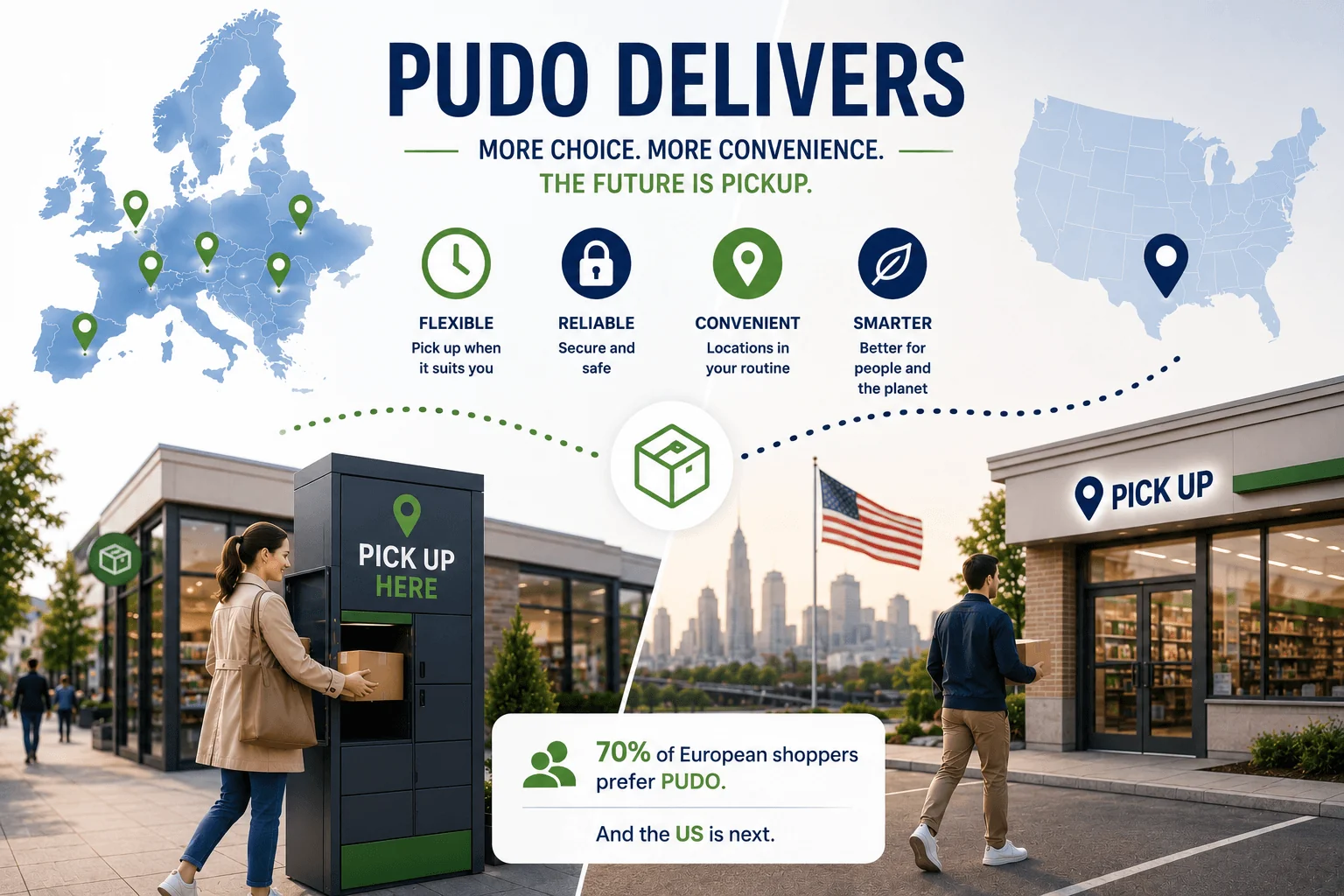
Why 70% of European Shoppers Prefer PUDO - And Why the US Is Next
Key takeaways
- PUDO (Pick-Up and Drop-Off) has become a familiar delivery option for many European shoppers.
- Collection points, parcel shops, and lockers offer flexibility that traditional home delivery cannot always provide.
- Ecommerce growth has increased pressure on last-mile delivery networks.
- US consumers are becoming more comfortable with alternative delivery methods.
- Retailers and brands are looking for ways to reduce delivery costs while improving convenience.
- A combination of customer demand and operational efficiency is helping drive interest in PUDO networks.
Share:
The delivery problem shoppers and retailers are trying to solve
Online shopping has made buying products easier than ever. Getting those products to customers efficiently is a different challenge. Home delivery became the default ecommerce model because it offered convenience. A customer places an order, enters an address, and waits for a package to arrive. While simple in theory, this approach creates challenges for both consumers and businesses.
Customers are not always home when deliveries arrive. Packages can be delayed, left unattended, or require additional delivery attempts. Retailers and carriers absorb the cost of these inefficiencies while customers deal with the inconvenience.
As ecommerce volumes continue to grow, many markets are searching for alternatives that balance convenience, reliability, and cost. In Europe, Pick-Up and Drop-Off locations, commonly known as PUDO points, have become a common part of the shopping experience. The United States may be moving in a similar direction.
Customers are not always home when deliveries arrive. Packages can be delayed, left unattended, or require additional delivery attempts. Retailers and carriers absorb the cost of these inefficiencies while customers deal with the inconvenience.
As ecommerce volumes continue to grow, many markets are searching for alternatives that balance convenience, reliability, and cost. In Europe, Pick-Up and Drop-Off locations, commonly known as PUDO points, have become a common part of the shopping experience. The United States may be moving in a similar direction.
What PUDO means in practice
PUDO stands for Pick-Up and Drop-Off. Instead of delivering every package directly to a residential address, orders are delivered to a designated location where customers collect them when convenient.
A PUDO location may include:
The process is straightforward. Customers select a collection point during checkout. The package is delivered to that location, and the customer picks it up within a specified time frame. For many shoppers, this provides more control than waiting at home for a delivery.
A PUDO location may include:
- Convenience stores
- Grocery stores
- Parcel shops
- Retail partner locations
- Automated lockers
- Dedicated collection centers
The process is straightforward. Customers select a collection point during checkout. The package is delivered to that location, and the customer picks it up within a specified time frame. For many shoppers, this provides more control than waiting at home for a delivery.
Why PUDO became popular in Europe
European markets developed under conditions that naturally supported collection-based delivery.
Urban density, public transportation use, and established neighborhood retail networks created an environment where pickup locations fit into daily routines.
A shopper can collect a package on the way home from work, during a grocery trip, or while running errands. This convenience often outweighs the perceived benefit of home delivery.
Urban density, public transportation use, and established neighborhood retail networks created an environment where pickup locations fit into daily routines.
A shopper can collect a package on the way home from work, during a grocery trip, or while running errands. This convenience often outweighs the perceived benefit of home delivery.
Cities create natural pickup patterns
European cities frequently have dense populations and shorter travel distances. Collection points can serve large numbers of customers within relatively small geographic areas. This creates efficiency for carriers while giving customers convenient access.
Existing retail networks support adoption
Many PUDO locations operate within businesses that customers already visit regularly. Customers are not making special trips solely to retrieve packages. Instead, package collection becomes part of existing routines.
Delivery reliability matters
Missed deliveries create frustration. When packages are delivered to collection points, customers no longer need to worry about being home during a specific delivery window.
This reliability is often one of the most attractive aspects of PUDO.
This reliability is often one of the most attractive aspects of PUDO.
What shoppers actually value about pickup locations
The conversation around delivery often focuses on speed. However, convenience is not always about receiving an order as quickly as possible. Many customers prioritize flexibility.
Control over timing
A package waiting at a pickup location can often be collected when the customer chooses. This removes the uncertainty associated with delivery windows.
Reduced risk of missed deliveries
Customers do not need to rearrange schedules to receive packages. The package remains available for pickup rather than requiring another delivery attempt.
Greater confidence for valuable purchases
Higher-value products sometimes require signatures or secure handoff procedures. Collection points can make these transactions easier and more predictable.
Consistent customer experience
A pickup location often provides the same process every time. That consistency can be appealing compared with variable home delivery experiences.
Comparing home delivery and PUDO
| Factor | Home Delivery | PUDO |
|---|---|---|
| Delivery location | Customer address | Collection point |
| Delivery attempts | May require multiple attempts | Usually one delivery |
| Customer availability required | Often yes | No |
| Route efficiency | Lower | Higher |
| Delivery flexibility | Limited by schedule | Customer chooses pickup time |
| Parcel security | Varies | Typically centralized |
| Operational costs | Often higher | Often lower |
Neither model is universally better. Many retailers find that offering both options creates the strongest customer experience.
Why retailers are paying attention
The benefits of PUDO extend beyond customer convenience. Retailers and logistics providers face increasing pressure to improve delivery efficiency. Home delivery requires drivers to travel to individual addresses, which increases transportation costs and complexity.
PUDO networks create opportunities for consolidation. Instead of making dozens of residential stops, carriers can deliver multiple packages to a single location. This improves route efficiency and reduces operational strain.
For ecommerce brands, delivery is no longer simply a fulfillment issue. It is part of the overall customer experience.
PUDO networks create opportunities for consolidation. Instead of making dozens of residential stops, carriers can deliver multiple packages to a single location. This improves route efficiency and reduces operational strain.
For ecommerce brands, delivery is no longer simply a fulfillment issue. It is part of the overall customer experience.
Common misconceptions about PUDO
As interest grows, several misconceptions continue to appear.
Customers only want home delivery
Home delivery remains popular, but consumer preferences are not uniform. Different customers value different forms of convenience.
Pickup locations are only for urban areas
While cities often see higher adoption, collection points can also work in suburban and regional markets when properly placed.
PUDO is only about reducing costs
Cost reduction is one benefit, but customer flexibility and delivery reliability are equally important.
Customers see pickup as an inconvenience
For many shoppers, pickup becomes convenient when locations fit naturally into existing routines.
Why the US market is showing similar signals
The United States differs from Europe in geography, population distribution, and shopping behavior. Even so, several trends are creating conditions that support alternative delivery models.
Ecommerce volumes continue to grow
More online orders place additional pressure on delivery networks. Retailers and carriers continue searching for ways to manage increasing demand.
Consumers are becoming familiar with pickup services
Store pickup, curbside collection, and parcel lockers have become more common. As consumers become comfortable with these services, collection-based delivery feels increasingly familiar.
Delivery expectations are evolving
Customers increasingly want flexibility rather than a single delivery option. The ability to choose how and where orders are received is becoming part of the shopping experience.
Last-mile costs remain challenging
The final stage of delivery remains one of the most expensive parts of ecommerce fulfillment. Consolidated delivery models offer one potential way to improve efficiency.
What brands should consider before adding PUDO options
Introducing pickup locations requires planning.
Several factors should be evaluated before implementation.
Customer demographics
Brands should understand where customers live and how they typically receive orders.
Product characteristics
Small and medium-sized products often fit naturally into collection-based fulfillment.
Delivery patterns
Analyzing failed deliveries and customer service inquiries may reveal opportunities for alternative delivery methods.
Checkout experience
Delivery options should be easy to understand and simple to select. Confusing checkout flows can reduce adoption.
Several factors should be evaluated before implementation.
Customer demographics
Brands should understand where customers live and how they typically receive orders.
Product characteristics
Small and medium-sized products often fit naturally into collection-based fulfillment.
Delivery patterns
Analyzing failed deliveries and customer service inquiries may reveal opportunities for alternative delivery methods.
Checkout experience
Delivery options should be easy to understand and simple to select. Confusing checkout flows can reduce adoption.
FAQ
What is a PUDO location?
A PUDO location is a designated pickup and drop-off point where customers can collect packages instead of receiving them at home.
Why do shoppers use PUDO services?
Many customers appreciate the flexibility, reliability, and convenience of collecting packages on their own schedule.
Is PUDO replacing home delivery?
No. In most markets, PUDO complements home delivery rather than replacing it.
Does PUDO help reduce delivery costs?
Collection-based delivery can improve route efficiency because multiple packages are delivered to a single location.
Are PUDO networks common in the United States?
PUDO adoption is growing, although home delivery remains the dominant fulfillment method.
Can all ecommerce businesses offer PUDO?
Many businesses can, but suitability depends on products, customer preferences, and available delivery infrastructure.