





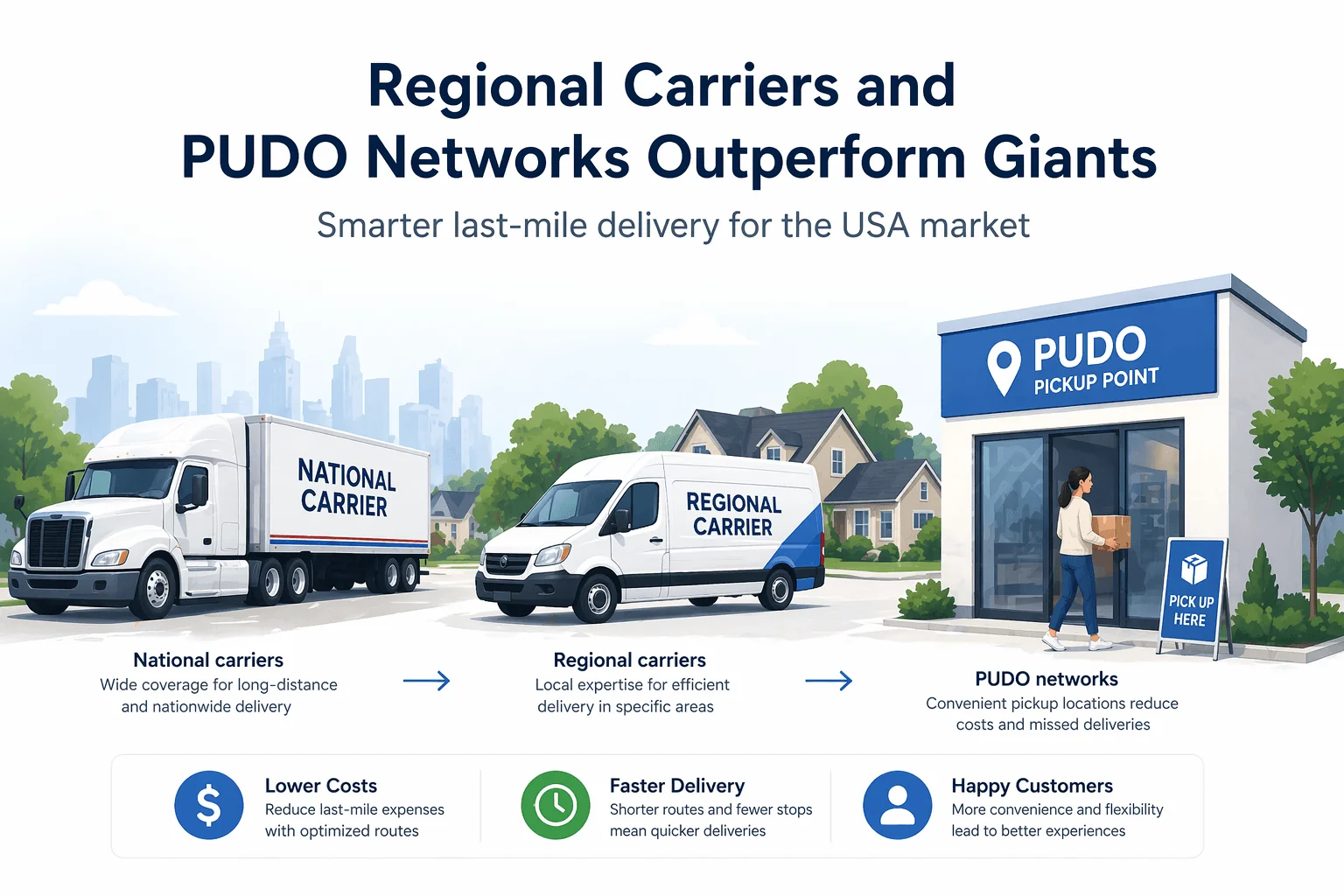
Regional Carriers and PUDO Networks Outperform Giants
Key takeaways
- In the US, regional carriers often outperform national carriers within specific service areas.
- PUDO networks reduce last-mile costs by consolidating deliveries into fewer stops.
- National carriers provide coverage but can be less efficient at the local level.
- A mixed delivery strategy helps brands balance cost, speed, and reliability.
- Local delivery density is one of the main drivers of performance in the US market.
Share:
The problem in plain terms
In the United States, many brands rely heavily on national carriers because they offer broad coverage and established systems. At first, this seems like the safest option for reaching customers across a large and diverse country. However, as order volumes grow and expectations shift, this approach often becomes more expensive and less flexible.
The US delivery environment is complex. It includes dense urban areas, spread-out suburbs, and long-distance rural routes, all within the same network. National carriers are designed to handle this scale, but not always with local efficiency.
At the same time, customers expect fast, predictable delivery. Meeting these expectations using only national carriers can increase costs without improving performance. This is where regional carriers and PUDO networks begin to show clear advantages.
The US delivery environment is complex. It includes dense urban areas, spread-out suburbs, and long-distance rural routes, all within the same network. National carriers are designed to handle this scale, but not always with local efficiency.
At the same time, customers expect fast, predictable delivery. Meeting these expectations using only national carriers can increase costs without improving performance. This is where regional carriers and PUDO networks begin to show clear advantages.
What regional carriers and PUDO networks actually do differently
Regional carriers focus on specific areas within the United States. Instead of trying to cover the entire country, they concentrate on defined regions and build their operations around local demand patterns. This allows them to create more efficient routes and maintain better control over delivery conditions.
PUDO networks, which stand for pick-up and drop-off locations, take a different approach. Rather than delivering every package to a home, they consolidate deliveries into shared locations such as stores or lockers. Customers then pick up their orders at a convenient time.
Both models simplify the last mile. Instead of handling thousands of scattered delivery points, they focus on density and predictability. In a country as geographically varied as the US, this shift can make a noticeable difference in cost and reliability.
PUDO networks, which stand for pick-up and drop-off locations, take a different approach. Rather than delivering every package to a home, they consolidate deliveries into shared locations such as stores or lockers. Customers then pick up their orders at a convenient time.
Both models simplify the last mile. Instead of handling thousands of scattered delivery points, they focus on density and predictability. In a country as geographically varied as the US, this shift can make a noticeable difference in cost and reliability.
Where national carriers lose efficiency
National carriers play an important role in the US logistics system. However, their scale also introduces limitations that affect performance at the local level.
Long and complex routes
In the US, delivery routes can span large suburban and rural areas. Drivers often travel long distances between stops, especially outside major cities. This reduces the number of deliveries that can be completed in a single route.
Even small inefficiencies become significant at scale. Extra miles, traffic delays, and dispersed addresses all contribute to higher fuel usage and longer delivery times.
Even small inefficiencies become significant at scale. Extra miles, traffic delays, and dispersed addresses all contribute to higher fuel usage and longer delivery times.
High variability in delivery conditions
The US market includes a wide range of delivery environments. Urban centers, suburban neighborhoods, and rural areas all require different approaches. National carriers must adapt constantly, which can reduce consistency.
This variability makes it harder to maintain predictable delivery performance. Routes that work well in one region may be inefficient in another.
This variability makes it harder to maintain predictable delivery performance. Routes that work well in one region may be inefficient in another.
Cost structure tied to nationwide operations
National carriers maintain large infrastructure networks across the country. These include sorting facilities, transportation hubs, and fleets that support nationwide coverage.
While this enables scale, it also increases fixed costs. Businesses often pay for this infrastructure even when their shipments are concentrated in specific regions.
While this enables scale, it also increases fixed costs. Businesses often pay for this infrastructure even when their shipments are concentrated in specific regions.
Why regional carriers often perform better locally
Regional carriers are built around the idea of focusing on a defined service area. In the US, where delivery conditions vary widely by region, this approach can lead to better results.
Better route familiarity
Drivers working within a limited region become familiar with local roads, traffic patterns, and delivery challenges. This familiarity helps reduce delays and improves route planning over time.
Consistent exposure to the same areas allows drivers to refine their routes. As a result, deliveries become more predictable and efficient.
Consistent exposure to the same areas allows drivers to refine their routes. As a result, deliveries become more predictable and efficient.
Higher delivery density
Regional carriers often operate in areas where they can group deliveries closely together. This increases the number of packages delivered per route.
Higher density is especially valuable in suburban regions across the US. It reduces fuel usage per package and improves overall efficiency.
Higher density is especially valuable in suburban regions across the US. It reduces fuel usage per package and improves overall efficiency.
More flexible operations
Regional carriers typically have simpler structures than national organizations. This allows them to adjust more quickly to local demand and customer needs.
Flexibility can be important in the US market, where seasonal trends and regional differences can affect delivery volumes. Being able to adapt quickly helps maintain consistent performance.
Flexibility can be important in the US market, where seasonal trends and regional differences can affect delivery volumes. Being able to adapt quickly helps maintain consistent performance.
How PUDO networks simplify the last mile
PUDO networks address one of the biggest challenges in US delivery: the cost of reaching individual homes across large and varied areas.
Consolidated delivery points
Delivering multiple packages to a single pickup location reduces the number of stops required. In dense US cities, this can significantly improve efficiency.
Even in suburban areas, central pickup points can reduce travel distances. Fewer stops mean less time on the road and lower fuel usage.
Even in suburban areas, central pickup points can reduce travel distances. Fewer stops mean less time on the road and lower fuel usage.
Reduced failed deliveries
Missed deliveries are common in residential shipping across the US. Customers may not be home, or access may be limited.
PUDO networks eliminate this issue by delivering to staffed locations or secure lockers. Packages are stored until customers collect them, removing the need for repeat attempts.
PUDO networks eliminate this issue by delivering to staffed locations or secure lockers. Packages are stored until customers collect them, removing the need for repeat attempts.
Predictable operations
Fixed pickup locations make route planning more consistent. Drivers follow established routes instead of adjusting to changing residential addresses.
Predictability is especially useful in the US, where traffic conditions and distances can vary widely. Stable routes help maintain reliable delivery performance.
Predictability is especially useful in the US, where traffic conditions and distances can vary widely. Stable routes help maintain reliable delivery performance.
Comparing national, regional, and PUDO models
| Factor | National Carriers | Regional Carriers | PUDO Networks |
|---|---|---|---|
| Coverage | Nationwide | Regional (US-based) | Location-based |
| Route efficiency | Variable | Higher within region | Very high |
| Stops per route | High | Moderate | Low |
| Packages per stop | Low | Moderate | High |
| Delivery predictability | Variable | More stable | Highly stable |
| Cost per package | Higher in many cases | Lower locally | Lower overall |
In the US market, these differences are especially noticeable due to the mix of dense cities and widely spread suburban areas. Each model performs differently depending on the delivery environment.
Common mistakes when choosing delivery partners
Many US-based businesses default to national carriers without fully evaluating alternatives. This can limit their ability to improve efficiency and control costs.
Relying on a single carrier
Using only one carrier reduces flexibility. If performance drops in certain regions, there are few alternatives available.
A mixed approach allows businesses to choose the most efficient option for each area. This is especially important in a country as large as the US.
A mixed approach allows businesses to choose the most efficient option for each area. This is especially important in a country as large as the US.
Ignoring regional differences
Delivery conditions in the US vary significantly by location. What works in New York may not work in Texas or California.
Failing to account for these differences can lead to inefficiencies. A more tailored approach often produces better results.
Failing to account for these differences can lead to inefficiencies. A more tailored approach often produces better results.
Overlooking pickup options
Some brands assume US customers prefer home delivery in all cases. However, many are open to pickup options if they are convenient and well located.
Ignoring this option can increase delivery costs unnecessarily. Offering alternatives provides more flexibility.
Ignoring this option can increase delivery costs unnecessarily. Offering alternatives provides more flexibility.
Focusing only on speed
Speed is important, but it is not the only factor. Reliability and cost also influence customer satisfaction.
Balancing these elements leads to a more sustainable delivery strategy.
Balancing these elements leads to a more sustainable delivery strategy.
How a combined approach improves performance
Rather than choosing one model, many US brands benefit from combining national carriers, regional carriers, and PUDO networks.
Matching carriers to regions
Regional carriers can handle areas where they have strong coverage. National carriers can fill gaps where needed.
This approach allows each carrier to operate where it is most efficient.
This approach allows each carrier to operate where it is most efficient.
Using PUDO for high-density zones
Urban areas in the US are well suited for pickup networks. Consolidating deliveries in these areas reduces costs and improves efficiency.
Customers in cities often value flexibility, making pickup a practical option.
Customers in cities often value flexibility, making pickup a practical option.
Balancing cost and coverage
A combined strategy ensures nationwide coverage while keeping costs under control. It also reduces reliance on any single delivery model.
This balance is especially important in the US, where delivery conditions vary widely.
This balance is especially important in the US, where delivery conditions vary widely.
The role of technology in connecting these models
Managing multiple delivery models requires coordination. In the US market, where scale and complexity are high, this becomes even more important.
Unified order routing
Orders need to be directed to the appropriate carrier with the correct label for each type of delivery. Via.Delivery is built to ensure the correct label is generated when orders are routed to a pickup location.
Visibility across delivery types
Customers expect consistent updates regardless of delivery method. This includes tracking, notifications, and order status updates.
Providing clear visibility helps maintain a consistent experience across different delivery options.
Providing clear visibility helps maintain a consistent experience across different delivery options.
Integration with existing systems
Delivery options need to fit into current workflows, including checkout and order management systems.
Via.Delivery provides an IT solution that helps D2C brands in the US connect regional carriers and PUDO networks into a unified delivery strategy. By supporting alternative delivery options, it allows brands to improve efficiency without adding operational complexity.
Via.Delivery provides an IT solution that helps D2C brands in the US connect regional carriers and PUDO networks into a unified delivery strategy. By supporting alternative delivery options, it allows brands to improve efficiency without adding operational complexity.
What to consider before shifting your delivery strategy
Adapting a delivery strategy in the US requires careful planning. Different regions and customer segments may respond differently.
Customer expectations
US customers have varied preferences depending on location and lifestyle. Some prioritize home delivery, while others value flexibility.
Understanding these differences helps guide implementation.
Understanding these differences helps guide implementation.
Geographic coverage
Not all regions have access to the same carriers or pickup networks. Coverage varies widely across the US.
Mapping available options ensures reliable service.
Mapping available options ensures reliable service.
Operational readiness
Introducing new delivery methods may require changes in fulfillment processes. Teams need clear workflows to manage these changes.
Preparation reduces errors and improves consistency.
Preparation reduces errors and improves consistency.
Cost analysis
Each delivery model has its own cost structure. Comparing these costs helps identify the most efficient mix.
A clear analysis supports better decision-making.
A clear analysis supports better decision-making.
Practical next steps
Start by reviewing your current delivery performance across different US regions. Identify where costs are highest and where delivery performance is inconsistent. This will help you prioritize areas for improvement.
Test regional carriers in areas where they have strong local coverage. At the same time, introduce PUDO options in high-density regions to improve efficiency. These small tests provide useful insights without requiring large changes.
Gradually build a mixed delivery strategy based on performance data. Over time, refine your approach to match regional conditions and customer behavior. For D2C brands operating in the US, solutions like Via.Delivery can help integrate regional carriers and pickup networks into a single system, making it easier to manage complexity and improve delivery efficiency.
Test regional carriers in areas where they have strong local coverage. At the same time, introduce PUDO options in high-density regions to improve efficiency. These small tests provide useful insights without requiring large changes.
Gradually build a mixed delivery strategy based on performance data. Over time, refine your approach to match regional conditions and customer behavior. For D2C brands operating in the US, solutions like Via.Delivery can help integrate regional carriers and pickup networks into a single system, making it easier to manage complexity and improve delivery efficiency.
FAQ
What are PUDO networks?
PUDO stands for pick-up and drop-off. These are locations where customers can collect or return packages instead of receiving them at home. They are commonly used to improve delivery efficiency.
Why are regional carriers more efficient in the US?
They focus on specific areas, which allows for better route planning and higher delivery density. This improves efficiency and reduces costs in those regions.
Are national carriers still useful?
Yes. They provide nationwide coverage and are essential for reaching areas outside regional networks.
Can businesses use all three models together?
Yes. Combining national carriers, regional carriers, and PUDO networks often leads to better performance and cost control.
How do these models reduce delivery costs?
They improve route efficiency, reduce the number of stops, and minimize failed deliveries. This leads to lower fuel usage and more efficient operations.
Not ready for a call?
Get the Via.Delivery Shipping Brief: short reads on carrier fees, holiday cutoffs and pickup options for online stores and wineries, twice a month.
No spam. Unsubscribe anytime.