





Why Residential Porches Are the Weakest Link in Your Supply Chain
Published
Key Takeaways
- Porch theft costs U.S. consumers and retailers an estimated $19.5 billion annually, with 1 in 20 packages at risk in high-density urban areas.
- Residential delivery now represents a major supply chain vulnerability—lost parcels, re-shipments, customer churn, and inflated last-mile costs eat directly into margins.
- The last mile accounts for roughly 50% of total supply chain costs in e commerce, and porch-related inefficiencies contribute 10-15% of those expenses through theft and failed deliveries.
- Moving deliveries from residential porches to secure pickup locations closes this vulnerability and stabilizes last-mile performance.
- Via.Delivery provides an out-of-the-box 36,000 retail pickup locations network and tools that integrate with existing e-commerce stacks to solve this weakness.
Share:
Introduction: The Overlooked Weak Link in Modern Supply Chains
Since 2020, supply chain leaders have invested heavily in factories, warehousing, and linehaul resilience. They’ve diversified suppliers, added inventory buffers, and upgraded transportation networks. Yet many have ignored the last 50 feet to the customer’s front door—and it’s costing them dearly.
The post-COVID-19 boom years (2020–2023) saw e-commerce volume surge dramatically, shifting risk to the residential last mile. Before the pandemic, approximately 40% of U.S. deliveries went to porches. During lockdowns, that number climbed to 60% as contactless options proliferated. This wasn’t a planned evolution—it was an unplanned bottleneck ill-equipped for volume spikes.
Operations and logistics leaders spend countless hours discussing ports, carriers, and inventory buffers. Yet residential porches remain unmanaged, uncontrolled handoff points where supply chain performance goes to die. For DTC and retail brands shipping to U.S. and European consumers, the front porch isn’t just a customer experience issue—it’s a structural vulnerability that directly affects cost, reliability, and brand reputation.
The post-COVID-19 boom years (2020–2023) saw e-commerce volume surge dramatically, shifting risk to the residential last mile. Before the pandemic, approximately 40% of U.S. deliveries went to porches. During lockdowns, that number climbed to 60% as contactless options proliferated. This wasn’t a planned evolution—it was an unplanned bottleneck ill-equipped for volume spikes.
Operations and logistics leaders spend countless hours discussing ports, carriers, and inventory buffers. Yet residential porches remain unmanaged, uncontrolled handoff points where supply chain performance goes to die. For DTC and retail brands shipping to U.S. and European consumers, the front porch isn’t just a customer experience issue—it’s a structural vulnerability that directly affects cost, reliability, and brand reputation.
What Makes a “Supply Chain Weak Link” in 2024?
In supply chain terms, a “weak link” is any node or process with high variability, low control, and outsized impact on cost or service. It’s the point where carefully orchestrated operations fall apart.
Historically, supply chain managers have focused on common weak links:
But in omni-channel commerce, the final delivery node—where the parcel is physically handed to the shopper—now qualifies as a critical area demanding attention. This is where global supply chains meet individual customers, and where supply chain operations either succeed or fail in the customer’s eyes.
Supply chain teams monitor key metrics like OTIF (On-Time In-Full), NPS scores, WISMO tickets, RTO rates, and damage/loss KPIs. Residential delivery consistently skews these numbers negatively. Front porches, apartment lobbies, and shared mailrooms meet every criterion for a systemic weak link: unpredictable access, zero security, and no standardized processes.
Historically, supply chain managers have focused on common weak links:
- Single-source suppliers vulnerable to disruption
- Congested ports creating bottlenecks
- Limited warehouse capacity during peak seasons
- Fragile IT systems prone to data breaches
But in omni-channel commerce, the final delivery node—where the parcel is physically handed to the shopper—now qualifies as a critical area demanding attention. This is where global supply chains meet individual customers, and where supply chain operations either succeed or fail in the customer’s eyes.
Supply chain teams monitor key metrics like OTIF (On-Time In-Full), NPS scores, WISMO tickets, RTO rates, and damage/loss KPIs. Residential delivery consistently skews these numbers negatively. Front porches, apartment lobbies, and shared mailrooms meet every criterion for a systemic weak link: unpredictable access, zero security, and no standardized processes.
Why Residential Porches Fail as a Supply Chain Node
Consider the contrast between controlled logistics infrastructure—distribution centers, cross-docks, staffed pickup counters—and uncontrolled residential environments. In a warehouse, every item is scanned, tracked, and secured. On a porch, a package simply sits there, exposed to the world.
Porches offer zero access control, no standardized handoff process, and no reliable proof-of-delivery. Every delivery becomes a high-variance event that supply chain management cannot predict or control.
Carriers are incentivized to mark packages “delivered” quickly, often without actual confirmation that the right customer received the right parcel. This creates a gap between what your system shows and what actually happened—a blind spot that leads to supply chain disruptions and dissatisfied customers.
Whether you’re shipping to urban multifamily buildings, suburban neighborhoods, rural homes, or mixed-use complexes, the porch presents consistent challenges that undermine your entire supply chain.
Porches offer zero access control, no standardized handoff process, and no reliable proof-of-delivery. Every delivery becomes a high-variance event that supply chain management cannot predict or control.
Carriers are incentivized to mark packages “delivered” quickly, often without actual confirmation that the right customer received the right parcel. This creates a gap between what your system shows and what actually happened—a blind spot that leads to supply chain disruptions and dissatisfied customers.
Whether you’re shipping to urban multifamily buildings, suburban neighborhoods, rural homes, or mixed-use complexes, the porch presents consistent challenges that undermine your entire supply chain.
Porch Piracy and Theft: Direct Losses and Hidden Costs
The numbers are stark: surveys from 2022–2024 show that tens of millions of Americans experienced package theft, with an estimated $19.5 billion in annual losses based on insurance claims and consumer surveys. During peak holiday seasons like 2020–2021, U.S. porch theft incidents surged by 30-50%.
Theft creates a triple cost that many companies fail to fully account for:
Theft creates a triple cost that many companies fail to fully account for:
| Cost Category | Impact | |
|---|---|---|
| Replacement product | Full COGS for reshipped items | |
| Additional shipping | Second delivery attempt fees | |
| Customer support time | Labor costs for resolution | |
| Chargebacks/refunds | Payment processing losses |
High-ticket items—electronics, fashion, specialty goods—are particularly targeted, increasing the risk profile for DTC brands in these categories. This represents significant business risk that compounds with every stolen package.
Perhaps most damaging is the reputational damage: customers blame the retailer, not the thief or the shipping companies. This leads to negative reviews, reduced lifetime value, and lasting impact on brand reputation. Your customer relationship management efforts can’t overcome the fundamental problem of packages disappearing from porches.
Perhaps most damaging is the reputational damage: customers blame the retailer, not the thief or the shipping companies. This leads to negative reviews, reduced lifetime value, and lasting impact on brand reputation. Your customer relationship management efforts can’t overcome the fundamental problem of packages disappearing from porches.
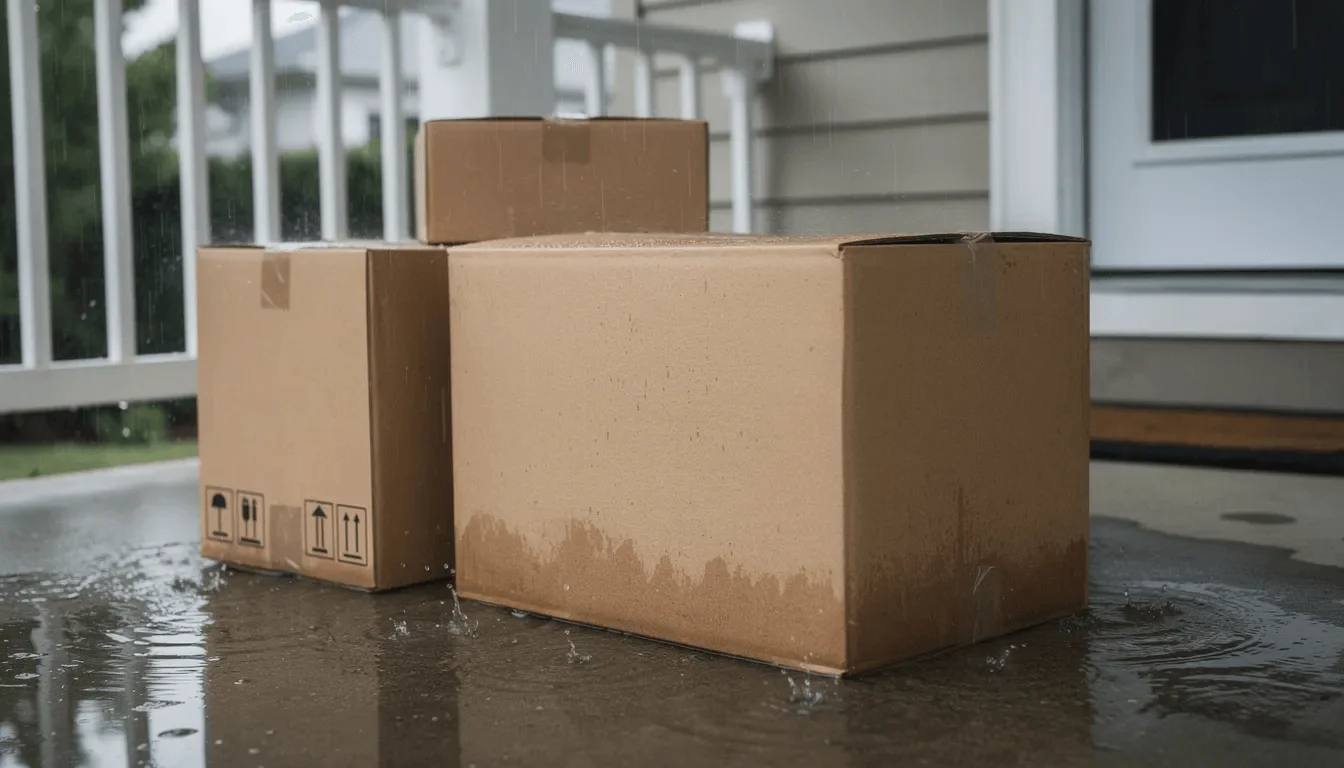
Weather, Damage, and Environmental Exposure
Picture a cosmetics shipment sitting in Arizona summer heat for three hours. Or a nutraceutical order slowly absorbing moisture during a Seattle rain shower. Or electronics packaging frozen solid on a Minnesota porch in January.
During the 2021–2023 North American heat domes, exposed packages faced temperatures that damaged products designed for controlled transport environments, not hours of direct sun exposure on a porch. Studies indicate 10-15% spoilage rates for perishables left 30+ minutes in extreme temperatures, while 5-7% of exposed porch packages are damaged annually by climate events.
Product categories heavily impacted include:
Environmental exposure leads to product damage claims, reshipments, and waste. Each incident lengthens true order cycle time and inflates costs. There’s also a sustainability angle: more waste and extra transportation undermine the ESG goals many brands have set for 2025 and beyond.
During the 2021–2023 North American heat domes, exposed packages faced temperatures that damaged products designed for controlled transport environments, not hours of direct sun exposure on a porch. Studies indicate 10-15% spoilage rates for perishables left 30+ minutes in extreme temperatures, while 5-7% of exposed porch packages are damaged annually by climate events.
Product categories heavily impacted include:
- Cosmetics and skincare (heat-sensitive formulations)
- Nutraceuticals and supplements (moisture and temperature sensitivity)
- Temperature-sensitive food items
- Electronics (humidity and temperature extremes)
- Moisture-sensitive packaging and paper products
Environmental exposure leads to product damage claims, reshipments, and waste. Each incident lengthens true order cycle time and inflates costs. There’s also a sustainability angle: more waste and extra transportation undermine the ESG goals many brands have set for 2025 and beyond.
Failed Deliveries, Access Issues, and Unit Economics
Beyond theft and weather, there’s the simple problem of access. Gated communities, secured apartment buildings, incorrect buzzer codes, and customers not home for signature-required deliveries all create friction.
Each failed first-attempt delivery adds non-trivial costs:
In 2023 urban markets, estimates suggest incremental costs of $5-15 per failed delivery attempt. The U.S. alone sees a 7% redelivery rate, costing approximately $1 billion yearly—money that could fund growth initiatives instead of covering porch failures.
Carriers often respond by relaxing signature rules, which reduces visible failure rates on paper but increases hidden loss and theft. When repeated attempts fail, carriers return packages to sender, triggering refunds, restocking, and write-offs that ripple back through the supply chain. These processes create inefficiencies that affect your ability to meet customer demand efficiently.
Each failed first-attempt delivery adds non-trivial costs:
- Additional driver miles and fuel
- Labor time for retry attempts
- Route disruption affecting other deliveries
- Customer service resources to handle complaints
In 2023 urban markets, estimates suggest incremental costs of $5-15 per failed delivery attempt. The U.S. alone sees a 7% redelivery rate, costing approximately $1 billion yearly—money that could fund growth initiatives instead of covering porch failures.
Carriers often respond by relaxing signature rules, which reduces visible failure rates on paper but increases hidden loss and theft. When repeated attempts fail, carriers return packages to sender, triggering refunds, restocking, and write-offs that ripple back through the supply chain. These processes create inefficiencies that affect your ability to meet customer demand efficiently.
Data Blind Spots and Weak Proof of Delivery
Porch delivery typically relies on a binary status code (“delivered”) with limited context—sometimes accompanied by low-quality photos that prove nothing about who actually received the package.
This creates critical areas of concern for supply chain visibility:
Real time visibility stops at the porch. Only 20-30% of households have functional cameras, leaving most deliveries in a data blind spot. A node you cannot observe or control is, by definition, a risky node in your supply chain architecture.
This creates critical areas of concern for supply chain visibility:
- Supply chain control towers and WMS/TMS dashboards cannot see what happens between “delivered” and “received by customer”
- Poor data granularity makes it difficult to differentiate between carrier error, theft, misrouting, and customer fraud
- Refund and reshipment rules often default to favoring the customer, which protects customer expectations but proves costly when data is inconclusive
Real time visibility stops at the porch. Only 20-30% of households have functional cameras, leaving most deliveries in a data blind spot. A node you cannot observe or control is, by definition, a risky node in your supply chain architecture.
The Downstream Impact on E-Commerce Operations and Customer Experience
Front-porch issues aren’t isolated incidents—they show up across customer service, finance, and planning functions. Higher service costs, lower conversion rates, inflated safety stocks, and increased customer churn all trace back to porch vulnerabilities.
These effects are measurable and should be part of your total landed cost calculations. For e-commerce directors, heads of logistics, and CFOs who need a full cost picture, understanding these downstream impacts is crucial for making informed decisions about delivery strategy.
These effects are measurable and should be part of your total landed cost calculations. For e-commerce directors, heads of logistics, and CFOs who need a full cost picture, understanding these downstream impacts is crucial for making informed decisions about delivery strategy.
Customer Support Overload and WISMO Tickets
“Where Is My Order?” (WISMO) tickets represent a significant share of support volume for DTC brands. Industry data from 2022–2024 shows that porch-related issues—theft, misdelivery, carrier scanning anomalies—drive up WISMO and complaint tickets substantially.
Each ticket costs an average of $5-15 in support time, eroding margin on low-price orders. For a brand shipping 100,000 orders monthly with even a 3% ticket rate, that’s 3,000 interactions monthly—potentially $15,000-45,000 in support costs alone.
Repeated disappointments at the doorstep fuel escalations, chargebacks, and negative reviews. These factors hurt both acquisition and retention. Many brands over-invest in customer relationship management tools while under-investing in fixing the root cause: unreliable last-mile delivery to residential locations.
Each ticket costs an average of $5-15 in support time, eroding margin on low-price orders. For a brand shipping 100,000 orders monthly with even a 3% ticket rate, that’s 3,000 interactions monthly—potentially $15,000-45,000 in support costs alone.
Repeated disappointments at the doorstep fuel escalations, chargebacks, and negative reviews. These factors hurt both acquisition and retention. Many brands over-invest in customer relationship management tools while under-investing in fixing the root cause: unreliable last-mile delivery to residential locations.
Return Logistics, Reshipments, and Inventory Distortion
Porch problems often show up in systems as returns, write-offs, or manual inventory adjustments—not as a distinct category. This makes them harder to identify and manage effectively.
The operational impacts compound:
These hidden impacts complicate S&OP processes and make supply chain performance seem worse than it actually is upstream. Your supply chain resilience gets tested not by external factors but by your own final destination failures.
The operational impacts compound:
- Unexpected reshipments distort demand signals, making forecasting more difficult for planners
- Frequent re-shipments during Q4 peak seasons (holidays 2022 and 2023 showed this clearly) create inventory shortages in high-velocity SKUs
- Safety stock buffers meant for genuine demand variability end up covering porch-related losses, increasing carrying costs
- Returns processing adds 15-20% to order costs
These hidden impacts complicate S&OP processes and make supply chain performance seem worse than it actually is upstream. Your supply chain resilience gets tested not by external factors but by your own final destination failures.
Checkout Conversion, Shipping Options, and Cart Abandonment
Consumers in 2023–2024 are increasingly aware of porch theft and missed deliveries, especially in dense urban markets. This awareness shapes behavior at checkout in ways that directly impact sales.
Some buyers abandon carts when only home delivery is offered, or when deliveries cannot be scheduled securely. Brands that offer flexible alternatives—pickup points, lockers, store pickup—often see increased conversion, especially among first-time customers who haven’t yet established trust.
High shipping surcharges for certain residential ZIP codes further discourage conversion if no lower-cost alternative is provided. This directly links residential delivery risk to top-line revenue, not just logistics cost. Meeting customer expectations for secure, flexible delivery options creates competitive advantage in crowded markets.
Some buyers abandon carts when only home delivery is offered, or when deliveries cannot be scheduled securely. Brands that offer flexible alternatives—pickup points, lockers, store pickup—often see increased conversion, especially among first-time customers who haven’t yet established trust.
High shipping surcharges for certain residential ZIP codes further discourage conversion if no lower-cost alternative is provided. This directly links residential delivery risk to top-line revenue, not just logistics cost. Meeting customer expectations for secure, flexible delivery options creates competitive advantage in crowded markets.
Porches vs. Commercial Pickup Points: A Structural Comparison
Not all last-mile endpoints are equal. The contrast between residential porches and staffed or controlled commercial pickup locations reveals fundamental differences in reliability, cost, security, and data quality.
Via.Delivery network of pick up locations represents an evolution of BOPIS, extending pickup flexibility to brands without physical stores. This approach turns the weakest, least controlled node into one of the most predictable steps in the supply chain.
Via.Delivery network of pick up locations represents an evolution of BOPIS, extending pickup flexibility to brands without physical stores. This approach turns the weakest, least controlled node into one of the most predictable steps in the supply chain.
Security, Chain of Custody, and Proof of Delivery
Commercial pickup locations—partner retailers, convenience stores, parcel shops—offer staffed counters or controlled storage areas that function as a safety net for your shipments.
The security difference is substantial:
The security difference is substantial:
| Factor | Residential Porch | Commercial Pickup | |
|---|---|---|---|
| Access control | None | Staffed/secured | |
| Package storage | Exposed | Behind counter/locked | |
| ID verification | None | Required | |
| Theft reduction | Baseline | 80-90% reduction | |
| Proof of delivery | Photo only | Scan + signature + staff confirmation |
Each scan event at a pickup location generates traceable data from carrier to pickup partner to end customer. This improved chain of custody contrasts sharply with the near-zero control over who actually takes a parcel from a porch, especially in shared buildings.
Higher-quality proof of delivery reduces disputes and protects against fraud, directly protecting margins and reducing the need for incident response plans.
Higher-quality proof of delivery reduces disputes and protects against fraud, directly protecting margins and reducing the need for incident response plans.
Cost, Consolidation, and Route Efficiency
Delivering multiple parcels to a single commercial pickup location is inherently more efficient than scattered door-to-door drops across a neighborhood. Carriers recognize this efficiency and often offer better commercial rates when density and predictability improve.
The cost benefits include:
Pickup points prove especially cost-effective for rural, hard-to-reach, or complex urban addresses where home delivery is expensive. Brands shifting a portion of residential volume to pickup often see 15-25% cost savings on those shipments while simultaneously improving delivery reliability.
The cost benefits include:
- Lower per-package delivery rates
- Fewer failed deliveries and re-deliveries
- Improved driver productivity
- Reduced fuel consumption
Pickup points prove especially cost-effective for rural, hard-to-reach, or complex urban addresses where home delivery is expensive. Brands shifting a portion of residential volume to pickup often see 15-25% cost savings on those shipments while simultaneously improving delivery reliability.
Customer Flexibility and Reliability
Pickup points typically offer extended opening hours, allowing customers to collect parcels when it suits their schedule—not when a carrier happens to arrive. This flexibility particularly benefits:
For many consumers, reliability and security matter more than the pure convenience of doorstep delivery, especially for valuable items. Notification workflows (email/SMS/app alerts) tied to pickup locations create a clear, predictable customer journey.
This higher reliability directly improves NPS scores, reduces WISMO contacts, and encourages repeat purchases. Technology like this transforms a pain point into a positive experience.
- Shoppers who work outside the home
- Apartment dwellers in buildings with limited secure delivery options
- Customers ordering high value cargo they don’t want left unattended
- Anyone with unpredictable home schedules
For many consumers, reliability and security matter more than the pure convenience of doorstep delivery, especially for valuable items. Notification workflows (email/SMS/app alerts) tied to pickup locations create a clear, predictable customer journey.
This higher reliability directly improves NPS scores, reduces WISMO contacts, and encourages repeat purchases. Technology like this transforms a pain point into a positive experience.
Re-Engineering the Last Mile: From Porch Risk to Pickup-First Strategy
Mitigating porch risk requires strategic design, not just operational band-aids like better packaging or more delivery photos. A “pickup-first” strategy belongs in your broader supply chain risk management toolkit, similar to supplier diversification or dual-sourcing.
The goal isn’t to eliminate home delivery—it’s to offer structured alternatives where risk and cost are highest. This requires cross-functional collaboration between logistics, e-commerce, product, and customer experience teams using a comprehensive approach.
The goal isn’t to eliminate home delivery—it’s to offer structured alternatives where risk and cost are highest. This requires cross-functional collaboration between logistics, e-commerce, product, and customer experience teams using a comprehensive approach.
Segment Your Risk: Not All Orders Should Go to Porches
Start by analyzing historical data to identify theft and failure hotspots. Look at:
Criteria for steering orders to pickup options by default might include high-risk neighborhoods, high-value baskets, and temperature-sensitive products. Rules-based engines in order management systems can flag risky shipments and surface pickup options more prominently at checkout.
This targeted approach maintains convenience for low-risk deliveries while hardening vulnerable segments. Over time, refine segmentation thresholds based on measured results: reduced loss, fewer tickets, lower re-shipments. Using artificial intelligence and data analytics makes this segmentation increasingly precise.
- ZIP code-level loss rates
- Building type (apartment vs. house)
- Product category (high-value vs. low-value)
- Seasonal patterns (holiday peaks)
- Time-of-day delivery windows
Criteria for steering orders to pickup options by default might include high-risk neighborhoods, high-value baskets, and temperature-sensitive products. Rules-based engines in order management systems can flag risky shipments and surface pickup options more prominently at checkout.
This targeted approach maintains convenience for low-risk deliveries while hardening vulnerable segments. Over time, refine segmentation thresholds based on measured results: reduced loss, fewer tickets, lower re-shipments. Using artificial intelligence and data analytics makes this segmentation increasingly precise.
Designing Checkout to Promote Secure Alternatives
Many sites currently bury pickup options under “more methods,” effectively nudging customers toward porch delivery by default. This limiting approach fails to mitigate risks that could be easily avoided.
Better design patterns include:
A/B testing on platforms like Shopify or custom front-ends can measure impact on conversion and pickup selection rates. Transparent messaging works: explain that pickup reduces theft and missed deliveries, and may unlock lower or free shipping tiers.
Consider offering loyalty incentives or small discounts for customers who choose pickup. This ties behavior change to economic benefit for both parties—an organization wins with lower costs while customers get savings and security.
Better design patterns include:
- Presenting pickup options side-by-side with home delivery
- Labeling secure pickup as “recommended for valuable items”
- Showing nearby pickup location count and distances
- Displaying estimated pickup availability times
A/B testing on platforms like Shopify or custom front-ends can measure impact on conversion and pickup selection rates. Transparent messaging works: explain that pickup reduces theft and missed deliveries, and may unlock lower or free shipping tiers.
Consider offering loyalty incentives or small discounts for customers who choose pickup. This ties behavior change to economic benefit for both parties—an organization wins with lower costs while customers get savings and security.
Integrating a Pickup Network Into Existing Logistics Flows
Many brands rely on existing 3PLs, WMS, and carrier contracts. Pickup integration must be API-driven and minimally disruptive to current operations and resources.
Via.Delivery can supply carrier-compatible labels, routing logic, and tracking that sit on top of existing fulfillment workflows. Key integration points include:
Integration with systems like ShipStation and major e-commerce platforms simplifies adoption for small and mid-size merchants. Training customer service teams to explain pickup options and handle related inquiries is a critical part of change management—don’t skip this step.
Via.Delivery can supply carrier-compatible labels, routing logic, and tracking that sit on top of existing fulfillment workflows. Key integration points include:
- Label generation compatible with current shipping systems
- Order status updates feeding into existing dashboards
- Exception handling workflows for pickup-specific scenarios
- Customer notification systems
Integration with systems like ShipStation and major e-commerce platforms simplifies adoption for small and mid-size merchants. Training customer service teams to explain pickup options and handle related inquiries is a critical part of change management—don’t skip this step.
Case Study-Style Examples: How Brands Can De-Risk the Porch
These composite examples illustrate the real-world impact of shifting from porch to pickup delivery. Each includes concrete metrics showing the before-and-after difference.
Urban Fashion Brand Reducing Theft and Support Tickets
A mid-sized DTC fashion brand shipping to major U.S. metros faced persistent challenges with apartment building theft and misdelivery. Baseline metrics in Q4 2022 showed:
The brand introduced pickup locations as a recommended option for orders over $75 in high-risk ZIP codes. After six months:
Family members in urban apartments particularly appreciated not having to coordinate package retrieval from unsecured lobbies.
- 2.5% loss/theft rate in specific high-risk ZIP codes
- Heavy WISMO load during holiday season
- NPS scores 15 points lower for urban customers vs. suburban
The brand introduced pickup locations as a recommended option for orders over $75 in high-risk ZIP codes. After six months:
- Theft rate in targeted areas dropped by 60%
- Support tickets related to missing packages declined 45%
- Net margin per order improved by $3.50 in affected areas
- Customer feedback highlighted relief at having a secure option
Family members in urban apartments particularly appreciated not having to coordinate package retrieval from unsecured lobbies.
Consumer Electronics Seller Protecting High-Value Orders
An e-commerce retailer specializing in laptops, peripherals, and gaming gear dealt with average order values above $400. Porch theft and fraudulent “not received” claims during 2021–2023 created significant intellectual property and financial concerns:
The seller implemented a policy defaulting high-value shipments to pickup locations, while still allowing home delivery by explicit customer choice. Results after implementation:
This direct approach to managing supply chain security transformed a liability into a competitive advantage.
- Write-offs exceeded $200,000 annually
- Claim investigation consumed 15 hours weekly
- Insurance costs increased 25% year-over-year
The seller implemented a policy defaulting high-value shipments to pickup locations, while still allowing home delivery by explicit customer choice. Results after implementation:
- Claim volumes dropped 70%
- Proof-of-delivery disputes nearly eliminated
- Improved relationships with carriers and insurers
- Ability to offer more aggressive shipping promotions (free pickup) while protecting profitability
This direct approach to managing supply chain security transformed a liability into a competitive advantage.
From Weak Link to Strategic Advantage: The Role Pick Up Locations Network
Once brands acknowledge the porch as a weak link, they can transform the last mile into a differentiator. Buy Online, Pickup Anywhere (BOPA) enables customers to choose from a large network of nearby pickup points at checkout, regardless of whether the brand operates physical stores.
Via.Delivery operates in this space, offering a ready-made network of commercial pickup locations and the technology to connect them to your existing e commerce infrastructure. BOPA isn’t a niche perk—it’s part of a modern logistics security strategy for e commerce merchants who want to mitigate risks at the final destination.
By 2025, pickup options will be as standard as tracking and free returns were in the previous decade. Brands that implement solutions now gain competitive advantage while protecting supply chain performance.
Via.Delivery operates in this space, offering a ready-made network of commercial pickup locations and the technology to connect them to your existing e commerce infrastructure. BOPA isn’t a niche perk—it’s part of a modern logistics security strategy for e commerce merchants who want to mitigate risks at the final destination.
By 2025, pickup options will be as standard as tracking and free returns were in the previous decade. Brands that implement solutions now gain competitive advantage while protecting supply chain performance.
How Via.Delivery Helps De-Risk Residential Last Mile
Via.Delivery connects e commerce merchants to a network of over 36,000 retail pickup locations across the U.S. and other supported regions. This site network includes convenience stores, pharmacies, and retail partners where packages are securely stored until customer collection.
Merchants can surface these locations inside their checkout flows, allowing customers to choose secure commercial addresses instead of porches. The process integrates seamlessly with platforms like Shopify and tools like ShipStation, fitting into existing fulfillment operations without requiring a complete system overhaul.
Features relevant to supply chain security include:
By routing risky shipments to Via.Delivery pickup points, brands materially reduce theft, damage, and failed-delivery-driven costs while improving the customer experience.
Merchants can surface these locations inside their checkout flows, allowing customers to choose secure commercial addresses instead of porches. The process integrates seamlessly with platforms like Shopify and tools like ShipStation, fitting into existing fulfillment operations without requiring a complete system overhaul.
Features relevant to supply chain security include:
- Standardized labels compatible with major carriers
- Chain-of-custody scanning at each handoff point
- Real-time tracking updates throughout delivery
- Proactive customer notifications
- Secure storage at pickup locations
By routing risky shipments to Via.Delivery pickup points, brands materially reduce theft, damage, and failed-delivery-driven costs while improving the customer experience.
Checkout Plugins, Tracking, and Notifications
Via.Delivery provides checkout components and prebuilt plugins that show nearby pickup options inside the standard shipping step. Customers see available locations with distances and hours, making selection simple.
The system handles:
End customers receive branded tracking pages and timely notifications (email/SMS) when parcels arrive at pickup locations and when pickup deadlines approach. This integrated experience reduces WISMO calls and builds trust by making the final handoff predictable and transparent.
Via.Delivery’s tracking tools also support merchants’ customer service teams with clear, detailed status information—no more guessing what happened to a package.
The system handles:
- Address validation for pickup locations
- Location selection with mapping interface
- Automatic label generation
- Integration with existing order management
End customers receive branded tracking pages and timely notifications (email/SMS) when parcels arrive at pickup locations and when pickup deadlines approach. This integrated experience reduces WISMO calls and builds trust by making the final handoff predictable and transparent.
Via.Delivery’s tracking tools also support merchants’ customer service teams with clear, detailed status information—no more guessing what happened to a package.
Reducing Shipping Costs While Increasing Reliability
Commercial delivery into a dense pickup network often costs less than scattered residential stops for carriers and merchants alike. Via.Delivery’s model helps brands access these efficiencies, often enabling lower or flat-rate shipping options for pickup.
The financial benefits extend beyond direct shipping costs:
For brands on thin margins, these savings can be redirected into better packaging, marketing, or loyalty programs rather than covering porch-related losses. Money previously lost to theft and reshipments can lead growth initiatives instead.
With Via.Delivery, brands reposition the last mile from their most fragile link to one of their most predictable and resilient components. The supply chain resilience gained creates lasting impact on overall business performance.
The financial benefits extend beyond direct shipping costs:
- Fewer failed deliveries mean fewer retry expenses
- Reduced theft eliminates replacement costs
- Lower support ticket volume frees resources
- Better proof-of-delivery reduces fraud losses
For brands on thin margins, these savings can be redirected into better packaging, marketing, or loyalty programs rather than covering porch-related losses. Money previously lost to theft and reshipments can lead growth initiatives instead.
With Via.Delivery, brands reposition the last mile from their most fragile link to one of their most predictable and resilient components. The supply chain resilience gained creates lasting impact on overall business performance.
FAQ: Residential Delivery Risk and Pickup Solutions
This FAQ addresses practical questions about implementing pickup solutions and managing the transition from porch-centric delivery.
How do I know if porch theft is a big enough problem for my brand to justify changing my delivery strategy?
Start by analyzing your data: loss claims, “not received” tickets, re-shipments, and ZIP-code level patterns over the last 12–24 months. If loss and re-ship rates exceed 1–2% in certain areas, porch risk is materially impacting your margin. Look at customer feedback too—reviews and survey comments mentioning missing or damaged deliveries are strong qualitative signals.
Consider running pilot tests in your highest-risk regions with pickup-focused options, then compare performance against traditional residential delivery. Collaborate between logistics, finance, and CX teams to quantify the true cost before and after any changes. Many brands are surprised to discover how much porch problems actually cost when they aggregate all the factors.
Consider running pilot tests in your highest-risk regions with pickup-focused options, then compare performance against traditional residential delivery. Collaborate between logistics, finance, and CX teams to quantify the true cost before and after any changes. Many brands are surprised to discover how much porch problems actually cost when they aggregate all the factors.
Will customers actually choose pickup points instead of home delivery?
Some customers strongly prefer doorstep delivery, but many are open to pickup when benefits are clearly presented. The key is positioning pickup as safer, often cheaper, and more reliable—especially for high-value or time-sensitive orders.
Offering incentives like discounted shipping or loyalty points increases adoption. Transparent explanations about theft and failed delivery risks resonate with customers who’ve experienced these problems. International markets, particularly parts of Europe, already show high adoption of pickup and locker models, demonstrating that consumer behavior can shift when better options exist. Start with optional pickup, monitor selection rates, and iterate your UX and messaging based on actual customer behavior.
Offering incentives like discounted shipping or loyalty points increases adoption. Transparent explanations about theft and failed delivery risks resonate with customers who’ve experienced these problems. International markets, particularly parts of Europe, already show high adoption of pickup and locker models, demonstrating that consumer behavior can shift when better options exist. Start with optional pickup, monitor selection rates, and iterate your UX and messaging based on actual customer behavior.
How complicated is it to integrate a pickup network like Via.Delivery with my existing systems?
Integration complexity depends on your tech stack, but Via.Delivery is designed to plug into common platforms. Many merchants can start with prebuilt apps or plugins for Shopify rather than custom development.
Core implementation steps include enabling the checkout option, configuring shipping rules, and updating fulfillment workflows for labels. Logistics teams can usually continue using existing carriers and tools like ShipStation, with Via.Delivery adding routing intelligence on top. A phased rollout—starting with a subset of regions or product lines—lets you refine processes before company-wide deployment.
Core implementation steps include enabling the checkout option, configuring shipping rules, and updating fulfillment workflows for labels. Logistics teams can usually continue using existing carriers and tools like ShipStation, with Via.Delivery adding routing intelligence on top. A phased rollout—starting with a subset of regions or product lines—lets you refine processes before company-wide deployment.
Can I use both home delivery and pickup points without confusing customers?
Yes—hybrid models are common and effective when designed carefully. Clearly label options at checkout (e.g., “Home delivery” vs. “Secure pickup at a nearby location”) and avoid cluttered layouts that make selection difficult.
Use business rules to pre-select or highlight the most appropriate method based on order value, address risk, or customer preferences. Over time, analytics reveal which customers gravitate toward which option, allowing more personalized defaults. The goal is to expand choice and security, not eliminate home delivery altogether.
Use business rules to pre-select or highlight the most appropriate method based on order value, address risk, or customer preferences. Over time, analytics reveal which customers gravitate toward which option, allowing more personalized defaults. The goal is to expand choice and security, not eliminate home delivery altogether.
How quickly can I expect to see supply chain benefits after implementing pickup options?
Some benefits—fewer failed deliveries, reduced theft in targeted areas—can appear within the first 1–3 months. Cost and margin improvements may take a few billing cycles to become fully visible as carriers, losses, and support costs normalize.
Track a focused KPI set before and after rollout: loss/theft rate, WISMO tickets, re-shipments, and cost-per-shipment in pilot regions. Customer behavior change may ramp over several months as shoppers become familiar with the option. Treat the initial 1–2 months as a learning period for refining communication, incentives, and targeting rules. Brands that commit to iteration see the strongest long-term impact on supply chain performance.
Track a focused KPI set before and after rollout: loss/theft rate, WISMO tickets, re-shipments, and cost-per-shipment in pilot regions. Customer behavior change may ramp over several months as shoppers become familiar with the option. Treat the initial 1–2 months as a learning period for refining communication, incentives, and targeting rules. Brands that commit to iteration see the strongest long-term impact on supply chain performance.