





Shipping Consolidation at Pickup Points Saves You Money
Key takeaways
- Shipping consolidation reduces delivery costs by grouping multiple orders into one shipment
- Pickup points cut down on failed deliveries and repeated delivery attempts
- Businesses save on fuel, labor, and route planning
- Customers gain flexibility by collecting parcels when it suits them
- A gradual rollout helps test and refine the model without risk
Share:
The everyday problem with delivery costs
Shipping costs tend to grow quietly until they start affecting both pricing and customer expectations. For businesses, frequent individual deliveries increase operational expenses. For customers, these costs often appear as higher checkout prices or additional fees.
The most expensive part of delivery is usually the last mile. Each individual drop-off requires time, fuel, and coordination. When multiplied across dozens or hundreds of orders, the inefficiencies become difficult to ignore.
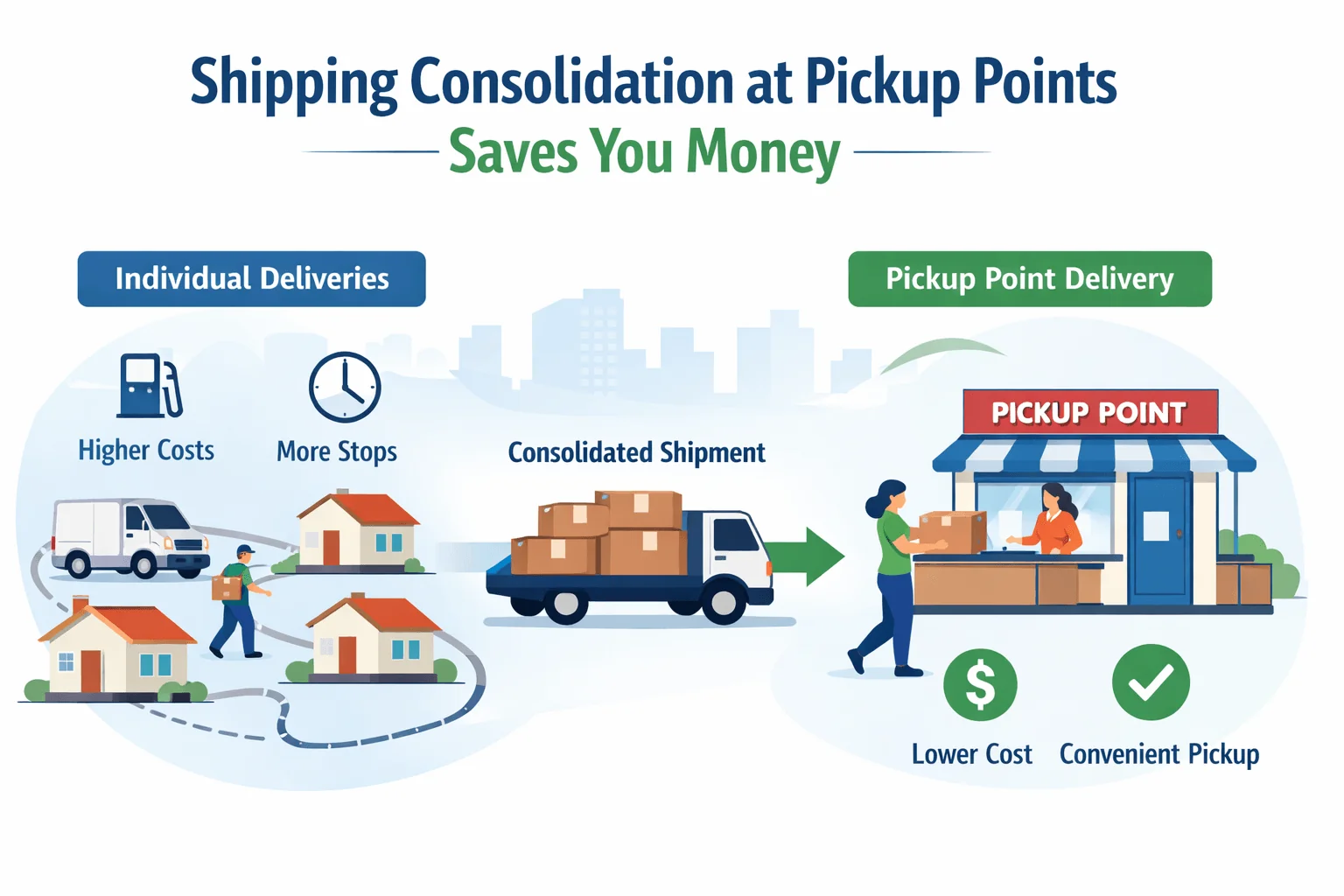
Shipping consolidation at pickup points offers a practical way to reduce these inefficiencies without removing delivery options entirely. Instead of sending each parcel to a separate address, shipments are grouped and delivered to a shared location where customers can collect them.
The most expensive part of delivery is usually the last mile. Each individual drop-off requires time, fuel, and coordination. When multiplied across dozens or hundreds of orders, the inefficiencies become difficult to ignore.
Shipping consolidation at pickup points offers a practical way to reduce these inefficiencies without removing delivery options entirely. Instead of sending each parcel to a separate address, shipments are grouped and delivered to a shared location where customers can collect them.
What shipping consolidation actually means
Shipping consolidation is the process of combining multiple parcels into a single delivery flow. Instead of handling each shipment independently, orders heading to the same area are grouped together.
When this model is paired with pickup points, the process becomes more efficient. Parcels are bundled, transported together, and delivered to one location rather than many separate addresses. Customers then collect their items at a time that works for them.
This approach reduces the number of delivery stops, simplifies routes, and lowers overall handling costs. It works especially well in areas where many customers are located close to one another.
When this model is paired with pickup points, the process becomes more efficient. Parcels are bundled, transported together, and delivered to one location rather than many separate addresses. Customers then collect their items at a time that works for them.
This approach reduces the number of delivery stops, simplifies routes, and lowers overall handling costs. It works especially well in areas where many customers are located close to one another.
Why pickup points change the cost structure
Traditional home delivery is built around individual convenience, but it requires a large number of separate stops. Each stop involves navigation, time spent locating the address, and sometimes waiting for the recipient.
Pickup points remove much of this complexity. A driver can deliver many parcels to a single location in one trip, which significantly reduces time and fuel usage. The impact becomes clearer when comparing the two approaches.
Pickup points remove much of this complexity. A driver can deliver many parcels to a single location in one trip, which significantly reduces time and fuel usage. The impact becomes clearer when comparing the two approaches.
Cost comparison: home delivery vs pickup points
| Factor | Home Delivery | Pickup Point Delivery |
|---|---|---|
| Number of stops | One per order | One per group of orders |
| Delivery attempts | May require multiple attempts | Usually one successful drop-off |
| Fuel consumption | Higher due to scattered routes | Lower due to centralized delivery |
| Time per parcel | High | Lower |
| Risk of missed delivery | Common | Rare |
| Operational complexity | High | More controlled |
This comparison shows how consolidation directly reduces costs by removing repeated actions and unnecessary travel.
How consolidation saves money step by step
Understanding the process helps explain where the savings come from. Each stage removes small inefficiencies that add up over time.
Step 1: Orders are grouped by location
Incoming orders are sorted based on their destination. Orders going to the same area are flagged for consolidation.
Step 2: Parcels are combined into larger shipments
Instead of being dispatched separately, parcels are packed together. This reduces handling and simplifies logistics at sorting centers.
Step 3: Bulk transportation to a local hub
Grouped shipments are transported together, reducing the number of individual transport movements.
Step 4: Delivery to a pickup point
A single delivery is made to a pickup location instead of multiple home deliveries. This is where most of the savings occur.
Step 5: Customer collection
Customers receive a notification and collect their parcels at their convenience. This removes the need for delivery scheduling or repeat visits.
Step 1: Orders are grouped by location
Incoming orders are sorted based on their destination. Orders going to the same area are flagged for consolidation.
Step 2: Parcels are combined into larger shipments
Instead of being dispatched separately, parcels are packed together. This reduces handling and simplifies logistics at sorting centers.
Step 3: Bulk transportation to a local hub
Grouped shipments are transported together, reducing the number of individual transport movements.
Step 4: Delivery to a pickup point
A single delivery is made to a pickup location instead of multiple home deliveries. This is where most of the savings occur.
Step 5: Customer collection
Customers receive a notification and collect their parcels at their convenience. This removes the need for delivery scheduling or repeat visits.
A simple example of cost difference
Consider a scenario where 30 orders are heading to the same neighborhood. With home delivery, each parcel requires a separate stop, and some deliveries may fail if customers are not available.
With a pickup point model, all 30 parcels are delivered in one trip. The driver makes a single stop, and there is no need to return for missed deliveries. Even without exact figures, the reduction in time, fuel, and labor is easy to see.
With a pickup point model, all 30 parcels are delivered in one trip. The driver makes a single stop, and there is no need to return for missed deliveries. Even without exact figures, the reduction in time, fuel, and labor is easy to see.
When consolidation works best
Shipping consolidation is most effective in certain conditions. It is not necessary for every shipment, but it can deliver strong results when used in the right context.
Areas with high customer density benefit the most because many orders can be grouped together. Non-urgent deliveries are also a good fit, as customers are more open to flexible pickup times.
E-commerce brands with steady order volume can build consistent consolidation flows. Repeat customers are often more willing to adopt pickup habits, especially if the process is simple and predictable.
Areas with high customer density benefit the most because many orders can be grouped together. Non-urgent deliveries are also a good fit, as customers are more open to flexible pickup times.
E-commerce brands with steady order volume can build consistent consolidation flows. Repeat customers are often more willing to adopt pickup habits, especially if the process is simple and predictable.
Common mistakes that reduce savings
While the model is straightforward, a few common mistakes can reduce its effectiveness.
Choosing inconvenient pickup locations can discourage customers from using the option. Locations should be easy to access and part of everyday routines.
Poor communication is another issue. Customers need clear instructions on how pickup works, including notifications and collection steps.
Ignoring customer preferences can also limit adoption. Some customers will still prefer home delivery, so offering a choice is important.
Choosing inconvenient pickup locations can discourage customers from using the option. Locations should be easy to access and part of everyday routines.
Poor communication is another issue. Customers need clear instructions on how pickup works, including notifications and collection steps.
Ignoring customer preferences can also limit adoption. Some customers will still prefer home delivery, so offering a choice is important.
Quick checks before using consolidation
Before introducing shipping consolidation, it helps to review a few practical points.
If these conditions are in place, consolidation is likely to deliver measurable benefits.
- Your customers are open to flexible delivery options
- You can partner with accessible pickup locations
- Your order volume supports grouping shipments
- You can communicate the process clearly
If these conditions are in place, consolidation is likely to deliver measurable benefits.
The customer perspective
Cost savings matter, but customers also care about convenience. Pickup points offer a different kind of flexibility.
Customers do not need to wait at home for deliveries or worry about missing a parcel. They can collect their items at a time that fits their schedule, often as part of an existing routine.
For some people, this is more practical than home delivery. However, it works best when offered as an option rather than a requirement.
Customers do not need to wait at home for deliveries or worry about missing a parcel. They can collect their items at a time that fits their schedule, often as part of an existing routine.
For some people, this is more practical than home delivery. However, it works best when offered as an option rather than a requirement.
Where Via.Delivery fits into this model
Implementing shipping consolidation requires coordination between order management, logistics, and customer communication. This is where technology becomes useful.
Via.Delivery provides an IT solution that helps D2C brands offer alternative delivery options, including pickup-based models. It allows businesses to introduce consolidation without needing to build a system from scratch.
Rather than replacing existing delivery methods, this approach can work alongside them. Businesses can continue offering home delivery while adding pickup options for customers who prefer them.
Via.Delivery provides an IT solution that helps D2C brands offer alternative delivery options, including pickup-based models. It allows businesses to introduce consolidation without needing to build a system from scratch.
Rather than replacing existing delivery methods, this approach can work alongside them. Businesses can continue offering home delivery while adding pickup options for customers who prefer them.
Balancing cost and convenience
There is always a balance between cost and convenience. Home delivery offers direct service but at a higher cost. Pickup points reduce costs but require customers to travel a short distance.
Many customers are willing to accept this trade-off if the pickup location is nearby and easy to access. The goal is to provide options so customers can choose what works best for them.
Many customers are willing to accept this trade-off if the pickup location is nearby and easy to access. The goal is to provide options so customers can choose what works best for them.
How businesses can introduce consolidation gradually
A gradual rollout is often the most practical approach. Starting small allows businesses to test the model and adjust based on real feedback.
Begin with one region that has a high concentration of orders. Offer pickup as an optional delivery method rather than making it mandatory.
Track how often customers choose the option and compare delivery costs. Use this data to refine the approach and expand to other areas if it proves effective.
Begin with one region that has a high concentration of orders. Offer pickup as an optional delivery method rather than making it mandatory.
Track how often customers choose the option and compare delivery costs. Use this data to refine the approach and expand to other areas if it proves effective.
FAQ
Do customers actually use pickup points?
Yes, especially when the locations are convenient and the process is simple. Adoption tends to grow over time as customers become familiar with the option.
Can small businesses benefit from this model?
Small businesses can benefit if they have consistent order volume in specific areas. Even partial use of consolidation can reduce costs.
Is it possible to offer both home delivery and pickup?
Yes, and this is often the best approach. Offering both options allows customers to choose based on their preferences.