





Third-Party Pickup Networks to Compete with Amazon Prime
Key takeaways
- Competing with Amazon Prime is less about speed alone and more about delivery flexibility and cost control.
- Third-party pickup networks reduce last-mile costs by consolidating deliveries.
- Customers are increasingly open to alternatives if they are convenient and predictable.
- Brands can improve margins without removing fast delivery options.
- A mix of delivery methods often works better than relying on home delivery alone.
Share:
The real challenge behind competing with Amazon
Many brands assume that competing with Amazon Prime means matching two-day or same-day delivery at any cost. That assumption often leads to rising logistics expenses and shrinking margins over time. What looks like a customer-friendly strategy can quickly become financially unsustainable.
Amazon’s advantage is not just speed. It is the combination of dense delivery networks, high order volume, and tightly controlled logistics operations that most brands cannot replicate. Trying to mirror that model directly usually results in inefficiencies rather than gains.
This is where many businesses start losing ground. The focus shifts almost entirely to speed, while efficiency and cost structure receive less attention. A more sustainable approach is to rethink how deliveries are completed instead of copying the same model.
Amazon’s advantage is not just speed. It is the combination of dense delivery networks, high order volume, and tightly controlled logistics operations that most brands cannot replicate. Trying to mirror that model directly usually results in inefficiencies rather than gains.
This is where many businesses start losing ground. The focus shifts almost entirely to speed, while efficiency and cost structure receive less attention. A more sustainable approach is to rethink how deliveries are completed instead of copying the same model.
What third-party pickup networks actually are
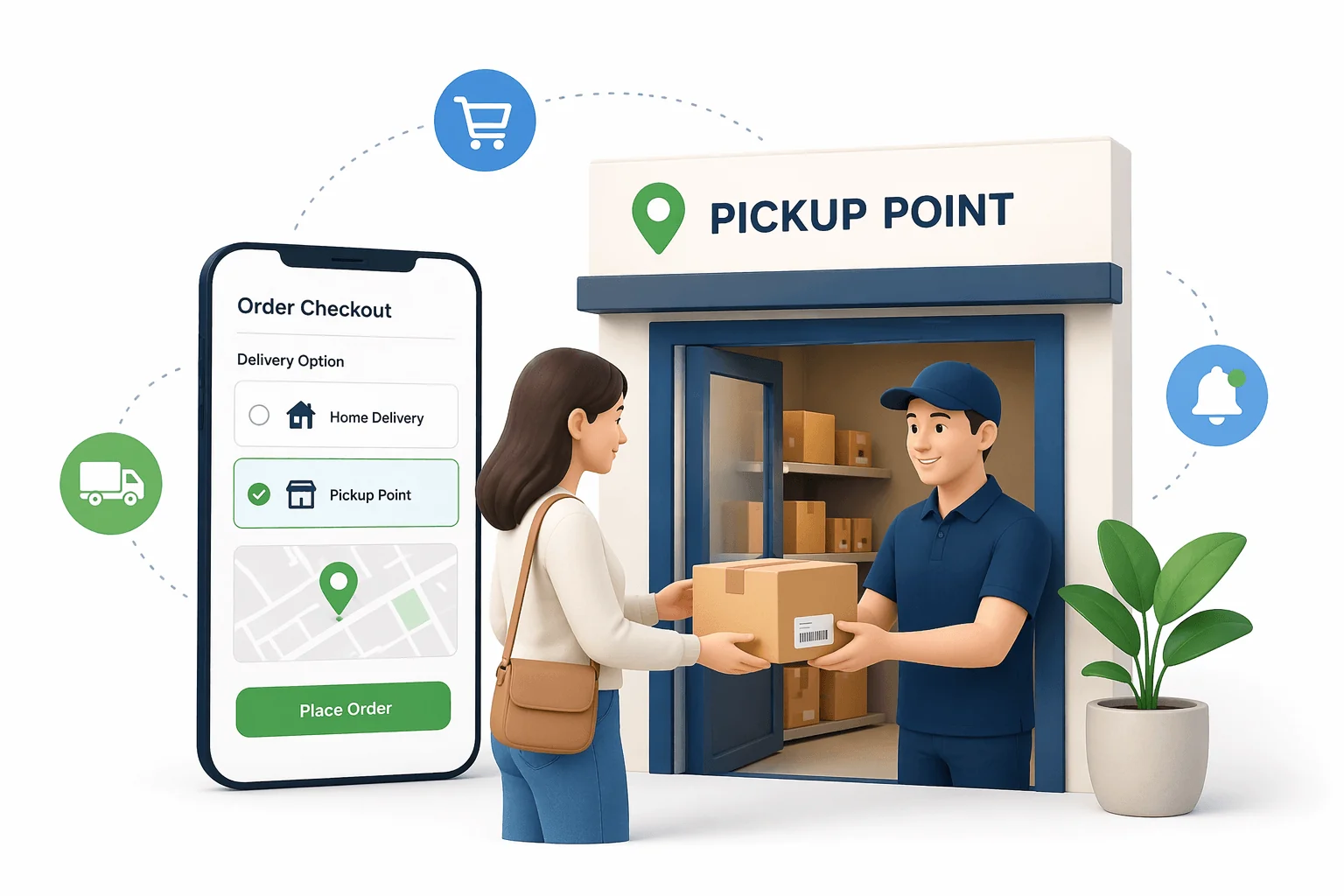
Third-party pickup networks are systems of locations where customers can collect their orders instead of receiving them at home. These locations are usually integrated into existing infrastructure, such as retail stores, lockers, or partner businesses. The idea is to bring multiple deliveries into a single point rather than spreading them across many addresses.
Instead of delivering each package to an individual home, carriers deliver many packages to one pickup location. Customers then collect their orders at a time that works for them, which removes the need for precise delivery windows. This creates a different flow in the last mile.
The shift may seem small, but it changes the entire cost structure of delivery. Fewer stops and better route planning allow carriers to operate more efficiently. As a result, the model becomes easier to scale without increasing costs at the same rate.
Instead of delivering each package to an individual home, carriers deliver many packages to one pickup location. Customers then collect their orders at a time that works for them, which removes the need for precise delivery windows. This creates a different flow in the last mile.
The shift may seem small, but it changes the entire cost structure of delivery. Fewer stops and better route planning allow carriers to operate more efficiently. As a result, the model becomes easier to scale without increasing costs at the same rate.
Why this model changes the cost equation
The biggest shift with pickup networks is how delivery density improves. When multiple packages are delivered to a single location, the cost of travel and time is spread across many orders. This makes each delivery more efficient without reducing service quality.
Fewer stops, more packages per stop
Drivers no longer need to visit dozens of individual homes. Instead, they can deliver a large number of packages in one stop, which significantly reduces travel distance per package. Over time, this leads to noticeable savings in fuel and labor.
The impact becomes clearer at scale. Even a small shift in delivery patterns can reduce the total number of stops required across all routes. This improves overall efficiency without requiring major operational changes.
The impact becomes clearer at scale. Even a small shift in delivery patterns can reduce the total number of stops required across all routes. This improves overall efficiency without requiring major operational changes.
Reduced failed deliveries
Missed deliveries are a common issue in residential shipping. When customers are not home, packages may need to be redelivered or rerouted, which increases both cost and complexity.
Pickup networks reduce this problem by delivering to staffed locations or secure lockers. Packages are received once and stored until the customer collects them. This removes the need for repeated delivery attempts.
Pickup networks reduce this problem by delivering to staffed locations or secure lockers. Packages are received once and stored until the customer collects them. This removes the need for repeated delivery attempts.
Better route planning
Because pickup locations are fixed, routes can be planned more consistently. Drivers follow predictable paths instead of adapting to scattered residential addresses. This reduces unnecessary detours and improves time management.
Better planning also helps carriers balance workloads across different routes. Instead of reacting to daily fluctuations, they can build more stable delivery patterns. This consistency contributes to long-term cost control.
Better planning also helps carriers balance workloads across different routes. Instead of reacting to daily fluctuations, they can build more stable delivery patterns. This consistency contributes to long-term cost control.
Lower cost per package
All of these factors combine to lower the cost of each delivery. Fuel usage decreases, delivery time becomes more efficient, and failed attempts are minimized. The result is a more stable and predictable cost structure.
This is where pickup networks help brands compete. They provide a way to improve efficiency without needing the same scale as large logistics operators.
This is where pickup networks help brands compete. They provide a way to improve efficiency without needing the same scale as large logistics operators.
Comparing home delivery and pickup networks
| Factor | Home Delivery | Pickup Network |
|---|---|---|
| Stops per route | High | Lower |
| Packages per stop | Low | High |
| Delivery success rate | Variable | High |
| Route predictability | Low | High |
| Cost per package | Higher | Lower |
| Customer control | Moderate | High |
This comparison shows that pickup networks shift the balance from convenience alone to a mix of convenience and efficiency. Instead of focusing only on speed, they introduce flexibility and cost awareness into the delivery process.
What customers actually care about
It is easy to assume that customers only want the fastest delivery possible. In reality, their expectations are more balanced and depend on reliability, convenience, and clarity. Speed is important, but it is not the only factor.
Reliability over speed
Customers often prefer knowing exactly when and where they can collect their package. A reliable pickup location can feel more predictable than waiting for a delivery window at home. This reduces uncertainty and improves satisfaction.
Consistency matters more than occasional speed. When customers trust the process, they are more likely to use it again.
Consistency matters more than occasional speed. When customers trust the process, they are more likely to use it again.
Flexibility in timing
Pickup networks allow customers to collect orders when it suits their schedule. This is especially helpful for people who are not at home during delivery hours. Instead of adjusting their day around a delivery, they can choose a convenient time.
This flexibility can improve the overall experience. It gives customers more control without adding complexity to the process.
This flexibility can improve the overall experience. It gives customers more control without adding complexity to the process.
Security
Packages left at the door can be lost, damaged, or stolen. This is a common concern in residential delivery, especially in urban areas. Pickup locations reduce this risk by keeping items in a controlled environment.
Customers know their order will be stored safely until they collect it. This adds a layer of trust to the delivery experience.
Customers know their order will be stored safely until they collect it. This adds a layer of trust to the delivery experience.
Clear communication
Customers are more open to alternative delivery methods when the process is clearly explained. They need to understand where to go, how pickup works, and what to expect.
When communication is simple and consistent, adoption becomes easier. Confusion, on the other hand, can discourage use even if the option is beneficial.
When communication is simple and consistent, adoption becomes easier. Confusion, on the other hand, can discourage use even if the option is beneficial.
Where brands often go wrong
Adopting pickup networks requires more than just adding a new option at checkout. Without proper planning, the benefits may not materialize.
Treating it as a secondary feature
If pickup is hidden or difficult to find, customers will default to home delivery. The option needs to be visible and easy to select early in the buying process.
Positioning matters. When presented clearly, pickup becomes a practical choice rather than an afterthought.
Positioning matters. When presented clearly, pickup becomes a practical choice rather than an afterthought.
Not explaining the benefit
Customers need a reason to choose pickup. If the benefit is not clear, they may assume it is less convenient than home delivery.
Simple messaging can make a difference. Explaining flexibility, reliability, or faster availability can encourage adoption.
Simple messaging can make a difference. Explaining flexibility, reliability, or faster availability can encourage adoption.
Ignoring operational alignment
Adding pickup without adjusting fulfillment processes can create inefficiencies. Orders may be delayed or routed incorrectly if systems are not aligned.
Operational clarity is important. Teams need to understand how pickup orders differ from standard deliveries.
Operational clarity is important. Teams need to understand how pickup orders differ from standard deliveries.
Expecting immediate adoption
Customer behavior does not change overnight. It takes time for people to try a new delivery method and build trust in it.
Testing and gradual rollout help manage expectations. Over time, adoption tends to grow as customers become familiar with the option.
Testing and gradual rollout help manage expectations. Over time, adoption tends to grow as customers become familiar with the option.
How pickup networks support competitive delivery
Pickup networks do not replace home delivery. Instead, they create a more balanced and flexible system that improves overall performance.
Reducing pressure on residential delivery
By shifting some orders to pickup locations, brands can reduce the number of residential stops. This improves efficiency across the entire delivery network.
With fewer scattered deliveries, carriers can focus resources more effectively. This leads to better overall performance.
With fewer scattered deliveries, carriers can focus resources more effectively. This leads to better overall performance.
Offering choice without increasing cost
Customers can choose between home delivery and pickup based on their preferences. This flexibility improves the experience without adding unnecessary cost.
When options are clear, customers can select what works best for them. This reduces friction in the buying process.
When options are clear, customers can select what works best for them. This reduces friction in the buying process.
How technology supports pickup networks
Managing pickup networks involves coordination between carriers, locations, and customers. Without the right systems, this coordination can become difficult.
Order routing
Orders need to be directed to the correct pickup location based on customer choice. This requires systems that can handle routing logic and availability in real time.
Via.Delivery integrates with major OMS platforms to support real-time order routing and ensure orders are sent to the right pickup location.
Via.Delivery integrates with major OMS platforms to support real-time order routing and ensure orders are sent to the right pickup location.
Integration with checkout
Pickup options must be easy to select during checkout. If the process is complicated, customers are less likely to choose it.
That’s why Via.Delivery offers plugins and APIs that integrate with retailers’ checkout systems, making pickup options clearly visible and easy for shoppers to select.
That’s why Via.Delivery offers plugins and APIs that integrate with retailers’ checkout systems, making pickup options clearly visible and easy for shoppers to select.
Tracking and notifications
Customers expect updates similar to home delivery tracking. Notifications about order status and pickup readiness keep the experience consistent.
Via.Delivery provides communication tools that help brands keep customers informed with real-time updates on their orders.
Via.Delivery provides communication tools that help brands keep customers informed with real-time updates on their orders.
FAQ
What are third-party pickup networks?
They are systems of locations where customers can collect their orders instead of receiving them at home. These locations are managed by external partners and integrated into the delivery process. They help consolidate deliveries and improve efficiency.
Do customers actually use pickup options?
Yes, especially when locations are convenient and the process is clearly explained. Adoption tends to increase over time as customers become familiar with the option. Trust and reliability play a big role in this shift.
Are pickup networks cheaper than home delivery?
In many cases, they are more cost-efficient. Consolidating deliveries reduces fuel usage and improves route efficiency. This lowers the cost per package compared to residential delivery.
Can pickup networks replace home delivery?
No, they are best used as an additional option. Home delivery remains important for many customers. A mix of both approaches usually works best.
How do pickup networks help compete with Amazon Prime?
They improve efficiency and reduce costs, allowing brands to offer competitive delivery options. Instead of matching speed at any cost, they focus on balance and sustainability. This creates a more stable and scalable delivery strategy.
Not ready for a call?
Get the Via.Delivery Shipping Brief: short reads on carrier fees, holiday cutoffs and pickup options for online stores and wineries, twice a month.
No spam. Unsubscribe anytime.