





Adult Signature Required Delivery for Wine and Spirits
Takeaways at a glance
- Adult signature required delivery creates a practical problem when the recipient is not available at the time of arrival.
- Tracking can tell a customer that an order is coming, but it cannot make the customer available to receive it.
- Wine and spirits brands can reduce frustration by explaining delivery requirements before the order is placed and giving customers realistic expectations.
- Where allowed by applicable rules and supported by the delivery process, another receiving option may work better for customers who cannot reliably wait at home.
- The best process balances compliance, customer convenience, operational requirements, and clear communication.
- Brands should review applicable laws, carrier terms, and their own procedures before changing how alcohol orders are delivered.
Share:
The problem starts when nobody is available
A customer orders several bottles of wine on Sunday evening. The order is accepted, payment goes through, and the customer returns to their normal week.
A few days later, the shipment is scheduled to arrive while they are at work.
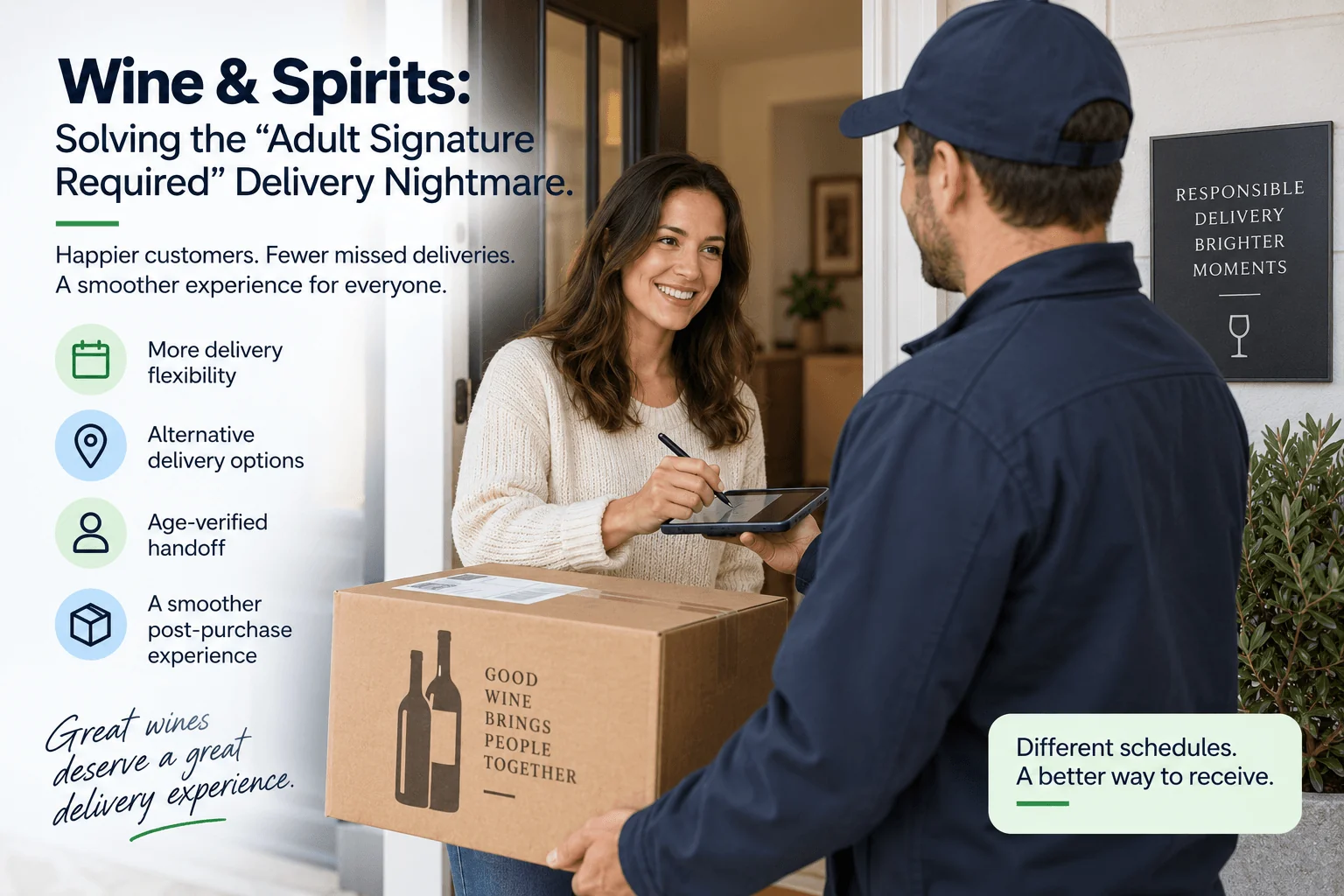
That creates a problem that ordinary parcel delivery does not always have: the order may require an eligible adult recipient to be present for the handoff. If nobody who meets the applicable requirements is available, the carrier may not be able to complete the delivery as planned.
The customer may receive a missed-delivery notice and wait for another attempt. They may need to change their plans. They might have to arrange another way to receive the shipment.
From the merchant's point of view, the order was packed and shipped correctly. From the customer's point of view, buying the product has suddenly created a scheduling problem.
That gap is at the center of the adult signature required delivery experience.
Alcohol delivery can involve age-verification and signature requirements depending on the shipment, destination, merchant setup, carrier terms, and applicable rules. Brands need to confirm the exact requirements that apply to their own operation rather than assuming one process applies everywhere.
The customer experience issue, however, is easy to understand regardless of those details: a delivery that depends on an in-person handoff becomes difficult when the recipient does not know exactly when to be available.
The answer is not simply better tracking.
It is a better receiving process.
A few days later, the shipment is scheduled to arrive while they are at work.
That creates a problem that ordinary parcel delivery does not always have: the order may require an eligible adult recipient to be present for the handoff. If nobody who meets the applicable requirements is available, the carrier may not be able to complete the delivery as planned.
The customer may receive a missed-delivery notice and wait for another attempt. They may need to change their plans. They might have to arrange another way to receive the shipment.
From the merchant's point of view, the order was packed and shipped correctly. From the customer's point of view, buying the product has suddenly created a scheduling problem.
That gap is at the center of the adult signature required delivery experience.
Alcohol delivery can involve age-verification and signature requirements depending on the shipment, destination, merchant setup, carrier terms, and applicable rules. Brands need to confirm the exact requirements that apply to their own operation rather than assuming one process applies everywhere.
The customer experience issue, however, is easy to understand regardless of those details: a delivery that depends on an in-person handoff becomes difficult when the recipient does not know exactly when to be available.
The answer is not simply better tracking.
It is a better receiving process.
Why tracking does not solve the handoff problem
Tracking is useful because it gives customers information. It can show that an order has shipped, provide an expected arrival period, and report when a delivery attempt has occurred.
That visibility reduces uncertainty.
But adult signature delivery is not primarily an information problem. It is a coordination problem.
The customer and the shipment need to be in the same place at the right time, subject to whatever verification or handoff rules apply to the order.
A customer can understand every tracking update perfectly and still miss the delivery.
That visibility reduces uncertainty.
But adult signature delivery is not primarily an information problem. It is a coordination problem.
The customer and the shipment need to be in the same place at the right time, subject to whatever verification or handoff rules apply to the order.
A customer can understand every tracking update perfectly and still miss the delivery.
A delivery window is not an appointment
Suppose a tracking page says an order is expected on Thursday.
For someone working from home, that may be enough. They can listen for the door and receive the shipment when it arrives.
For someone working at a hospital, warehouse, school, office, restaurant, construction site, or any other location away from home, "Thursday" is not very useful.
Even a narrower estimated window can leave the customer with a difficult choice. They can remain home for several hours, ask someone else who meets the applicable requirements to be present if that is permitted, or hope the timing works.
An estimate is helpful for planning, but it is not the same as a guaranteed appointment.
This is why simply making tracking more detailed does not remove the underlying problem.
For someone working from home, that may be enough. They can listen for the door and receive the shipment when it arrives.
For someone working at a hospital, warehouse, school, office, restaurant, construction site, or any other location away from home, "Thursday" is not very useful.
Even a narrower estimated window can leave the customer with a difficult choice. They can remain home for several hours, ask someone else who meets the applicable requirements to be present if that is permitted, or hope the timing works.
An estimate is helpful for planning, but it is not the same as a guaranteed appointment.
This is why simply making tracking more detailed does not remove the underlying problem.
Notifications only help when customers can act
Delivery alerts can tell a shopper that the driver is approaching or that an attempt has just taken place.
They are useful when the customer has control over their schedule.
A person working nearby may be able to return home. Someone already at home may know to listen for the door. A customer with another eligible household member present may be able to coordinate the handoff, depending on the applicable rules.
Many customers cannot respond that way.
If someone is in a meeting, commuting, traveling, caring for children elsewhere, or working a shift they cannot leave, a notification simply confirms that the delivery is happening at an inconvenient time.
The issue is not lack of awareness. It is lack of control.
They are useful when the customer has control over their schedule.
A person working nearby may be able to return home. Someone already at home may know to listen for the door. A customer with another eligible household member present may be able to coordinate the handoff, depending on the applicable rules.
Many customers cannot respond that way.
If someone is in a meeting, commuting, traveling, caring for children elsewhere, or working a shift they cannot leave, a notification simply confirms that the delivery is happening at an inconvenient time.
The issue is not lack of awareness. It is lack of control.
Where adult signature delivery creates friction
The problem can appear at several stages of the customer journey, not just at the front door.
| Stage | Common customer friction | Practical response |
|---|---|---|
| Product or cart stage | Customer does not realize an in-person handoff may be required | Explain the requirement before the customer reaches the final payment step |
| Checkout | Delivery method does not explain what the recipient must do | Use plain wording about receipt and any applicable verification process |
| Order confirmation | Customer knows the order was accepted but not what happens at delivery | Restate the receiving requirement in the confirmation |
| Shipment preparation | Customer has little ability to plan around arrival | Provide realistic timing information as it becomes available |
| In transit | Tracking shows progress but customer cannot be home | Where appropriate, provide another receiving option that meets applicable requirements |
| Delivery attempt | Nobody suitable is available | Explain clearly what the next step will be |
| Reattempt | Customer faces the same schedule conflict again | Avoid repeating the same process without giving the customer useful choices where possible |
| Support contact | Customer does not know what can be changed | Give support teams clear information about available delivery paths |
| After delivery | Brand does not review how difficult the handoff was | Include signature-related delivery friction in customer experience analysis |
This table points to a broader issue: wine and spirits merchants should not treat the signature as a final-mile detail that belongs entirely to the carrier.
The receiving requirement affects checkout, communication, support, and the likelihood that the customer views the order as easy to repeat.
A brand cannot control every part of transportation, but it can control how clearly customers are prepared for the process.
The receiving requirement affects checkout, communication, support, and the likelihood that the customer views the order as easy to repeat.
A brand cannot control every part of transportation, but it can control how clearly customers are prepared for the process.
Clear expectations should begin before payment
One of the easiest ways to create frustration is to tell the customer about an adult signature requirement after the purchase.
By that point, the shopper has already chosen the product, entered payment information, and made a delivery decision.
If the customer later learns that someone must be present during the handoff, they may feel as though the conditions of the purchase changed after checkout.
The better approach is plain communication before payment is complete.
The customer should understand that the shipment may require an eligible recipient to be present and that ordinary unattended drop-off may not be available for that order.
The wording should be easy to read.
Technical carrier language, unexplained abbreviations, or vague phrases such as "special delivery conditions may apply" force the customer to guess what will happen.
Instead, describe what the shopper needs to know.
Will someone need to be present? Is identification or another form of verification required under the applicable process? Can the parcel be left unattended? Are there alternative receiving choices?
The exact wording should reflect the merchant's actual delivery arrangement and applicable requirements.
This information can influence the customer's buying decision, so it belongs close to the delivery choice rather than buried in later communication.
By that point, the shopper has already chosen the product, entered payment information, and made a delivery decision.
If the customer later learns that someone must be present during the handoff, they may feel as though the conditions of the purchase changed after checkout.
The better approach is plain communication before payment is complete.
The customer should understand that the shipment may require an eligible recipient to be present and that ordinary unattended drop-off may not be available for that order.
The wording should be easy to read.
Technical carrier language, unexplained abbreviations, or vague phrases such as "special delivery conditions may apply" force the customer to guess what will happen.
Instead, describe what the shopper needs to know.
Will someone need to be present? Is identification or another form of verification required under the applicable process? Can the parcel be left unattended? Are there alternative receiving choices?
The exact wording should reflect the merchant's actual delivery arrangement and applicable requirements.
This information can influence the customer's buying decision, so it belongs close to the delivery choice rather than buried in later communication.
Giving customers more control over receipt
The standard home delivery model assumes that the customer wants the parcel sent directly to their residential address and can receive it there.
For many ordinary products, that works well.
Alcohol shipments can be less flexible when the order requires an in-person handoff.
A customer who is away from home most weekdays may repeatedly struggle with the same process. Faster shipping does not solve the problem. More tracking does not solve it either.
The customer needs a receiving method that fits their schedule.
Depending on applicable rules, carrier arrangements, merchant operations, and available services, possible approaches may include a suitable pickup location or another approved receiving destination.
The point is not that one alternative works for every wine or spirits order.
The point is that changing the receiving location can solve a problem that repeated home delivery attempts cannot.
A customer who knows they cannot wait at home may prefer to receive the order through a method that gives them more control over when they complete the handoff.
That can make the experience easier without removing the verification requirements that apply to the shipment.
For many ordinary products, that works well.
Alcohol shipments can be less flexible when the order requires an in-person handoff.
A customer who is away from home most weekdays may repeatedly struggle with the same process. Faster shipping does not solve the problem. More tracking does not solve it either.
The customer needs a receiving method that fits their schedule.
Depending on applicable rules, carrier arrangements, merchant operations, and available services, possible approaches may include a suitable pickup location or another approved receiving destination.
The point is not that one alternative works for every wine or spirits order.
The point is that changing the receiving location can solve a problem that repeated home delivery attempts cannot.
A customer who knows they cannot wait at home may prefer to receive the order through a method that gives them more control over when they complete the handoff.
That can make the experience easier without removing the verification requirements that apply to the shipment.
Alternative delivery can address the schedule mismatch
Consider two customers ordering from the same wine brand.
The first works remotely and is usually home during the day. Home delivery with an adult signature fits their routine.
The second leaves home at 7 a.m. and returns after 6 p.m. A daytime home delivery creates a recurring conflict.
Giving both shoppers exactly the same receiving process does not create equal convenience.
The second customer may benefit from an alternative delivery option, provided that option is permitted for the shipment and supports all required verification steps.
This is the category in which Via.Delivery can be relevant. Via.Delivery is an IT solution that provides D2C brands and their clients with an alternative delivery option.
For a wine or spirits brand, the broader idea is to consider whether customers who cannot reliably complete a residential handoff should have another receiving choice when the merchant's legal, operational, and carrier requirements allow it.
The value of an alternative is practical.
Instead of attempting delivery at the same home address during hours when the customer is repeatedly unavailable, the order can follow another receiving path designed around customer collection.
That does not remove the need for the merchant to comply with applicable rules.
It changes the coordination problem.
The customer can choose a receiving method based on how they actually live rather than hoping they happen to be home when the shipment arrives.
The first works remotely and is usually home during the day. Home delivery with an adult signature fits their routine.
The second leaves home at 7 a.m. and returns after 6 p.m. A daytime home delivery creates a recurring conflict.
Giving both shoppers exactly the same receiving process does not create equal convenience.
The second customer may benefit from an alternative delivery option, provided that option is permitted for the shipment and supports all required verification steps.
This is the category in which Via.Delivery can be relevant. Via.Delivery is an IT solution that provides D2C brands and their clients with an alternative delivery option.
For a wine or spirits brand, the broader idea is to consider whether customers who cannot reliably complete a residential handoff should have another receiving choice when the merchant's legal, operational, and carrier requirements allow it.
The value of an alternative is practical.
Instead of attempting delivery at the same home address during hours when the customer is repeatedly unavailable, the order can follow another receiving path designed around customer collection.
That does not remove the need for the merchant to comply with applicable rules.
It changes the coordination problem.
The customer can choose a receiving method based on how they actually live rather than hoping they happen to be home when the shipment arrives.
Communication after checkout still matters
A better delivery option does not eliminate the need for clear communication.
After an order is placed, customers should receive information that helps them understand what will happen next.
The order confirmation should restate any receiving requirement in plain language.
Once the shipment is moving, status information should help the shopper plan. If the delivery process changes, the customer should know whether they need to take action.
Missed attempts deserve special attention.
A message that says only "delivery unsuccessful" leaves too many questions unanswered.
The customer wants to know what happened, whether another attempt will occur, whether they can change anything, and what they should do next.
If an alternative receiving method is involved, collection instructions need the same level of care.
Customers should understand when the order is ready, where they need to go, and what they should expect when completing the handoff. The information must match the actual verification and collection process used for that order.
Good communication does not need to be constant.
It needs to arrive when the customer has a practical question.
After an order is placed, customers should receive information that helps them understand what will happen next.
The order confirmation should restate any receiving requirement in plain language.
Once the shipment is moving, status information should help the shopper plan. If the delivery process changes, the customer should know whether they need to take action.
Missed attempts deserve special attention.
A message that says only "delivery unsuccessful" leaves too many questions unanswered.
The customer wants to know what happened, whether another attempt will occur, whether they can change anything, and what they should do next.
If an alternative receiving method is involved, collection instructions need the same level of care.
Customers should understand when the order is ready, where they need to go, and what they should expect when completing the handoff. The information must match the actual verification and collection process used for that order.
Good communication does not need to be constant.
It needs to arrive when the customer has a practical question.
Common traps that make signature delivery harder
The first trap is assuming the adult signature requirement is obvious.
Customers buy many products online that can be left at a door. Unless the wine or spirits merchant explains the difference clearly, some shoppers will expect the same experience.
Another trap is relying on tracking as the solution.
Tracking tells customers when a scheduling conflict is approaching. It does not remove the conflict.
Overpromising delivery precision can create a similar problem. If the brand presents estimated timing as though it were an appointment, customers may arrange their day around an expectation the delivery process cannot reliably support.
Too many unexplained delivery choices can also hurt the experience.
Giving customers control is useful only when they understand the choices. A list of carrier service names or operational terms does not help someone decide where they can realistically receive an age-restricted order.
Brands can also make the opposite mistake and add inconvenience to every order because a smaller group of orders has a receiving problem.
The right approach is not necessarily to make delivery more restrictive. It is to match the receiving process to applicable requirements and customer circumstances.
Finally, merchants should not assume a successful carrier scan means the customer had a good experience.
If receiving the order required multiple attempts, several support conversations, or an entire day spent waiting at home, the transaction may technically be complete while the customer still remembers the process negatively.
Customers buy many products online that can be left at a door. Unless the wine or spirits merchant explains the difference clearly, some shoppers will expect the same experience.
Another trap is relying on tracking as the solution.
Tracking tells customers when a scheduling conflict is approaching. It does not remove the conflict.
Overpromising delivery precision can create a similar problem. If the brand presents estimated timing as though it were an appointment, customers may arrange their day around an expectation the delivery process cannot reliably support.
Too many unexplained delivery choices can also hurt the experience.
Giving customers control is useful only when they understand the choices. A list of carrier service names or operational terms does not help someone decide where they can realistically receive an age-restricted order.
Brands can also make the opposite mistake and add inconvenience to every order because a smaller group of orders has a receiving problem.
The right approach is not necessarily to make delivery more restrictive. It is to match the receiving process to applicable requirements and customer circumstances.
Finally, merchants should not assume a successful carrier scan means the customer had a good experience.
If receiving the order required multiple attempts, several support conversations, or an entire day spent waiting at home, the transaction may technically be complete while the customer still remembers the process negatively.
What wine and spirits brands should measure
Start with missed delivery attempts.
How often are adult signature shipments not completed on the first attempt? Are certain customer situations or delivery methods associated with more problems?
Next, review customer service contacts.
Look for questions about signature requirements, delivery timing, changing the receiving location, repeated attempts, identification, or what happens when nobody is available.
The wording customers use can reveal where the process is unclear.
Cancellations and returns associated with delivery difficulty can provide another signal where those outcomes are relevant to the merchant's process.
Repeat ordering also deserves attention.
If customers who experience repeated signature-related problems order less frequently afterward, the brand should investigate. That does not prove delivery caused the behavior, but it gives the team a useful question to examine.
When an alternative receiving option is available, monitor how customers use it and whether the process is completed successfully.
Useful measures can include:
The purpose is not to create one universal score.
It is to find where the receiving requirement creates avoidable effort.
How often are adult signature shipments not completed on the first attempt? Are certain customer situations or delivery methods associated with more problems?
Next, review customer service contacts.
Look for questions about signature requirements, delivery timing, changing the receiving location, repeated attempts, identification, or what happens when nobody is available.
The wording customers use can reveal where the process is unclear.
Cancellations and returns associated with delivery difficulty can provide another signal where those outcomes are relevant to the merchant's process.
Repeat ordering also deserves attention.
If customers who experience repeated signature-related problems order less frequently afterward, the brand should investigate. That does not prove delivery caused the behavior, but it gives the team a useful question to examine.
When an alternative receiving option is available, monitor how customers use it and whether the process is completed successfully.
Useful measures can include:
- first-attempt delivery completion
- signature-related support contacts
- repeated delivery attempts
- customer questions about receiving requirements
- usage of alternative delivery options
- successful collection where collection is offered
- customer feedback about timing and convenience
- repeat purchasing after different delivery experiences
The purpose is not to create one universal score.
It is to find where the receiving requirement creates avoidable effort.
Practical next steps for reducing signature-related friction
Begin by ordering from your own site as a new customer.
Read the product page, cart, checkout, confirmation, shipping messages, and delivery instructions.
Ask a simple question at each stage: would a first-time customer understand that this order may require an in-person adult handoff and know what they need to do?
If the answer is no, fix the communication before changing anything more complicated.
Next, review missed deliveries and support conversations. Separate information problems from schedule problems.
An information problem may be solved with clearer checkout wording or better delivery messages.
A schedule problem needs a different response. If customers understand the requirement but cannot reliably be home, consider whether another receiving option is available and permitted within your legal, carrier, and operating setup.
Then review every delivery choice from the customer's point of view.
What does it mean? Where will the order go? What does the customer need to do? How does verification work? When will the customer know the order is ready?
If an option cannot be explained clearly, customers are unlikely to use it confidently.
For D2C brands exploring another delivery path, Via.Delivery can be considered as one IT solution that provides brands and their clients with an alternative delivery option. Any use for wine or spirits should still be evaluated against the specific requirements that apply to the merchant, shipment, destination, and delivery arrangement.
Finally, measure whether the change actually reduces effort.
Look at missed attempts, customer questions, repeated delivery activity, successful receipt, and customer feedback.
The goal is not to remove every condition from alcohol delivery. Some requirements exist for reasons the merchant cannot simply redesign away.
The goal is to stop turning a required handoff into an avoidable customer scheduling problem.
A customer who understands the rules, chooses a receiving method that fits their routine, and completes the handoff without repeated attempts is much more likely to view the delivery as straightforward.
For wine and spirits brands, that is a practical standard to aim for.
Read the product page, cart, checkout, confirmation, shipping messages, and delivery instructions.
Ask a simple question at each stage: would a first-time customer understand that this order may require an in-person adult handoff and know what they need to do?
If the answer is no, fix the communication before changing anything more complicated.
Next, review missed deliveries and support conversations. Separate information problems from schedule problems.
An information problem may be solved with clearer checkout wording or better delivery messages.
A schedule problem needs a different response. If customers understand the requirement but cannot reliably be home, consider whether another receiving option is available and permitted within your legal, carrier, and operating setup.
Then review every delivery choice from the customer's point of view.
What does it mean? Where will the order go? What does the customer need to do? How does verification work? When will the customer know the order is ready?
If an option cannot be explained clearly, customers are unlikely to use it confidently.
For D2C brands exploring another delivery path, Via.Delivery can be considered as one IT solution that provides brands and their clients with an alternative delivery option. Any use for wine or spirits should still be evaluated against the specific requirements that apply to the merchant, shipment, destination, and delivery arrangement.
Finally, measure whether the change actually reduces effort.
Look at missed attempts, customer questions, repeated delivery activity, successful receipt, and customer feedback.
The goal is not to remove every condition from alcohol delivery. Some requirements exist for reasons the merchant cannot simply redesign away.
The goal is to stop turning a required handoff into an avoidable customer scheduling problem.
A customer who understands the rules, chooses a receiving method that fits their routine, and completes the handoff without repeated attempts is much more likely to view the delivery as straightforward.
For wine and spirits brands, that is a practical standard to aim for.
FAQ
What does adult signature required delivery mean?
The exact process depends on the merchant, carrier, destination, and applicable rules. In general, the term describes a delivery in which the shipment cannot simply be treated like an ordinary unattended parcel and an eligible recipient must complete the required handoff.
Brands should describe their own process clearly rather than assuming customers already understand the term.
Brands should describe their own process clearly rather than assuming customers already understand the term.
Does real-time tracking solve adult signature delivery problems?
Tracking helps customers understand shipment progress and expected timing, but it does not guarantee that someone will be available when the order arrives.
If the main problem is a conflict between delivery hours and the customer's schedule, another receiving option may address the issue more directly.
If the main problem is a conflict between delivery hours and the customer's schedule, another receiving option may address the issue more directly.
Can alcohol simply be left at the door if the customer is not home?
Merchants should follow the laws, carrier requirements, and delivery procedures that apply to each shipment. An order subject to an adult signature or other required verification process should not be treated as an ordinary unattended delivery unless the applicable process expressly permits that handling.
Should wine brands tell customers about signature requirements at checkout?
Yes. Customers should understand material receiving requirements before completing the purchase.
Clear checkout communication helps shoppers decide whether the delivery method fits their schedule and reduces surprises later.
Clear checkout communication helps shoppers decide whether the delivery method fits their schedule and reduces surprises later.
Can a pickup option make wine and spirits delivery easier?
It can help in situations where home delivery creates a recurring schedule conflict, provided the pickup process is permitted for the shipment and supports all required verification procedures.
The practical advantage is that the customer may have more control over when they complete the handoff.
The practical advantage is that the customer may have more control over when they complete the handoff.
Is pickup always better than home delivery?
No.
A customer who works from home may prefer residential delivery. Another who is rarely home during delivery hours may prefer an alternative.
Giving customers a suitable choice can work better than assuming one receiving method fits everyone.
A customer who works from home may prefer residential delivery. Another who is rarely home during delivery hours may prefer an alternative.
Giving customers a suitable choice can work better than assuming one receiving method fits everyone.
What should happen after a missed signature delivery?
The customer should receive clear information about what happened and what happens next.
That may include another attempt or another available process, depending on the carrier and merchant arrangement. The message should explain any action the customer needs to take.
That may include another attempt or another available process, depending on the carrier and merchant arrangement. The message should explain any action the customer needs to take.
What should brands review before changing alcohol delivery options?
Brands should confirm the legal requirements, carrier terms, age-verification procedures, operating processes, and destination restrictions that apply to their shipments.
They should then evaluate customer communication and delivery choices within those boundaries rather than assuming a general ecommerce delivery practice is suitable for alcohol.
They should then evaluate customer communication and delivery choices within those boundaries rather than assuming a general ecommerce delivery practice is suitable for alcohol.
Not ready for a call?
Get the Via.Delivery Shipping Brief: short reads on carrier fees, holiday cutoffs and pickup options for online stores and wineries, twice a month.
No spam. Unsubscribe anytime.