





Lessons from Amazon: How Local Pickup Points Drive Foot Traffic and Community Engagement
Key Takeaways
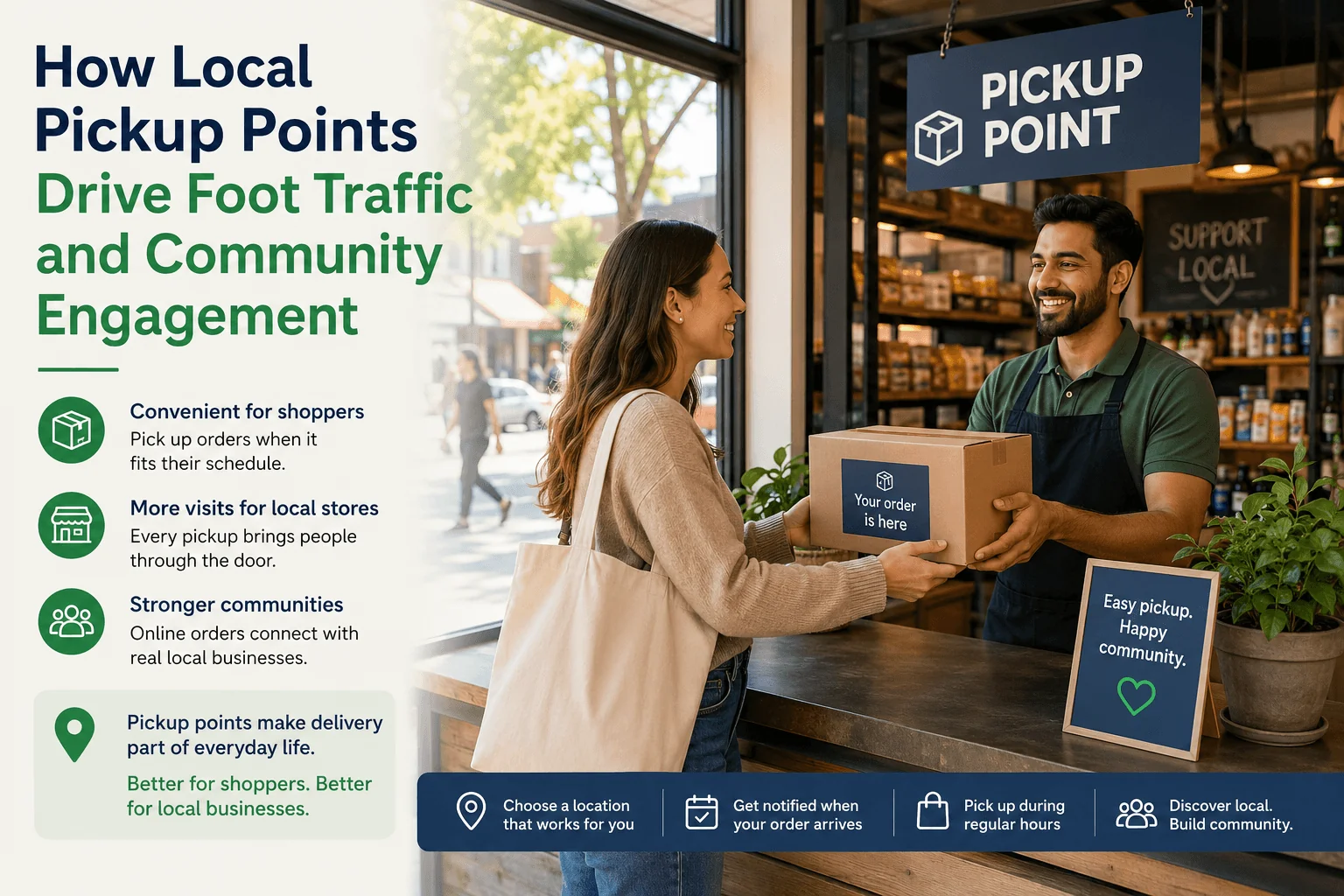
Local pickup points give shoppers a practical alternative to home delivery, especially when they are not home during the day or want a safer place for packages.
For local stores, pickup activity can create extra visits from people who may not have planned to come in otherwise. For e-commerce brands, pickup points can support a better delivery experience without requiring the brand to open its own physical locations.
The value is not only in package handoff. The bigger opportunity is connecting delivery convenience with everyday local shopping habits. The best pickup strategy is simple for customers to understand, easy for store staff to manage, and clear at checkout.
For local stores, pickup activity can create extra visits from people who may not have planned to come in otherwise. For e-commerce brands, pickup points can support a better delivery experience without requiring the brand to open its own physical locations.
The value is not only in package handoff. The bigger opportunity is connecting delivery convenience with everyday local shopping habits. The best pickup strategy is simple for customers to understand, easy for store staff to manage, and clear at checkout.
Share:
The everyday problem with home delivery
Home delivery sounds simple until real life gets involved. People are at work, in school, traveling, or running errands when packages arrive. Some homes do not have a safe porch, lobby, mailroom, or front desk. In many apartment buildings, carriers leave packages in shared spaces where they can be missed, damaged, or taken.
This creates stress for shoppers and support work for merchants. A customer may receive a delivery notification but not find the package. Another customer may need a signature but cannot be home during the delivery window. Some shoppers simply prefer to pick up an order on their own schedule instead of planning their day around a driver.
Local pickup points solve part of this problem by moving the delivery destination from a private home to a nearby commercial location. The customer chooses a participating store, pharmacy, convenience shop, or carrier location and picks up the package when it fits their day. The location becomes a practical stop rather than a special trip.
For the merchant, this can reduce delivery friction. For the pickup location, it can bring more people through the door. That is where the foot traffic and community value begin.
This creates stress for shoppers and support work for merchants. A customer may receive a delivery notification but not find the package. Another customer may need a signature but cannot be home during the delivery window. Some shoppers simply prefer to pick up an order on their own schedule instead of planning their day around a driver.
Local pickup points solve part of this problem by moving the delivery destination from a private home to a nearby commercial location. The customer chooses a participating store, pharmacy, convenience shop, or carrier location and picks up the package when it fits their day. The location becomes a practical stop rather than a special trip.
For the merchant, this can reduce delivery friction. For the pickup location, it can bring more people through the door. That is where the foot traffic and community value begin.
How pickup points turn delivery into store visits
A pickup point is more than a package counter. It is a reason for a shopper to walk into a local business. The person may be there for only one package, but once inside, they may notice products, ask a question, buy a drink, or remember the store for a future visit.
This does not mean every pickup becomes a sale. That would be an unrealistic claim. The point is simpler: pickup activity creates physical visits, and physical visits create chances for local businesses to be seen.
For small stores, visibility matters. A shopper who normally walks past the store may enter for the first time because it is a pickup location. A repeat pickup customer may become familiar with the staff and layout. Over time, the store can become part of the shopper’s routine.
This does not mean every pickup becomes a sale. That would be an unrealistic claim. The point is simpler: pickup activity creates physical visits, and physical visits create chances for local businesses to be seen.
For small stores, visibility matters. A shopper who normally walks past the store may enter for the first time because it is a pickup location. A repeat pickup customer may become familiar with the staff and layout. Over time, the store can become part of the shopper’s routine.
A normal pickup visit
A customer orders from a D2C brand and chooses a nearby pickup point at checkout. A few days later, the customer receives a notification that the package is ready. On the way home, they stop at the store, show their pickup details, collect the order, and leave.
That visit may take only a few minutes. Still, it puts the customer inside the business. If the location sells snacks, personal care items, office supplies, pet products, or other everyday goods, the pickup trip can turn into a small purchase. Even when it does not, the store gains exposure without running a separate advertising campaign.
That visit may take only a few minutes. Still, it puts the customer inside the business. If the location sells snacks, personal care items, office supplies, pet products, or other everyday goods, the pickup trip can turn into a small purchase. Even when it does not, the store gains exposure without running a separate advertising campaign.
What Amazon teaches about pickup behavior
Lessons from Amazon are useful because Amazon has made pickup part of normal shopping behavior for many customers. Amazon Lockers and staffed pickup options show that customers will use out-of-home delivery when it is convenient, clear, and close to where they already go.
The lesson is not that every brand should copy Amazon’s exact model. Most D2C brands do not have the same scale, physical network, or operational control. The useful lesson is that pickup works best when it fits into daily routines. Customers are more likely to use pickup when the location is near home, work, school, transit, or errands they already run.
Amazon also shows that pickup can reduce some common delivery worries. Customers do not need to wonder whether a package will sit outside. They do not need to be home at a specific moment. They can collect the order when they have time.
For merchants, the broader takeaway is that delivery choice can shape customer confidence. When shoppers see a pickup option that feels convenient, they may feel more comfortable completing the order.
The lesson is not that every brand should copy Amazon’s exact model. Most D2C brands do not have the same scale, physical network, or operational control. The useful lesson is that pickup works best when it fits into daily routines. Customers are more likely to use pickup when the location is near home, work, school, transit, or errands they already run.
Amazon also shows that pickup can reduce some common delivery worries. Customers do not need to wonder whether a package will sit outside. They do not need to be home at a specific moment. They can collect the order when they have time.
For merchants, the broader takeaway is that delivery choice can shape customer confidence. When shoppers see a pickup option that feels convenient, they may feel more comfortable completing the order.
The community side of pickup points
Local pickup points can make online shopping feel less disconnected from local life. The purchase may happen on a website, but the final step happens inside a neighborhood business. That creates a small link between e-commerce and the local commercial area.
This can matter for communities where small stores depend on regular foot traffic. A pickup visit gives customers another reason to enter nearby businesses instead of only interacting with packages at their doorstep. It can also help people discover locations they might not have used before.
Community engagement in this context should stay practical. It is not about vague local branding. It is about repeated, ordinary interactions: a customer visiting a nearby shop, staff helping with package pickup, and the location becoming more familiar to people in the area.
This can matter for communities where small stores depend on regular foot traffic. A pickup visit gives customers another reason to enter nearby businesses instead of only interacting with packages at their doorstep. It can also help people discover locations they might not have used before.
Community engagement in this context should stay practical. It is not about vague local branding. It is about repeated, ordinary interactions: a customer visiting a nearby shop, staff helping with package pickup, and the location becoming more familiar to people in the area.
Benefits for e-commerce brands
Pickup points can help brands offer delivery flexibility without building stores or managing their own pickup counters. This is especially useful for D2C brands that sell nationally but still want to give shoppers a more controlled delivery option.
A pickup option can be useful for customers who:
For the brand, the benefit is not only operational. A better delivery choice can also improve the customer’s perception of the buying experience. When checkout gives shoppers a realistic option that fits their life, delivery feels less risky.
A pickup option can be useful for customers who:
- Are not home during delivery hours
- Live in buildings with shared entryways
- Want to avoid packages being left outside
- Prefer to collect orders during errands
- Need a location near work instead of home
- Want more privacy around delivery timing
For the brand, the benefit is not only operational. A better delivery choice can also improve the customer’s perception of the buying experience. When checkout gives shoppers a realistic option that fits their life, delivery feels less risky.
Benefits for pickup locations
For pickup locations, the main value is increased visits. A person who enters for a package may also become aware of the store’s products and services. This can be especially useful for businesses in areas with steady pedestrian traffic or convenient parking.
Pickup activity can also help local stores become part of daily routines. A customer may choose the same location for multiple deliveries because it is easy to reach. That repeated pattern can build familiarity over time.
Pickup activity can also help local stores become part of daily routines. A customer may choose the same location for multiple deliveries because it is easy to reach. That repeated pattern can build familiarity over time.
| Pickup location benefit | How it can work in practice |
|---|---|
| More visits | Customers enter the store to collect packages |
| Better local visibility | New visitors notice the business while picking up |
| Possible add-on purchases | Some customers buy everyday items during pickup |
| Repeat contact | Shoppers may return to the same location for future orders |
| Stronger local habit | The store becomes part of errands, commuting, or weekly routines |
Common mistakes that weaken a pickup strategy
Pickup points work best when the process feels simple. Many problems happen when the option is added without enough attention to customer clarity, store operations, or package handling.
Making pickup hard to understand
If customers do not understand where the package is going, they may avoid the option. Checkout should make it clear that the order is going to a pickup location, not a home address. The location name, address, hours, and pickup instructions should be easy to see before the customer confirms the order.
Confusing wording can create support questions later. Customers may think the merchant is offering in-store pickup from the brand, when the actual option is pickup through a carrier or local network location. Clear language prevents that problem.
Confusing wording can create support questions later. Customers may think the merchant is offering in-store pickup from the brand, when the actual option is pickup through a carrier or local network location. Clear language prevents that problem.
Choosing locations only by distance
The closest location is not always the best location. A pickup point may be near the customer’s home but hard to park near, closed during useful hours, or inconvenient for commuting patterns. A slightly farther location may work better if it is near a grocery store, office, school, or transit stop.
Distance matters, but convenience is broader than distance. Hours, safety, access, and routine all affect whether shoppers will actually use the option.
Distance matters, but convenience is broader than distance. Hours, safety, access, and routine all affect whether shoppers will actually use the option.
Forgetting the staff experience
A pickup point depends on store staff. If staff do not know where packages are stored, how to verify pickup, or what to do when a customer has a question, the experience can feel messy. That can frustrate customers and create extra work for the location.
The best process should be simple enough for normal store operations. Package pickup should not interrupt the store’s main business or create long delays at the counter.
The best process should be simple enough for normal store operations. Package pickup should not interrupt the store’s main business or create long delays at the counter.
How to make pickup points useful at checkout
Pickup options should appear at the point where customers are already choosing delivery. The option should feel like a normal shipping choice, not a separate process that requires extra explanation.
For most shoppers, the most helpful information is basic:
The wording should be direct. For example, “Ship to a nearby pickup location” is clearer than vague delivery language. Customers should understand that their order will not go to their home address.
This is where technology providers can support the process. Via.Delivery, for example, is an IT solution that provides D2C brands and their clients with an alternative delivery option. In a practical checkout flow, that kind of solution can help brands present pickup as a delivery choice without making the customer manage the details manually.
For most shoppers, the most helpful information is basic:
- Where the pickup point is
- When it is open
- Which carrier or network supports it
- How the customer will know the package is ready
- What the customer needs to bring for pickup
The wording should be direct. For example, “Ship to a nearby pickup location” is clearer than vague delivery language. Customers should understand that their order will not go to their home address.
This is where technology providers can support the process. Via.Delivery, for example, is an IT solution that provides D2C brands and their clients with an alternative delivery option. In a practical checkout flow, that kind of solution can help brands present pickup as a delivery choice without making the customer manage the details manually.
FAQ
Are local pickup points the same as in-store pickup?
No. In-store pickup usually means the customer buys from a retailer and collects the order from that same retailer’s store. Local pickup points can be third-party locations where packages from different brands or carriers are held for customer collection.
Do pickup points only help large retailers?
No. Large retailers may have more scale, but smaller D2C brands can also benefit from offering pickup as an alternative delivery option. The value is strongest when customers need safer, more flexible package collection.
Can pickup points increase store sales?
They can create more store visits, which may lead to extra purchases in some cases. It is better to view this as an opportunity for exposure and convenience rather than a guaranteed sales driver.
What makes a good pickup point?
A good pickup point is easy to find, open during useful hours, simple for staff to manage, and convenient for the customer’s routine. Clear pickup instructions also matter.
Should merchants offer pickup points to every customer?
Not always. Some customers are happy with home delivery. Pickup points are most useful when customers want more control, live in areas with package security concerns, or cannot be home during delivery hours.