





Package Theft: Why Real-Time Tracking Fails and What Works
Takeaways at a glance
- Real-time tracking improves visibility, but visibility is not the same as physical protection.
- A delivery alert can help a customer retrieve a package sooner, but only when that customer is able to act on the notification.
- Package theft risk is better addressed by reducing the time a parcel sits unattended or changing where it is delivered.
- Pickup locations, signatures, lockers where available, and delivery instructions solve different problems. No single method fits every order.
- D2C brands should give customers practical delivery choices instead of assuming home delivery is always the safest or most convenient option.
- Theft-related support contacts and replacement orders should be reviewed alongside delivery methods to identify where the customer experience is breaking down.
Share:
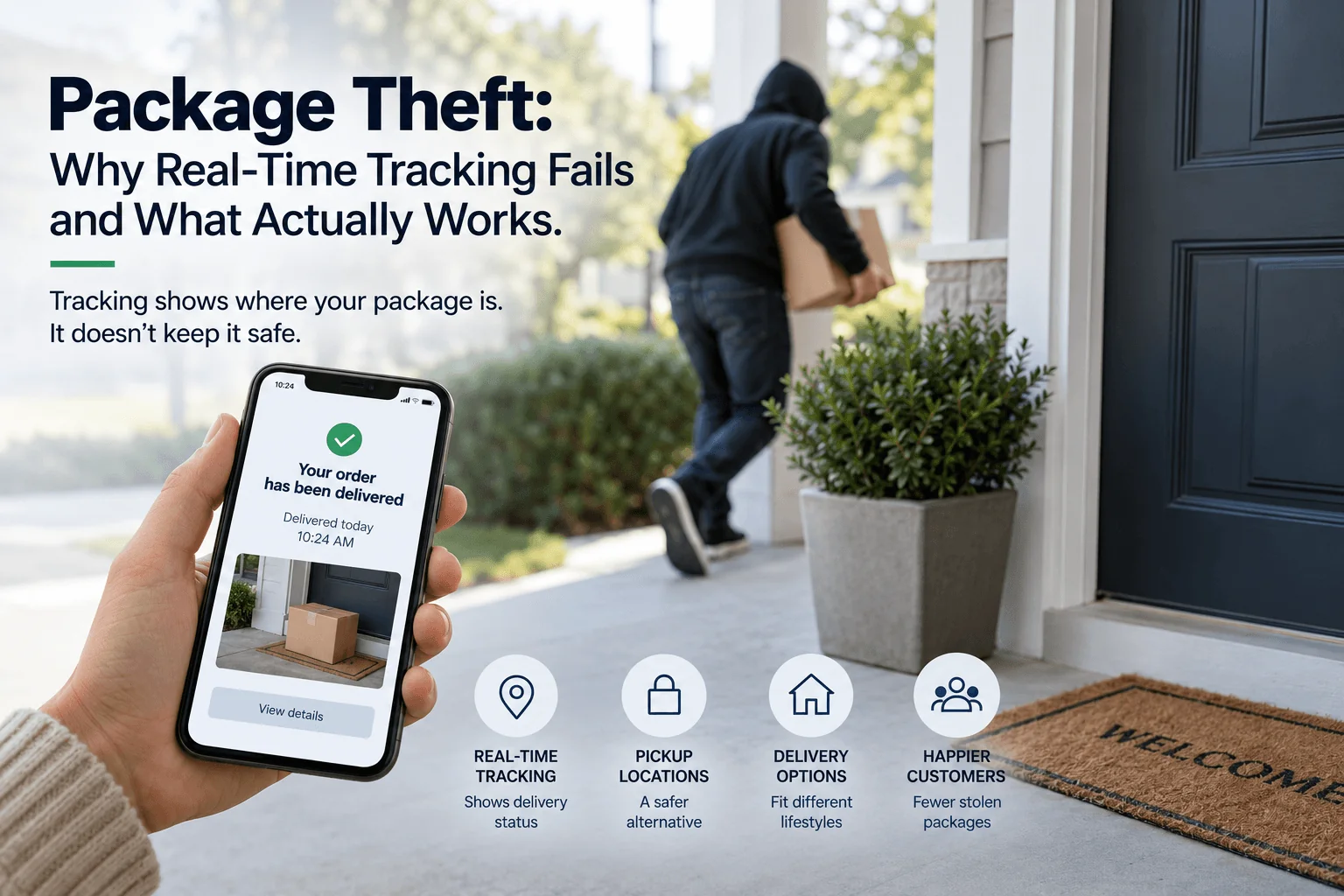
Tracking can tell you a package arrived, but it cannot guard it
A customer is sitting in a meeting when their phone displays a delivery notification: the package has arrived.
They know exactly what happened. They may even be able to see the delivery time and a photo showing where the parcel was left.
There is still a problem. They will not be home for another five hours.
The package is now outside their door, inside a shared entrance, near an apartment mail area, or somewhere else the carrier considered suitable. Tracking has done its job. The customer knows the shipment was delivered.
What tracking cannot do is protect the parcel during the hours before the customer reaches it.
This distinction matters because tracking is often discussed as though greater shipment visibility automatically means greater package security. The two are related, but they solve different problems.
Tracking answers questions such as: Where is my order? Has it shipped? When is it expected? Was it marked as delivered?
Theft prevention asks a different question: How do we keep the package from being accessible to the wrong person?
Once the parcel has been left unattended, increasingly detailed tracking information does not change its physical situation. A customer may learn about a risky delivery more quickly, but that does not mean they can do anything about it.
For brands trying to reduce package theft complaints, replacements, and customer frustration, the goal should therefore extend beyond better visibility. The delivery process itself needs to reduce unnecessary exposure.
They know exactly what happened. They may even be able to see the delivery time and a photo showing where the parcel was left.
There is still a problem. They will not be home for another five hours.
The package is now outside their door, inside a shared entrance, near an apartment mail area, or somewhere else the carrier considered suitable. Tracking has done its job. The customer knows the shipment was delivered.
What tracking cannot do is protect the parcel during the hours before the customer reaches it.
This distinction matters because tracking is often discussed as though greater shipment visibility automatically means greater package security. The two are related, but they solve different problems.
Tracking answers questions such as: Where is my order? Has it shipped? When is it expected? Was it marked as delivered?
Theft prevention asks a different question: How do we keep the package from being accessible to the wrong person?
Once the parcel has been left unattended, increasingly detailed tracking information does not change its physical situation. A customer may learn about a risky delivery more quickly, but that does not mean they can do anything about it.
For brands trying to reduce package theft complaints, replacements, and customer frustration, the goal should therefore extend beyond better visibility. The delivery process itself needs to reduce unnecessary exposure.
What real-time tracking actually solves
Tracking remains useful. The mistake is expecting it to solve a problem it was not designed to solve.
For customers, shipment information can remove much of the uncertainty between checkout and receipt. Instead of wondering whether an order has shipped or when it might arrive, the customer can follow its progress.
That information can also help customers make practical plans.
For customers, shipment information can remove much of the uncertainty between checkout and receipt. Instead of wondering whether an order has shipped or when it might arrive, the customer can follow its progress.
That information can also help customers make practical plans.
Visibility reduces uncertainty
Consider someone who expects a delivery sometime during the week. Without shipment information, they may have little idea when to watch for the parcel.
Tracking gives them a clearer view of the process. A customer can see whether the order is still being prepared, moving through the carrier network, approaching its destination, or already delivered.
That reduces uncertainty and can prevent unnecessary customer service contacts.
It also helps when something does not happen as expected. A customer who sees that a parcel is still in transit understands the situation differently from someone who has received no information at all.
These are meaningful benefits. They improve communication and make the delivery process easier to follow.
They still do not change where the package eventually sits.
Tracking gives them a clearer view of the process. A customer can see whether the order is still being prepared, moving through the carrier network, approaching its destination, or already delivered.
That reduces uncertainty and can prevent unnecessary customer service contacts.
It also helps when something does not happen as expected. A customer who sees that a parcel is still in transit understands the situation differently from someone who has received no information at all.
These are meaningful benefits. They improve communication and make the delivery process easier to follow.
They still do not change where the package eventually sits.
Delivery alerts can shorten unattended time
Notifications become more relevant to theft prevention because they can reduce the period between drop-off and collection.
If a customer is home and receives an immediate delivery alert, they may collect the parcel within minutes. If they are nearby, they may be able to return soon.
That is useful.
But the protection depends on circumstances outside the tracking system.
A nurse working a long shift cannot leave simply because a package was delivered. A commuter may be an hour away. Someone on vacation might not return for several days. A resident of a building with a shared entrance may receive the notification after the package is already accessible to other people.
An alert changes awareness. It does not necessarily change availability.
This is the basic limit brands should keep in mind when evaluating tracking as part of a theft reduction plan.
If a customer is home and receives an immediate delivery alert, they may collect the parcel within minutes. If they are nearby, they may be able to return soon.
That is useful.
But the protection depends on circumstances outside the tracking system.
A nurse working a long shift cannot leave simply because a package was delivered. A commuter may be an hour away. Someone on vacation might not return for several days. A resident of a building with a shared entrance may receive the notification after the package is already accessible to other people.
An alert changes awareness. It does not necessarily change availability.
This is the basic limit brands should keep in mind when evaluating tracking as part of a theft reduction plan.
Where tracking stops being protection
The difference between tracking and prevention becomes clearer when the available delivery measures are compared directly.
| Delivery measure | What it can do | Where it falls short |
|---|---|---|
| Real-time tracking | Shows shipment progress and recorded delivery status | Does not physically protect an unattended parcel |
| Delivery notification | Tells the customer that a delivery event occurred | Customer may not be available to retrieve the package |
| Delivery photo | Helps show where a parcel was left | Does not stop someone from taking it afterward |
| Delivery instructions | Can tell the carrier where the customer prefers the parcel to be placed | Instructions may not create a genuinely secure location |
| Signature requirement | Reduces the chance of an unattended handoff when properly completed | Can create missed-delivery inconvenience if nobody is available |
| Package locker | Keeps a parcel in a controlled compartment when the service is available and suitable | Availability and access depend on the customer's location and delivery setup |
| Pickup location | Sends the parcel to a location where the customer collects it | Customer must travel to the location and follow the collection process |
| Home delivery | Brings the parcel directly to the customer's residence | May leave the order exposed when nobody can receive it |
The table shows why theft prevention is better treated as a delivery design question rather than simply a tracking feature question.
A customer can have excellent visibility and still face an unsuitable receiving situation.
For example, a shopper living in a house with a private entrance may be comfortable with home delivery. Someone living in a building where packages are routinely placed near a shared door may have a very different risk calculation.
A single delivery process cannot account for both situations unless the customer has some control over the final destination.
A customer can have excellent visibility and still face an unsuitable receiving situation.
For example, a shopper living in a house with a private entrance may be comfortable with home delivery. Someone living in a building where packages are routinely placed near a shared door may have a very different risk calculation.
A single delivery process cannot account for both situations unless the customer has some control over the final destination.
Preventing exposure works better than watching it
Imagine placing a bicycle outside and installing a camera pointed at it. The camera can provide information about what happens to the bicycle.
Moving the bicycle into a controlled storage area solves a different problem. It changes the conditions that made the item easy to take.
Package delivery follows the same basic logic.
Tracking observes the shipment. Theft prevention tries to reduce the period during which the shipment is exposed.
That can happen in several ways.
The customer might be present to receive the parcel. A signature may be required for an appropriate order. A locker may be available. The customer may choose a pickup location rather than their home. Delivery timing may fit a period when somebody is available.
The best method depends on the customer and the purchase.
For brands, this means asking more specific questions than "Do we provide tracking?"
Where are theft complaints occurring? Are they concentrated around apartments or shared entrances? Do customers report parcels being left unattended while they are at work? Are certain orders more sensitive because of their value, size, or delivery requirements?
Once the actual exposure point is understood, the company can consider a delivery method that changes that condition.
Moving the bicycle into a controlled storage area solves a different problem. It changes the conditions that made the item easy to take.
Package delivery follows the same basic logic.
Tracking observes the shipment. Theft prevention tries to reduce the period during which the shipment is exposed.
That can happen in several ways.
The customer might be present to receive the parcel. A signature may be required for an appropriate order. A locker may be available. The customer may choose a pickup location rather than their home. Delivery timing may fit a period when somebody is available.
The best method depends on the customer and the purchase.
For brands, this means asking more specific questions than "Do we provide tracking?"
Where are theft complaints occurring? Are they concentrated around apartments or shared entrances? Do customers report parcels being left unattended while they are at work? Are certain orders more sensitive because of their value, size, or delivery requirements?
Once the actual exposure point is understood, the company can consider a delivery method that changes that condition.
Giving customers another place to receive an order
Home delivery works well for many shoppers. It becomes less practical when the customer cannot reliably receive packages at home.
Someone may live in an apartment without a staffed front desk. Another person may travel frequently. A customer might work away from home during normal delivery hours. Some simply prefer not to have purchases sitting outside.
For these customers, another delivery destination can address the underlying problem more directly than tracking alone.
Pickup locations are one example.
Instead of sending an order to the shopper's residence, the parcel is sent to a location where the customer can collect it. The customer still needs clear information about when the package is ready and how collection works, but the parcel is not dependent on the shopper being at their front door at the moment of delivery.
Via.Delivery fits into this category. It is an IT solution that provides D2C brands and their clients with an alternative delivery option. Via.Delivery's public site presents pickup locations as a checkout choice alongside other delivery methods, giving shoppers another destination when home delivery does not fit their situation.
That distinction is important. Alternative delivery does not need to replace home delivery.
A shopper who works from home and has a secure entrance may see no reason to collect a parcel elsewhere. Another shopper may consider pickup far more practical than worrying about a package sitting outside until evening.
Choice lets those customers make different decisions.
The theft prevention benefit comes from changing where the parcel waits. Instead of relying only on a notification that tells the shopper an unattended package has arrived, the delivery process can give that shopper a destination better suited to their circumstances.
Someone may live in an apartment without a staffed front desk. Another person may travel frequently. A customer might work away from home during normal delivery hours. Some simply prefer not to have purchases sitting outside.
For these customers, another delivery destination can address the underlying problem more directly than tracking alone.
Pickup locations are one example.
Instead of sending an order to the shopper's residence, the parcel is sent to a location where the customer can collect it. The customer still needs clear information about when the package is ready and how collection works, but the parcel is not dependent on the shopper being at their front door at the moment of delivery.
Via.Delivery fits into this category. It is an IT solution that provides D2C brands and their clients with an alternative delivery option. Via.Delivery's public site presents pickup locations as a checkout choice alongside other delivery methods, giving shoppers another destination when home delivery does not fit their situation.
That distinction is important. Alternative delivery does not need to replace home delivery.
A shopper who works from home and has a secure entrance may see no reason to collect a parcel elsewhere. Another shopper may consider pickup far more practical than worrying about a package sitting outside until evening.
Choice lets those customers make different decisions.
The theft prevention benefit comes from changing where the parcel waits. Instead of relying only on a notification that tells the shopper an unattended package has arrived, the delivery process can give that shopper a destination better suited to their circumstances.
Other measures that can reduce delivery risk
Pickup is one approach, not the only one.
Different orders call for different controls, and adding the strongest possible restriction to every shipment can create unnecessary inconvenience.
A signature requirement can make sense when leaving an order unattended is inappropriate. The tradeoff is that someone normally needs to be available for the handoff, which can lead to another attempt or another collection process if the recipient is away.
Lockers can provide controlled storage where they are available and compatible with the delivery process. Like pickup locations, they change the destination rather than merely reporting the package's status.
Delivery instructions can help when the customer's property has a less exposed place for a parcel. Their usefulness depends on the location, the carrier process, and whether the requested spot is actually more secure.
Timing also matters. If a customer has a meaningful choice about receiving an order when somebody is available, unattended time can be reduced.
Packaging deserves consideration too. A shipping box needs to protect the product and support normal fulfillment requirements. Brands can also avoid making the contents unnecessarily obvious where practical. This should be treated as one small part of a broader delivery process, not a substitute for secure receipt.
The common principle is simple: reduce opportunities for an unattended parcel to remain accessible.
Different orders call for different controls, and adding the strongest possible restriction to every shipment can create unnecessary inconvenience.
A signature requirement can make sense when leaving an order unattended is inappropriate. The tradeoff is that someone normally needs to be available for the handoff, which can lead to another attempt or another collection process if the recipient is away.
Lockers can provide controlled storage where they are available and compatible with the delivery process. Like pickup locations, they change the destination rather than merely reporting the package's status.
Delivery instructions can help when the customer's property has a less exposed place for a parcel. Their usefulness depends on the location, the carrier process, and whether the requested spot is actually more secure.
Timing also matters. If a customer has a meaningful choice about receiving an order when somebody is available, unattended time can be reduced.
Packaging deserves consideration too. A shipping box needs to protect the product and support normal fulfillment requirements. Brands can also avoid making the contents unnecessarily obvious where practical. This should be treated as one small part of a broader delivery process, not a substitute for secure receipt.
The common principle is simple: reduce opportunities for an unattended parcel to remain accessible.
Common traps in package theft prevention
The first trap is treating more tracking detail as more security.
Customers may appreciate frequent status information, but another tracking event does not protect a box sitting outside. Brands should separate communication improvements from physical delivery controls when deciding what problem they are trying to fix.
Another mistake is forcing every shopper through the same delivery method.
Home delivery may be convenient for one customer and uncomfortable for another. A pickup option may solve a serious problem for an apartment resident while offering little value to someone who is always home.
Choice is useful because risk is personal and local.
The opposite mistake is making every delivery more restrictive. Requiring a signature or collection step for every ordinary order can add customer effort without solving a meaningful problem for many shoppers.
Controls should fit the situation.
Unclear alternative delivery instructions create another problem. Offering pickup is not enough if the shopper does not understand where the package is going, when it can be collected, or what is required at collection.
A theft reduction measure that creates confusion can simply move the customer service problem to another stage of the journey.
Finally, brands should avoid using the carrier's "delivered" status as the only definition of success.
A delivery scan confirms an event in the shipping process. The customer's definition is closer to: "I received my order."
Those outcomes are not always identical.
Customers may appreciate frequent status information, but another tracking event does not protect a box sitting outside. Brands should separate communication improvements from physical delivery controls when deciding what problem they are trying to fix.
Another mistake is forcing every shopper through the same delivery method.
Home delivery may be convenient for one customer and uncomfortable for another. A pickup option may solve a serious problem for an apartment resident while offering little value to someone who is always home.
Choice is useful because risk is personal and local.
The opposite mistake is making every delivery more restrictive. Requiring a signature or collection step for every ordinary order can add customer effort without solving a meaningful problem for many shoppers.
Controls should fit the situation.
Unclear alternative delivery instructions create another problem. Offering pickup is not enough if the shopper does not understand where the package is going, when it can be collected, or what is required at collection.
A theft reduction measure that creates confusion can simply move the customer service problem to another stage of the journey.
Finally, brands should avoid using the carrier's "delivered" status as the only definition of success.
A delivery scan confirms an event in the shipping process. The customer's definition is closer to: "I received my order."
Those outcomes are not always identical.
How brands can tell whether the approach is working
Start with customer service data.
Look for contacts mentioning stolen parcels, missing packages after a delivery scan, unsafe placement, deliveries left in shared areas, or customers who could not be present.
Then connect those complaints to delivery methods.
If one receiving option produces a different pattern from another, investigate why. The goal is not to assume that the delivery method alone caused the result. Customer location, order type, carrier conditions, and other differences may matter.
Replacement orders are another useful signal.
When a brand sends another product because the first parcel disappeared after delivery, that incident represents more than a shipping problem. There is product cost, another fulfillment process, another shipment, support time, and a customer who has already experienced frustration.
Failed deliveries deserve separate attention. A control that reduces unattended parcels but produces frequent unsuccessful handoffs may be solving one problem while creating another.
For pickup orders, completion should be monitored. Customers selecting the option still need to collect their packages successfully and understand the process.
Customer comments add context that operational data cannot provide.
Statements such as "I chose pickup because packages disappear from our lobby" or "I would rather have this delivered to my house" explain why different shoppers make different choices.
A practical review might include:
Reviewing these signals together gives teams a better picture than shipment tracking alone.
Look for contacts mentioning stolen parcels, missing packages after a delivery scan, unsafe placement, deliveries left in shared areas, or customers who could not be present.
Then connect those complaints to delivery methods.
If one receiving option produces a different pattern from another, investigate why. The goal is not to assume that the delivery method alone caused the result. Customer location, order type, carrier conditions, and other differences may matter.
Replacement orders are another useful signal.
When a brand sends another product because the first parcel disappeared after delivery, that incident represents more than a shipping problem. There is product cost, another fulfillment process, another shipment, support time, and a customer who has already experienced frustration.
Failed deliveries deserve separate attention. A control that reduces unattended parcels but produces frequent unsuccessful handoffs may be solving one problem while creating another.
For pickup orders, completion should be monitored. Customers selecting the option still need to collect their packages successfully and understand the process.
Customer comments add context that operational data cannot provide.
Statements such as "I chose pickup because packages disappear from our lobby" or "I would rather have this delivered to my house" explain why different shoppers make different choices.
A practical review might include:
- theft and missing-package contacts by delivery method
- replacement orders connected to post-delivery loss
- failed or unsuccessful delivery attempts
- pickup completion when pickup is offered
- customer questions about receiving options
- feedback about where packages are being left
Reviewing these signals together gives teams a better picture than shipment tracking alone.
Practical next steps for reducing package theft
Begin with actual complaints rather than assumptions.
Review a recent group of theft, missing-package, and delivery-location contacts. Look for repeated circumstances. Apartment entrances, unattended porches, long periods before collection, or customers who are rarely home may point to different problems.
Next, separate visibility problems from destination problems.
If customers frequently ask where their orders are, communication may need improvement.
If customers know exactly when their orders arrived but still report theft, more tracking is unlikely to address the main issue. The destination or handoff process deserves attention.
Then identify which controls fit which situations.
A signature might be suitable for one type of order. A locker may work for another customer. Some shoppers may prefer a pickup location. Others will continue choosing home delivery because it works well for them.
Make those choices understandable at checkout. Customers should know where their parcel will go and what they will need to do.
For D2C brands exploring alternative delivery, an IT solution such as Via.Delivery can be considered as one way to provide customers with another delivery option. Its role fits the broader goal of giving shoppers a choice when an unattended residential delivery does not suit them.
Finally, measure what happens after the change.
Do not stop at adoption. Review theft contacts, replacement orders, failed deliveries, collection issues, and customer feedback. A delivery option is useful when it solves a real receiving problem without creating disproportionate effort somewhere else.
Real-time tracking should remain part of the customer experience. It answers important questions and gives shoppers useful information.
It simply should not be mistaken for a locked door.
If the problem is package theft, the more effective question is not only "How closely can the customer watch the shipment?" It is "Where can this order wait safely until the customer is ready to receive it?"
Review a recent group of theft, missing-package, and delivery-location contacts. Look for repeated circumstances. Apartment entrances, unattended porches, long periods before collection, or customers who are rarely home may point to different problems.
Next, separate visibility problems from destination problems.
If customers frequently ask where their orders are, communication may need improvement.
If customers know exactly when their orders arrived but still report theft, more tracking is unlikely to address the main issue. The destination or handoff process deserves attention.
Then identify which controls fit which situations.
A signature might be suitable for one type of order. A locker may work for another customer. Some shoppers may prefer a pickup location. Others will continue choosing home delivery because it works well for them.
Make those choices understandable at checkout. Customers should know where their parcel will go and what they will need to do.
For D2C brands exploring alternative delivery, an IT solution such as Via.Delivery can be considered as one way to provide customers with another delivery option. Its role fits the broader goal of giving shoppers a choice when an unattended residential delivery does not suit them.
Finally, measure what happens after the change.
Do not stop at adoption. Review theft contacts, replacement orders, failed deliveries, collection issues, and customer feedback. A delivery option is useful when it solves a real receiving problem without creating disproportionate effort somewhere else.
Real-time tracking should remain part of the customer experience. It answers important questions and gives shoppers useful information.
It simply should not be mistaken for a locked door.
If the problem is package theft, the more effective question is not only "How closely can the customer watch the shipment?" It is "Where can this order wait safely until the customer is ready to receive it?"
FAQ
Can real-time tracking prevent package theft?
Not by itself. Real-time tracking provides information about shipment progress and delivery status. It may help a customer retrieve a parcel sooner, but it does not physically secure a package after it has been left unattended.
Do delivery notifications reduce theft risk?
They can reduce unattended time when the customer is able to act on the notification quickly.
Their effectiveness depends on availability. A customer who is at work, traveling, or otherwise away from home may know the parcel has arrived without being able to collect it.
Their effectiveness depends on availability. A customer who is at work, traveling, or otherwise away from home may know the parcel has arrived without being able to collect it.
Are pickup locations safer than home delivery?
A pickup location changes the receiving conditions by sending the parcel somewhere the customer can collect it rather than leaving it at a residence.
Whether that is the better option depends on the shopper's circumstances. Home delivery may already work well for customers with secure receiving arrangements.
Whether that is the better option depends on the shopper's circumstances. Home delivery may already work well for customers with secure receiving arrangements.
Does requiring a signature solve package theft?
A signature requirement can reduce unattended delivery when the handoff requires a recipient, but it has tradeoffs. If nobody is available, the customer may face another delivery attempt or need to collect the parcel elsewhere.
It is better treated as one possible control rather than a universal requirement.
It is better treated as one possible control rather than a universal requirement.
What should a brand do if customers report packages stolen after delivery?
Review where and how those incidents occur. Determine whether the problem involves communication, unattended delivery, shared entrances, long collection delays, or another pattern.
Then consider controls that address that particular exposure rather than simply adding more tracking messages.
Then consider controls that address that particular exposure rather than simply adding more tracking messages.
Should every D2C brand offer alternative delivery?
Not necessarily. The decision should reflect customer needs, delivery problems, and the brand's operating model.
Alternative delivery is most relevant when a meaningful group of customers needs another way to receive purchases because home delivery creates inconvenience or security concerns.
Alternative delivery is most relevant when a meaningful group of customers needs another way to receive purchases because home delivery creates inconvenience or security concerns.
What is the difference between tracking and secure delivery?
Tracking concerns information. It tells customers what is happening with a shipment.
Secure delivery concerns the conditions under which the customer receives the parcel. That can involve where the order is delivered, whether someone must receive it, and how long it remains accessible before collection.
Secure delivery concerns the conditions under which the customer receives the parcel. That can involve where the order is delivered, whether someone must receive it, and how long it remains accessible before collection.
How should brands measure package theft prevention?
Look beyond carrier delivery scans. Review theft-related support contacts, missing-package reports, replacement shipments, unsuccessful deliveries, pickup completion where relevant, and customer feedback.
Compare those signals across delivery methods and customer situations before deciding which changes are working.
Compare those signals across delivery methods and customer situations before deciding which changes are working.
Not ready for a call?
Get the Via.Delivery Shipping Brief: short reads on carrier fees, holiday cutoffs and pickup options for online stores and wineries, twice a month.
No spam. Unsubscribe anytime.