





PUDO Networks for Wine Shipping: Reducing Heat Damage
Key Takeaways
- PUDO networks can reduce the time wine and spirits orders spend outside at a residential address, where direct sunlight and high temperatures may increase the risk of damage.
- Pickup delivery does not control the temperature throughout transportation, so it should support rather than replace protective packaging, suitable service levels, and seasonal shipping rules.
- Alcohol orders require special carrier agreements, compliant labels, age verification, and delivery processes that vary by carrier and destination.
- A staffed or approved pickup location can reduce failed delivery attempts because the parcel is delivered to a known commercial location rather than waiting for an adult recipient at home.
- Brands should confirm that each pickup location and carrier service is approved for the specific alcohol shipment before offering it at checkout.
Share:
The summer delivery problem in plain language
A wine order can travel successfully across several states and still face trouble during the final few hours of delivery. The carrier may leave the package on a porch, outside an apartment entrance, or in another exposed area. On a hot day, a relatively short period in direct sunlight can create very different conditions from those inside a warehouse or delivery vehicle.
This risk is especially relevant in the US, where summer temperatures vary greatly by region and residential delivery conditions are difficult to predict. A customer may be at work when the driver arrives, a signature may be required, or access to the building may be restricted. The shipment can then face a failed attempt, another day in the carrier network, or an exposed waiting period after delivery.
Wine is sensitive to storage and transportation conditions. Heat can affect flavor and color, while temperature fluctuations may contribute to stability problems in some wines. Research and technical materials from UC Davis also describe how heat can adversely affect wine characteristics and how temperature changes during storage and transport can contribute to visible haze in certain white and rosé wines.
Spirits are generally more stable than wine because of their higher alcohol content, but that does not make every shipment immune to summer conditions. Heat may still affect closures, labels, adhesives, gift packaging, and the overall presentation of the order. A leaking closure, damaged box, or heat-worn label can create a poor customer experience even when the liquid itself remains usable.
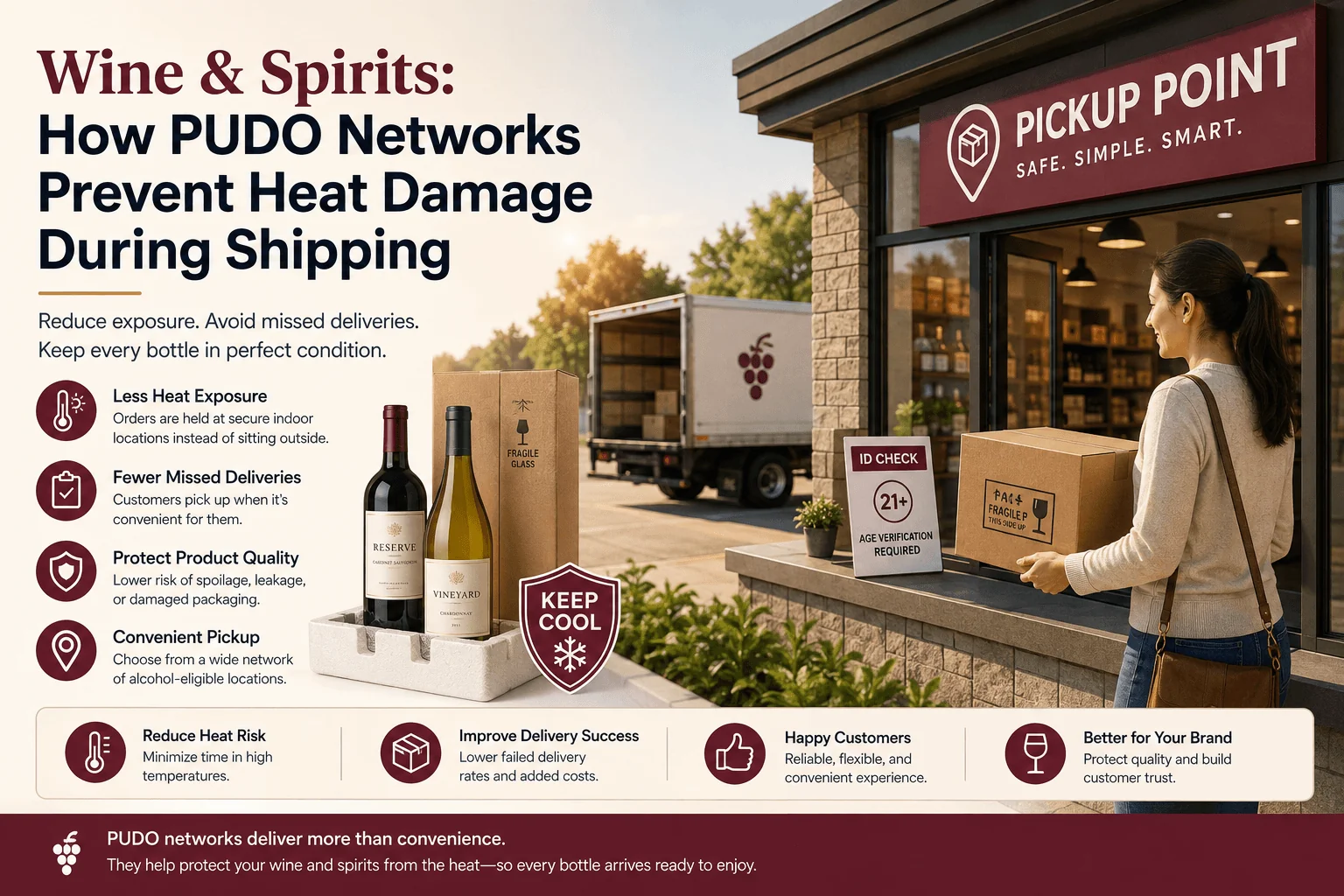
PUDO networks offer one way to address the final part of this problem. PUDO means pick-up and drop-off, and the model directs an order to an approved pickup point rather than a residential doorstep. This can reduce exposure after the carrier completes delivery, but it does not mean the shipment is temperature-controlled from the warehouse to the customer.
This risk is especially relevant in the US, where summer temperatures vary greatly by region and residential delivery conditions are difficult to predict. A customer may be at work when the driver arrives, a signature may be required, or access to the building may be restricted. The shipment can then face a failed attempt, another day in the carrier network, or an exposed waiting period after delivery.
Wine is sensitive to storage and transportation conditions. Heat can affect flavor and color, while temperature fluctuations may contribute to stability problems in some wines. Research and technical materials from UC Davis also describe how heat can adversely affect wine characteristics and how temperature changes during storage and transport can contribute to visible haze in certain white and rosé wines.
Spirits are generally more stable than wine because of their higher alcohol content, but that does not make every shipment immune to summer conditions. Heat may still affect closures, labels, adhesives, gift packaging, and the overall presentation of the order. A leaking closure, damaged box, or heat-worn label can create a poor customer experience even when the liquid itself remains usable.
PUDO networks offer one way to address the final part of this problem. PUDO means pick-up and drop-off, and the model directs an order to an approved pickup point rather than a residential doorstep. This can reduce exposure after the carrier completes delivery, but it does not mean the shipment is temperature-controlled from the warehouse to the customer.
What PUDO delivery changes
A PUDO network consists of approved locations where customers can collect eligible packages. Depending on the carrier and program, these locations may include carrier facilities, participating stores, or other staffed collection points.
The main change is the final destination. Instead of sending the order to a house or apartment, the shipment is routed to a commercial location that follows a defined receiving process. The customer receives a notification and visits the location to collect the parcel.
This model does not remove every shipping risk. The package still travels through sorting facilities, trailers, local vehicles, and loading areas. Its value is that it can remove one of the least controlled parts of the journey: the period after a parcel reaches a residential address but before the customer brings it inside.
The main change is the final destination. Instead of sending the order to a house or apartment, the shipment is routed to a commercial location that follows a defined receiving process. The customer receives a notification and visits the location to collect the parcel.
This model does not remove every shipping risk. The package still travels through sorting facilities, trailers, local vehicles, and loading areas. Its value is that it can remove one of the least controlled parts of the journey: the period after a parcel reaches a residential address but before the customer brings it inside.
It reduces uncontrolled porch exposure
A residential delivery may be completed when the customer is away. Even when a shaded placement is available, the driver cannot control how long the order remains outside or when the customer will return. A box placed near a doorway can also move into direct sunlight as the sun changes position.
An approved pickup point receives the package through a commercial handoff. The parcel can then remain at the location until the customer arrives, rather than sitting openly outside a home. This can reduce the risk created by unattended doorstep storage, although merchants should never describe every pickup location as climate-controlled unless that condition has been confirmed.
The distinction matters for honest customer communication. PUDO delivery reduces exposure to outdoor conditions after delivery, but it does not guarantee a particular storage temperature. Brands should describe the option as a way to reduce porch time and improve delivery control, not as refrigerated storage.
An approved pickup point receives the package through a commercial handoff. The parcel can then remain at the location until the customer arrives, rather than sitting openly outside a home. This can reduce the risk created by unattended doorstep storage, although merchants should never describe every pickup location as climate-controlled unless that condition has been confirmed.
The distinction matters for honest customer communication. PUDO delivery reduces exposure to outdoor conditions after delivery, but it does not guarantee a particular storage temperature. Brands should describe the option as a way to reduce porch time and improve delivery control, not as refrigerated storage.
It lowers the chance of a missed signature
Alcohol deliveries often require an eligible adult to be present and complete the required receipt process. When nobody is available, the driver may be unable to release the package. The order can then return to the local facility and re-enter the route on another day.
Another delivery attempt adds time to the journey. During hot weather, that extra time may mean another loading cycle, another vehicle route, and another period in facilities that are not designed as wine cellars. Even without measurable product damage, the delay can lead to customer frustration and more support inquiries.
An eligible pickup location may create a more predictable collection process. The customer can visit during the location’s operating hours and complete the required identification or age-verification process there, when the carrier program and local rules permit it. Brands must confirm these conditions in advance because not every parcel, location, or alcohol category qualifies for pickup.
Another delivery attempt adds time to the journey. During hot weather, that extra time may mean another loading cycle, another vehicle route, and another period in facilities that are not designed as wine cellars. Even without measurable product damage, the delay can lead to customer frustration and more support inquiries.
An eligible pickup location may create a more predictable collection process. The customer can visit during the location’s operating hours and complete the required identification or age-verification process there, when the carrier program and local rules permit it. Brands must confirm these conditions in advance because not every parcel, location, or alcohol category qualifies for pickup.
It gives the customer more control over timing
Home delivery asks the customer to coordinate with a moving vehicle and an estimated delivery window. That can be difficult for someone who works outside the home or lives in a building with limited carrier access. A missed connection can turn a planned delivery into a multi-day process.
Pickup delivery changes that timing. Once the customer receives confirmation that the order is ready, collection can take place during the approved location’s operating hours. The customer can choose a time when the package can be taken directly home rather than waiting outside.
This control is useful during hot weather because it shortens the uncertain period after delivery. Customers should still be encouraged to collect temperature-sensitive orders promptly. A pickup point is a delivery destination, not a long-term storage solution.
Pickup delivery changes that timing. Once the customer receives confirmation that the order is ready, collection can take place during the approved location’s operating hours. The customer can choose a time when the package can be taken directly home rather than waiting outside.
This control is useful during hot weather because it shortens the uncertain period after delivery. Customers should still be encouraged to collect temperature-sensitive orders promptly. A pickup point is a delivery destination, not a long-term storage solution.
Where heat risk appears during shipping
Heat exposure is not limited to the doorstep. A shipment can encounter elevated temperatures at several points between fulfillment and collection. Understanding those points prevents brands from treating PUDO as a complete heat-protection system.
Inside trailers and delivery vehicles
Packages may travel in vehicles that are not temperature-controlled. Conditions inside a parked or slow-moving vehicle can differ sharply from the outdoor air temperature, especially during intense summer weather. The amount of exposure depends on the route, vehicle, loading sequence, service level, and time of day.
PUDO cannot remove this stage because the parcel still needs to reach the pickup location. Brands should continue to consider shipping day, route duration, packaging, and carrier service when planning summer shipments. A better final destination helps, but the full journey still matters.
Merchants can also examine where shipments spend weekends or holidays. An order that remains in the network for an extra day may face more exposure than an order moving continuously toward its destination. Shipping calendars should account for both carrier schedules and the operating hours of the selected pickup location.
PUDO cannot remove this stage because the parcel still needs to reach the pickup location. Brands should continue to consider shipping day, route duration, packaging, and carrier service when planning summer shipments. A better final destination helps, but the full journey still matters.
Merchants can also examine where shipments spend weekends or holidays. An order that remains in the network for an extra day may face more exposure than an order moving continuously toward its destination. Shipping calendars should account for both carrier schedules and the operating hours of the selected pickup location.
At loading areas and sorting facilities
Packages may wait near docks, staging zones, or sorting areas while moving through the carrier network. These spaces can experience changing temperatures, and individual merchants usually have limited control over them. Faster movement through the network can reduce time at these transition points, but no standard parcel service can promise cellar-like conditions unless a specialized temperature-controlled service is being used.
This is another reason to avoid making absolute claims about heat prevention. A PUDO order can still encounter heat before reaching the pickup point. Its main contribution is reducing delivery failure and outdoor waiting at the final residential destination.
Brands should view heat protection as a series of controls. Packaging, routing, transit time, destination choice, notifications, and fast collection each address a different part of the risk. No single measure should carry the full burden.
This is another reason to avoid making absolute claims about heat prevention. A PUDO order can still encounter heat before reaching the pickup point. Its main contribution is reducing delivery failure and outdoor waiting at the final residential destination.
Brands should view heat protection as a series of controls. Packaging, routing, transit time, destination choice, notifications, and fast collection each address a different part of the risk. No single measure should carry the full burden.
Outside the customer’s home
The residential doorstep is often the most visible and least predictable exposure point. The merchant cannot know whether the box will be placed in shade, whether the customer will arrive soon, or whether the delivery area is protected from direct sun. Apartment buildings may introduce their own issues, including outdoor entry areas and unsecured package rooms.
A pickup point replaces that uncontrolled handoff with a defined location. The parcel is received through the carrier’s approved process, and the customer is notified when collection is available. This creates a clearer chain between completed delivery and customer receipt.
The advantage is operational rather than magical. The package is less likely to remain openly exposed, but conditions still vary by location. Merchants should verify the network rather than assuming every retail counter, locker, or carrier facility provides the same environment.
A pickup point replaces that uncontrolled handoff with a defined location. The parcel is received through the carrier’s approved process, and the customer is notified when collection is available. This creates a clearer chain between completed delivery and customer receipt.
The advantage is operational rather than magical. The package is less likely to remain openly exposed, but conditions still vary by location. Merchants should verify the network rather than assuming every retail counter, locker, or carrier facility provides the same environment.
Home delivery and PUDO during hot weather
| Shipping factor | Residential delivery | Eligible PUDO delivery |
|---|---|---|
| Final destination | Home, apartment, or residential building | Approved commercial pickup location |
| Adult availability | Recipient may be unavailable during the delivery attempt | Customer visits during permitted collection hours |
| Risk of a failed attempt | Higher when an eligible recipient must be present | Can be lower when the location supports the required handoff |
| Outdoor waiting after delivery | Possible and difficult for the merchant to control | Usually reduced through a staffed or approved collection process |
| Customer control over receipt time | Limited by the delivery route | Greater once the parcel is ready for collection |
| Temperature-controlled transport | Not normally included | Not normally included |
| Protection from all heat exposure | No | No |
| Alcohol eligibility | Depends on laws, carrier rules, and shipment details | Also depends on laws, carrier rules, content, and location approval |
The comparison shows the proper role of pickup delivery. It can reduce specific last-mile risks, particularly unattended residential exposure and unsuccessful delivery attempts. It does not turn a standard parcel network into a refrigerated supply chain.
Wine and spirits do not face identical risks
Wine and spirits are often discussed as one shipping category because both are regulated alcohol products. From a product-care perspective, however, they should not always be treated in exactly the same way. Their formulations, closures, packaging, and sensitivity to heat can differ.
Wine can suffer quality and stability changes
Wine contains compounds that can react to storage and transportation conditions. Depending on the wine, prolonged or repeated heat exposure may affect aroma, flavor, color, or clarity. Bottles can also experience closure problems if internal pressure rises or packaging is exposed to difficult conditions.
White and rosé wines may face visible haze when proteins become unstable during temperature changes. UC Davis research describes temperature fluctuation during non-temperature-controlled storage and transport as one condition that can contribute to this problem.
The practical lesson is not that every warm shipment will be ruined. The outcome depends on temperature, duration, wine composition, packaging, and prior stability work. Brands should still reduce avoidable exposure because customers cannot assess the shipment’s full temperature history when the box arrives.
White and rosé wines may face visible haze when proteins become unstable during temperature changes. UC Davis research describes temperature fluctuation during non-temperature-controlled storage and transport as one condition that can contribute to this problem.
The practical lesson is not that every warm shipment will be ruined. The outcome depends on temperature, duration, wine composition, packaging, and prior stability work. Brands should still reduce avoidable exposure because customers cannot assess the shipment’s full temperature history when the box arrives.
Spirits may face more packaging-related concerns
Many distilled spirits tolerate ordinary shipping conditions better than wine, but the package can still be affected by high heat. Closures may loosen or leak, decorative materials may warp, and adhesives may weaken. Premium gift boxes and limited-edition packaging can be especially important to the customer’s perception of value.
A leaking bottle can damage other items in the order and make the parcel unsafe or unpleasant to handle. Even minor cosmetic damage may lead to replacement requests when the product was purchased as a gift. Heat-risk planning for spirits should therefore include the entire packaged order, not only the liquid.
PUDO delivery can help by reducing the chance that a spirits shipment remains outside after delivery. It cannot correct weak closures or unsuitable packaging. Merchants should test packaging under realistic shipping conditions and use the pickup option as one part of a broader process.
A leaking bottle can damage other items in the order and make the parcel unsafe or unpleasant to handle. Even minor cosmetic damage may lead to replacement requests when the product was purchased as a gift. Heat-risk planning for spirits should therefore include the entire packaged order, not only the liquid.
PUDO delivery can help by reducing the chance that a spirits shipment remains outside after delivery. It cannot correct weak closures or unsuitable packaging. Merchants should test packaging under realistic shipping conditions and use the pickup option as one part of a broader process.
Alcohol compliance must shape the delivery plan
Alcohol shipping in the United States is regulated differently from ordinary e-commerce parcels. Carrier acceptance, shipper licensing, destination rules, labeling, age verification, and permitted delivery methods all need to be considered. State governments generally regulate alcohol sales and service to consumers, while federal and carrier requirements also affect the shipment.
FedEx states that businesses need appropriate licenses and enrollment in its alcohol shipping program to ship eligible alcohol orders. UPS likewise limits wine and spirits shipping to approved, licensed shippers that have entered into the required carrier agreement. Availability varies by product, destination, and service.
A pickup location should never be added to alcohol checkout simply because the location accepts ordinary parcels. The merchant needs to verify that the carrier permits the specific alcohol shipment to that location and that the correct label, service, and receipt process will be used. Some hold-for-pickup options may be unavailable because of package contents, service restrictions, shipper settings, or location eligibility.
The customer-facing experience also needs to set accurate expectations. The shopper should know that identification and age verification may be required, who is allowed to collect the order, how long the parcel will be held, and what happens if it is not collected. These details should match the carrier program and applicable destination rules.
FedEx states that businesses need appropriate licenses and enrollment in its alcohol shipping program to ship eligible alcohol orders. UPS likewise limits wine and spirits shipping to approved, licensed shippers that have entered into the required carrier agreement. Availability varies by product, destination, and service.
A pickup location should never be added to alcohol checkout simply because the location accepts ordinary parcels. The merchant needs to verify that the carrier permits the specific alcohol shipment to that location and that the correct label, service, and receipt process will be used. Some hold-for-pickup options may be unavailable because of package contents, service restrictions, shipper settings, or location eligibility.
The customer-facing experience also needs to set accurate expectations. The shopper should know that identification and age verification may be required, who is allowed to collect the order, how long the parcel will be held, and what happens if it is not collected. These details should match the carrier program and applicable destination rules.
Common mistakes that weaken summer protection
Pickup delivery can improve the final mile, but poor implementation can create new problems. Most errors begin when a brand treats every location, product, and customer order as if the same rules apply. A controlled rollout is safer than switching on a broad location network without checking eligibility.
Calling every pickup point climate-controlled
A staffed retail location may protect a parcel from direct sunlight and rain, but that does not prove the storage area is temperature-controlled. The package could be held behind a counter, in a stockroom, or in another area with conditions that differ from the customer-facing space. Merchants should not promise refrigeration, air conditioning, or a defined temperature range without confirmation.
More accurate language focuses on reduced outdoor exposure. Brands can explain that pickup delivery helps prevent the package from being left unattended at a residential address. This benefit is meaningful without adding a claim the network may not support.
Location-level information should also be reviewed regularly. Store hours, package eligibility, and operating procedures can change. The checkout experience should display only current, approved choices.
More accurate language focuses on reduced outdoor exposure. Brands can explain that pickup delivery helps prevent the package from being left unattended at a residential address. This benefit is meaningful without adding a claim the network may not support.
Location-level information should also be reviewed regularly. Store hours, package eligibility, and operating procedures can change. The checkout experience should display only current, approved choices.
Assuming PUDO removes the need for protective packaging
A pickup point only changes the final destination. It does not prevent heat exposure inside a trailer, during sorting, or while the parcel is moving through local delivery. Weak packaging remains weak regardless of where the shipment ends.
Wine and spirits brands should continue to evaluate inserts, bottle separation, closure protection, exterior cartons, and insulation when appropriate. Packaging decisions should reflect the product, route, transit time, season, and replacement cost. The goal is to create several layers of protection rather than depend on one feature.
Merchants should also be careful with packaging claims. Terms such as “heat-proof” can suggest a guarantee that ordinary parcel packaging cannot provide. Clear internal testing standards are more useful than broad marketing language.
Wine and spirits brands should continue to evaluate inserts, bottle separation, closure protection, exterior cartons, and insulation when appropriate. Packaging decisions should reflect the product, route, transit time, season, and replacement cost. The goal is to create several layers of protection rather than depend on one feature.
Merchants should also be careful with packaging claims. Terms such as “heat-proof” can suggest a guarantee that ordinary parcel packaging cannot provide. Clear internal testing standards are more useful than broad marketing language.
Sending late in the week without checking transit time
A shipment released near the end of the week may stop moving before it reaches the final location. Weekend timing varies by carrier, service, destination, and pickup-point schedule. A delay can add exposure even when the planned transit time looked reasonable.
Brands should create shipping calendars for warm months. Those calendars can restrict release days for longer routes and account for public holidays or known service interruptions. Orders with the highest sensitivity can be moved to a faster service or held until a safer dispatch day.
Pickup-location hours also matter. A parcel that arrives after closing may not be available to the customer until the next operating period. The delivery plan should account for the full handoff, not only the carrier’s estimated arrival date.
Brands should create shipping calendars for warm months. Those calendars can restrict release days for longer routes and account for public holidays or known service interruptions. Orders with the highest sensitivity can be moved to a faster service or held until a safer dispatch day.
Pickup-location hours also matter. A parcel that arrives after closing may not be available to the customer until the next operating period. The delivery plan should account for the full handoff, not only the carrier’s estimated arrival date.
Failing to tell customers to collect promptly
A customer may assume the parcel can remain at the pickup location for several days without consequence. For a temperature-sensitive order, that delay may undermine the benefit of avoiding porch exposure. The brand should encourage collection soon after the ready-for-pickup notification.
The wording should be practical rather than alarming. A message can explain that prompt collection helps protect product quality and ensures the order is taken home quickly. It should also state the location’s collection deadline and identification requirements.
Notifications need to arrive at useful moments. Order confirmation, shipment movement, pickup readiness, and approaching hold expiration each serve a different purpose. Too many messages create noise, while too few leave the customer uncertain.
The wording should be practical rather than alarming. A message can explain that prompt collection helps protect product quality and ensures the order is taken home quickly. It should also state the location’s collection deadline and identification requirements.
Notifications need to arrive at useful moments. Order confirmation, shipment movement, pickup readiness, and approaching hold expiration each serve a different purpose. Too many messages create noise, while too few leave the customer uncertain.
Building a safer summer delivery process
A useful heat-risk plan starts before the order leaves the warehouse. The merchant needs to decide which products need extra controls, which destinations face the highest seasonal exposure, and which carrier services support approved pickup. The process should remain understandable for warehouse teams and customers.
Classify products by shipping sensitivity
Not every wine or spirits order needs the same treatment. A stable distilled spirit in standard packaging may have a different risk profile from a delicate wine, a mixed case, or an order with premium presentation materials. Product teams can group shipments according to sensitivity, value, packaging, and replacement difficulty.
These groups can guide shipping rules. A more sensitive order may need restricted dispatch days, faster transit, insulation, or an approved pickup option. A lower-risk order may follow the standard workflow while still benefiting from clear notifications.
The classification does not need to be complicated. It should simply help the fulfillment system make consistent choices. Rules based on product characteristics are more dependable than decisions made order by order without a shared standard.
These groups can guide shipping rules. A more sensitive order may need restricted dispatch days, faster transit, insulation, or an approved pickup option. A lower-risk order may follow the standard workflow while still benefiting from clear notifications.
The classification does not need to be complicated. It should simply help the fulfillment system make consistent choices. Rules based on product characteristics are more dependable than decisions made order by order without a shared standard.
Match the delivery method to the route
The same delivery method will not be best for every customer. A short route in a mild region may perform well with home delivery, while a longer route into a hot metropolitan area may benefit from pickup. Rural customers may have fewer eligible locations, making service selection and shipping day more important.
Brands can start by reviewing destinations with frequent missed deliveries, long transit times, or heat-related support cases. These areas offer a practical place to test pickup delivery. The goal is not to remove home delivery but to add a suitable choice where it reduces a clear risk.
Customer convenience still matters. A pickup point that requires a long drive may be less useful than a reliable home delivery. Location distance, operating hours, parking, accessibility, and collection requirements should all be considered.
Brands can start by reviewing destinations with frequent missed deliveries, long transit times, or heat-related support cases. These areas offer a practical place to test pickup delivery. The goal is not to remove home delivery but to add a suitable choice where it reduces a clear risk.
Customer convenience still matters. A pickup point that requires a long drive may be less useful than a reliable home delivery. Location distance, operating hours, parking, accessibility, and collection requirements should all be considered.
Connect routing, labels, and notifications
Alcohol orders must reach the correct carrier service with the correct label and approved destination. Manual handling increases the chance that an order will be sent through the wrong flow. Routing rules should connect the customer’s checkout choice to fulfillment and label generation.
Via.Delivery is an IT solution that gives D2C brands and their customers an alternative delivery option. In this type of workflow, technology can connect pickup-point selection with the routing, labeling, and communication steps needed to complete the order. The role of the technology is to support the approved delivery process, not to replace carrier requirements or alcohol regulations.
Customer updates should follow the same data flow. Once the location receives the parcel, the shopper needs a clear readiness notification and collection instructions. Consistent information reduces missed pickups and helps the customer remove the order from the location promptly.
Via.Delivery is an IT solution that gives D2C brands and their customers an alternative delivery option. In this type of workflow, technology can connect pickup-point selection with the routing, labeling, and communication steps needed to complete the order. The role of the technology is to support the approved delivery process, not to replace carrier requirements or alcohol regulations.
Customer updates should follow the same data flow. Once the location receives the parcel, the shopper needs a clear readiness notification and collection instructions. Consistent information reduces missed pickups and helps the customer remove the order from the location promptly.
Measuring whether pickup reduces heat-related problems
A pickup program should be evaluated with operational data rather than assumptions. Brands can compare pickup orders with similar home-delivery orders during the same season and in similar regions. The comparison should account for service level, transit distance, product type, and packaging.
Useful measures include failed delivery attempts, time from first delivery attempt to customer receipt, support contacts, leakage reports, heat-related complaints, replacements, returns, and uncollected orders. Pickup adoption also matters because a technically strong option has little effect if customers cannot find or understand it. These measures help identify whether the option is solving the intended problem.
Customer feedback can provide context that shipment data misses. Shoppers may value the ability to collect after work, avoid doorstep theft, or complete age verification at a predictable time. Others may report that a location is inconvenient or that the collection instructions were unclear.
Results should guide changes. A location with repeated delays may need to be removed, while clear checkout wording may improve adoption elsewhere. The objective is to build a dependable delivery choice, not simply to display a large number of pickup points.
Useful measures include failed delivery attempts, time from first delivery attempt to customer receipt, support contacts, leakage reports, heat-related complaints, replacements, returns, and uncollected orders. Pickup adoption also matters because a technically strong option has little effect if customers cannot find or understand it. These measures help identify whether the option is solving the intended problem.
Customer feedback can provide context that shipment data misses. Shoppers may value the ability to collect after work, avoid doorstep theft, or complete age verification at a predictable time. Others may report that a location is inconvenient or that the collection instructions were unclear.
Results should guide changes. A location with repeated delays may need to be removed, while clear checkout wording may improve adoption elsewhere. The objective is to build a dependable delivery choice, not simply to display a large number of pickup points.
FAQ
Can a PUDO network completely prevent heat damage?
No standard pickup network can guarantee that a wine or spirits order avoids all heat exposure. The parcel still travels through vehicles, facilities, and loading areas before reaching the pickup location. PUDO mainly reduces the risk of the order being left unattended outside a residential address and may help avoid repeated delivery attempts.
Brands should combine pickup delivery with suitable packaging, thoughtful shipping days, appropriate service levels, and prompt customer collection. Claims should focus on reducing avoidable exposure rather than guaranteeing a particular temperature. Temperature-controlled transport is a separate service and should not be implied unless it is actually provided.
Brands should combine pickup delivery with suitable packaging, thoughtful shipping days, appropriate service levels, and prompt customer collection. Claims should focus on reducing avoidable exposure rather than guaranteeing a particular temperature. Temperature-controlled transport is a separate service and should not be implied unless it is actually provided.
Are all pickup locations climate-controlled?
No. A pickup point may be indoors or staffed without maintaining a verified temperature range for stored packages. Conditions may differ between a retail counter, carrier facility, stockroom, and locker.
Merchants should ask what the network can confirm before describing storage conditions. Unless temperature control is verified, the safer message is that pickup reduces outdoor porch exposure. Customers should still be encouraged to collect wine and spirits orders promptly.
Merchants should ask what the network can confirm before describing storage conditions. Unless temperature control is verified, the safer message is that pickup reduces outdoor porch exposure. Customers should still be encouraged to collect wine and spirits orders promptly.
Can wine and spirits be sent to any carrier pickup point?
No. Alcohol eligibility depends on the shipper’s licenses, carrier agreement, product type, destination, service, labeling, package details, and individual location. A location that accepts ordinary parcels may not be approved for alcohol.
Via.Delivery offers access to a network of alcohol-eligible pickup locations.
Via.Delivery offers access to a network of alcohol-eligible pickup locations.
Does pickup delivery remove the adult-signature requirement?
A pickup option does not remove the legal or carrier requirements that apply to the alcohol shipment. The required identification, age check, and recipient conditions still need to be completed through the approved collection process. Exact procedures depend on the carrier program and destination.
Customers should receive clear instructions about who may collect the order and what identification is needed. The merchant should not assume that an ordinary package-hold process is sufficient for wine or spirits. The alcohol-specific workflow needs to be confirmed in advance.
Customers should receive clear instructions about who may collect the order and what identification is needed. The merchant should not assume that an ordinary package-hold process is sufficient for wine or spirits. The alcohol-specific workflow needs to be confirmed in advance.
Is PUDO more useful for wine than for spirits?
Wine may be more sensitive to heat-related quality and stability changes, so reducing avoidable exposure can be especially valuable. Spirits may be more stable as liquids, but closures, labels, adhesives, and premium packaging can still suffer in difficult conditions.
The better comparison is based on the complete product and package rather than the beverage category alone. A high-value spirits gift set may need more protection than an ordinary bottle of wine. Merchants should set controls according to the actual order.
The better comparison is based on the complete product and package rather than the beverage category alone. A high-value spirits gift set may need more protection than an ordinary bottle of wine. Merchants should set controls according to the actual order.