





Holiday Package Theft: Pickup Orders Had 90% Fewer Claims
Key Takeaways
- Peak season is claims season. In a March 2026 Omnisend survey, 48% of package theft victims were hit in November (21%) or December (27%).
- Retailers pay for most of it: 62% of victims got a refund or free replacement, an estimated $7.9 billion cost to retailers in 2025.
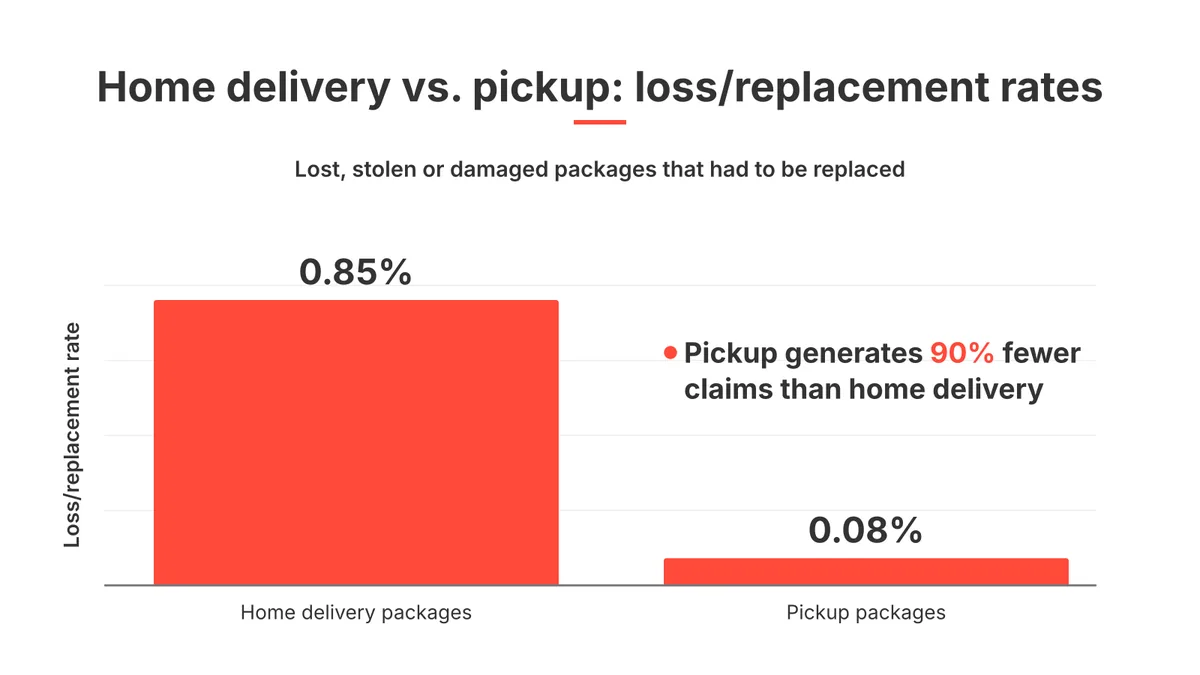
- In an analysis of order data from apparel retailer Perry Ellis International, 0.85% of home deliveries had to be replaced because they were lost, stolen or damaged, vs 0.08% of packages sent to pickup locations.
- That is 90% fewer replacements per pickup package: about 1 in 118 home deliveries vs 1 in 1,250 pickup packages.
- Across a whole order book, the saving scales with pickup share: at 16% of orders going to pickup, total replacements fall about 14.5%.
- The time to set this up is before Thanksgiving (Nov 26), ahead of the Cyber Week order spike and the December theft peak.
Share:
Lost and stolen package claims peak in November and December
Every retailer's support queue looks different in December. More packages go out, more of them are gifts, and more of them sit outside while people are at work or traveling. The surveys line up with what support teams see:
The question is how many of those claims you can prevent before the packages leave your warehouse.
- Almost half of thefts happen in the last two months of the year. In Omnisend's survey of 1,000 U.S. adults (March 2026, reported by Chain Store Age), 27% of theft victims were hit in December and 21% in November.
- Package volume roughly doubles. In Security.org's survey of 3,307 U.S. adults (October 2025), people expected about 25 packages each between October and December, twice their usual three-month count.
- Gifts get taken too. In the same Security.org survey, 12% of shoppers said a gift they'd ordered for someone else had been stolen.
The question is how many of those claims you can prevent before the packages leave your warehouse.
The Perry Ellis case study: 0.85% vs 0.08%
Perry Ellis International sells online through six storefronts, including PerryEllis.com, Original Penguin, Cubavera, Rafaella, Callaway Apparel and GolfApparelShop.com. Since late 2022, its shoppers have been able to choose a nearby pickup location at checkout instead of home delivery.
To see whether the delivery method changed how often orders went wrong, Perry Ellis shared its records of lost, stolen and damaged orders that needed a replacement, split by delivery type.
To see whether the delivery method changed how often orders went wrong, Perry Ellis shared its records of lost, stolen and damaged orders that needed a replacement, split by delivery type.
| Delivery method | Loss and replacement rate | Replacements per 10,000 packages | Roughly 1 in… |
|---|---|---|---|
| Home delivery | 0.85% | 85 | 118 |
| Pickup location | 0.08% | 8 | 1,250 |
| Difference | −0.77 points | −77 |
Source: Perry Ellis International order data. Per-10,000 and "1 in" figures are simple arithmetic on the two rates.
The relative difference is (0.85 − 0.08) ÷ 0.85 = 90.6%. Put the other way, a home delivery in this data set was about 10.6 times as likely to need a replacement as a pickup package.
The relative difference is (0.85 − 0.08) ÷ 0.85 = 90.6%. Put the other way, a home delivery in this data set was about 10.6 times as likely to need a replacement as a pickup package.
What counts as a loss or replacement
The rate counts every order that had to be replaced or refunded because the customer didn't get the item in usable condition:
- Lost in transit: the package never arrived.
- Stolen after delivery: marked delivered, but the customer says it wasn't there.
- Damaged: the item arrived unusable and was replaced.
Why pickup packages go missing less often
The study measured the outcome, not the reasons. These are the likely mechanisms, based on how the two delivery methods work:
- No unattended doorstep. A home delivery often sits outside until someone gets home. A pickup package goes from the driver to a store employee and stays behind a counter.
- A scan at both ends. The location scans the package in when it arrives and hands it over when the customer shows up, so there's a clear record of who has it.
- The customer picks the time. Shoppers get a notice when the package is ready and collect it when it suits them, including when they're away for the holidays.
- Fewer stops at the wrong door. Commercial addresses are easier to find than many apartment and rural addresses.
- Less exposure after delivery. Packages left outside face weather, pets and crowded building mailrooms, all worse in December.
What this data can and can't tell you
Be careful with any single-retailer number, including this one:
- Customers chose their delivery method. This wasn't a randomized test. Shoppers who pick pickup may differ from those who don't, for example by living in apartments or in areas where they've had packages stolen before. That could make the gap bigger or smaller than it would be for an average customer.
- One retailer, one category. These are apparel orders, mostly small soft packages. Fragile or high-value goods may show a different damage rate.
- One period. Theft levels change by year, and the period may not match this year's peak.
What national surveys say about package theft
Surveys measure theft from the shopper's side, and their totals vary widely depending on method:
The Perry Ellis data adds something these surveys can't: a retailer's actual replacement rate, compared by delivery method.
- Security.org (October 2025) estimates about 37 million packages were stolen over the past year, worth more than $8 billion, with an average stolen package value of $222.
- Omnisend (March 2026) found 30% of U.S. households had a package stolen in the past year and estimated 228 million stolen packages worth $12.8 billion in 2025.
The Perry Ellis data adds something these surveys can't: a retailer's actual replacement rate, compared by delivery method.
What it means across your whole order book
Only the orders that go to pickup get the lower rate, so your total saving depends on how many customers choose it. Perry Ellis saw 10% to 16% of customers choose pickup even with free home delivery available.
| Share of orders shipped to pickup | Blended replacement rate | Replacements per 10,000 orders | Fewer replacements than all-home |
|---|---|---|---|
| 0% (all home delivery) | 0.85% | 85 | – |
| 10% | 0.77% | 77 | 9% |
| 16% | 0.73% | 73 | 14.5% |
| 25% | 0.66% | 66 | 23% |
Arithmetic: blended rate = (home share × 0.85%) + (pickup share × 0.08%). Assumes the Perry Ellis rates apply to your orders.
A shortcut: every 10 points of pickup share removes about 9% of your replacements.
A shortcut: every 10 points of pickup share removes about 9% of your replacements.
What a peak-season replacement costs
Each replacement costs more than the item, and more in December than in March:
Savings = orders × pickup share × 0.77% × cost per replacement
Example, with numbers you should replace with your own: a store shipping 50,000 orders in November and December, with 16% going to pickup and an all-in cost of $60 per replacement, would avoid about 62 replacements, or about $3,700 over the two months. (50,000 × 0.16 × 0.0077 = 61.6; 62 × $60 = $3,720.)
This counts only replacements. The same pickup orders also avoid residential delivery surcharges, where Perry Ellis reported saving about $3.50 per package (see the Perry Ellis case study).
- the product at cost, which you can't resell if it's gone or damaged;
- the second shipment, at peak-season rates. Reuters reported on Oct 26, 2026 that this year is on track to be the most expensive year for parcel shipping on record, with the highest-ever holiday delivery prices (see our 2026 peak season surcharge guide);
- support time for the "where is my order" contact and the claim;
- sometimes a chargeback if the customer disputes the charge instead of contacting you;
- sometimes an upgrade to air so a replacement gift still arrives on time.
Savings = orders × pickup share × 0.77% × cost per replacement
Example, with numbers you should replace with your own: a store shipping 50,000 orders in November and December, with 16% going to pickup and an all-in cost of $60 per replacement, would avoid about 62 replacements, or about $3,700 over the two months. (50,000 × 0.16 × 0.0077 = 61.6; 62 × $60 = $3,720.)
This counts only replacements. The same pickup orders also avoid residential delivery surcharges, where Perry Ellis reported saving about $3.50 per package (see the Perry Ellis case study).
Your pre-peak checklist: what to do before Thanksgiving
Thanksgiving is Nov 26 and Cyber Monday is Nov 30. Changes to checkout are hard to make once the order spike starts, so this is the window:
- Measure your baseline now. Tag last December's orders by delivery type and count replacements and "not received" refunds per 1,000 shipments. Break it down by ZIP code; losses cluster.
- Add pickup at checkout next to home delivery, with the nearest location and its distance.
- Say why in one line: "Held securely until you pick it up. No waiting at home."
- Make it free or cheaper than home delivery where your margins allow.
- Highlight it for high-risk orders: apartment addresses, ZIP codes with repeat claims, and high-value items.
- Plan for failed deliveries. Decide what happens when a December delivery attempt fails: another attempt, a return, or a redirect to a pickup location.
- Prepare your support team. Write a "not received" reply template and a clear rule for when to replace, refund or open a carrier claim.
- Publish your holiday cutoffs. Christmas cutoffs start around Dec 15 for ground services; see the holiday shipping deadlines.
Via.Delivery's solution
Via.Delivery ran this analysis with Perry Ellis, which has offered our pickup option at checkout on its storefronts since 2022. We first shared the two loss rates in our package safety guide; this is the full case study, ahead of the season when it matters most.
Via.Delivery adds 36,000+ FedEx and UPS pickup locations to your checkout, including pharmacies, grocery and convenience stores. The customer chooses a location next to your other shipping options, the package ships with a compliant label to that location, and it's held for up to 7 days, with reminders until it's picked up.
Three products cover the points where a customer can switch to pickup:
There's still time to go live before the December peak. Book a demo and bring your order and claims numbers.
Via.Delivery adds 36,000+ FedEx and UPS pickup locations to your checkout, including pharmacies, grocery and convenience stores. The customer chooses a location next to your other shipping options, the package ships with a compliant label to that location, and it's held for up to 7 days, with reminders until it's picked up.
Three products cover the points where a customer can switch to pickup:
- Pickup at Checkout: pickup locations as a shipping option when the customer orders.
- Pickup Redirect: before the order ships, the customer gets an email offering a nearby location.
- Missed Delivery Redirect: after a failed home delivery, the customer can send the package to a pickup location instead of waiting for another attempt.
There's still time to go live before the December peak. Book a demo and bring your order and claims numbers.
FAQ
When do lost and stolen package claims peak?
In November and December. In Omnisend's March 2026 survey, 27% of package theft victims were hit in December and 21% in November, almost half of all incidents.
What is a normal lost package rate for an online store?
There's no single industry figure, and few retailers publish theirs. In this case study, about 0.85% of Perry Ellis home deliveries needed a replacement because they were lost, stolen or damaged. Your rate depends on your products, your customers' addresses and the season, so measure it from your own replacement and refund records.
How much do pickup locations reduce lost and stolen packages?
In the Perry Ellis data, packages sent to pickup locations needed a replacement 0.08% of the time, vs 0.85% for home deliveries: 90% fewer. Your overall saving depends on how many customers choose pickup.
Does the 0.85% include returns?
No. It counts only orders that had to be replaced or refunded because they were lost, stolen or damaged, not normal returns where the customer received the item.
Who pays when a package is stolen from a doorstep?
Usually the retailer. In Omnisend's survey, 62% of theft victims got a refund or free replacement, an estimated $7.9 billion cost to retailers in 2025. Only some cases are covered by carrier claims or shipping insurance.
Is it too late to add pickup before the holidays?
Usually not, if you start before Thanksgiving. A pickup option at checkout is a new shipping method, not a new fulfillment process: orders are packed the same way and only the delivery address changes. Test it on a few orders before Cyber Week.
Sources
- Case Study: Perry Ellis & BOPA Integration — Via.Delivery
- Survey: Package theft totaled $12.8 billion in 2025 — Chain Store Age, Apr 23, 2026 (Omnisend survey of 1,000 U.S. adults, March 2026)
- 2025 Package Theft Report and Statistics — Security.org (survey of 3,307 U.S. adults, October 2025; page updated Sep 8, 2026)
- U.S. retailers face record holiday delivery prices from surcharges tied to costlier diesel — Reuters via BNN Bloomberg, Oct 26, 2026
- Pickup location data — Via.Delivery
Not ready for a call?
Get the Via.Delivery Shipping Brief: short reads on carrier fees, holiday cutoffs and pickup options for online stores and wineries, twice a month.
No spam. Unsubscribe anytime.