





The Global Guide to Pickup Locations: What They're Called and Who Uses Them Most
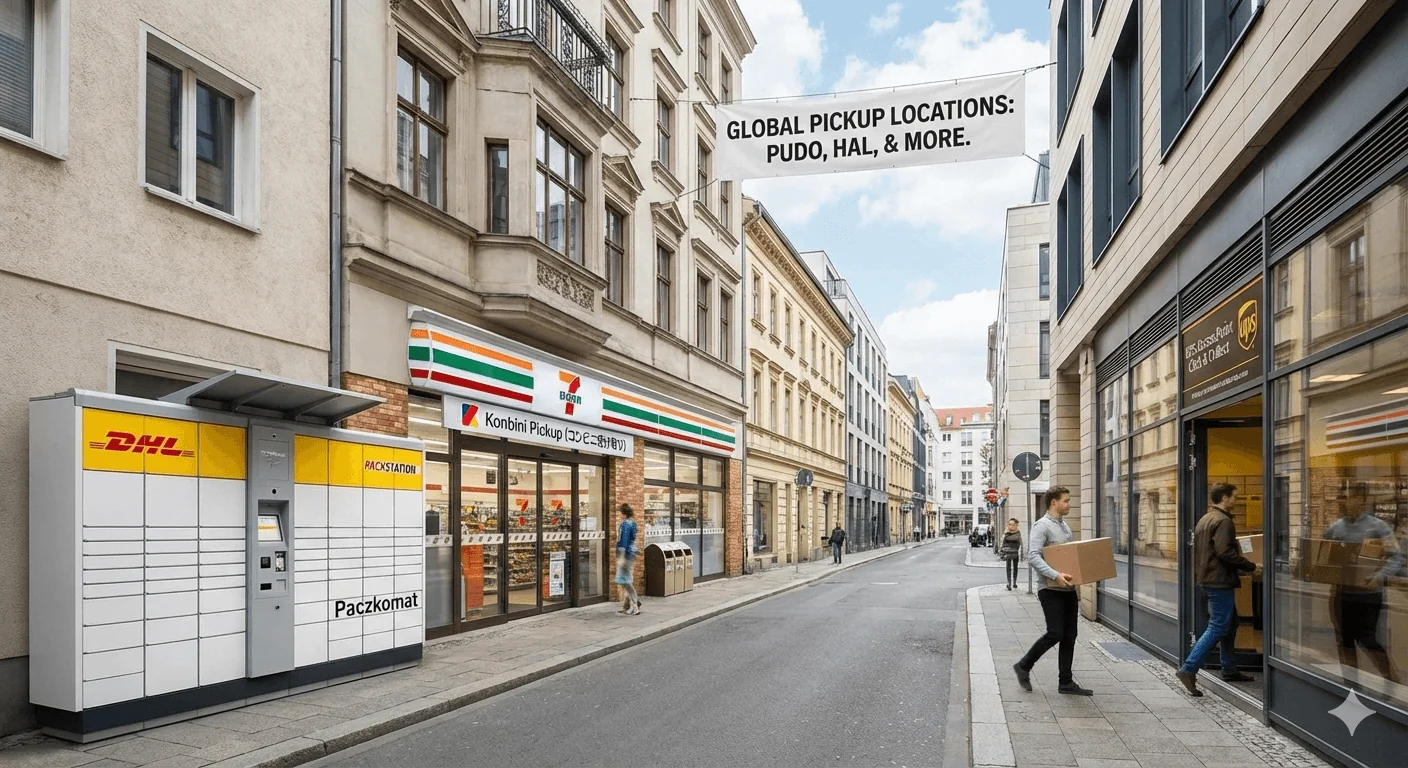
In the world of e-commerce, the final few miles are often the most complicated. As shoppers demand more flexibility, the traditional "package on the porch" model is being replaced by Out-of-Home (OOH) delivery. However, if you are a US merchant looking to expand or optimize your shipping, you might find that a "Pickup Location" goes by many different names depending on where you are in the world. From the automated lockers of Poland to the PVZ points of Russia to the convenience stores of Tokyo, here is how the world picks up its parcels in 2026.
Key Takeaways
- Denmark is tightening pickup timelines: Bring operates roughly 7,000 Pakkeshop and Pakkeboks points across Denmark and the wider Nordic region, and from October 1, 2026, the standard hold window shortens from 7 days to 4 days.
- The UK's locker network is scaling fast: InPost UK alone reached 15,000 lockers nationwide by June 2026, and Retail Economics data puts locker/parcel-shop preference at close to 20% of UK shoppers.
- Russia's PVZ network is now one of the largest in the world: over 226,400 pickup points nationwide as of January 2026, up 44.7% year over year — led by marketplaces Wildberries (~94,000 points) and Ozon (~80,000 points).
- Poland remains Europe's adoption leader: 93% of Polish online shoppers have used a parcel locker or pickup point in the past year, though it is far from the only market where OOH delivery dominates.
- US residential delivery carries a real cost: major carriers apply a $6.45–$6.50 residential surcharge per shipment, which is one of the clearest financial reasons US merchants are shifting toward pickup networks.
- Via.Delivery already covers 36,000+ pickup locations across the US, spanning FedEx Hold at Location, UPS Access Point, and retail partner networks.
The Regional Glossary: What's in a Name?
While the industry uses the technical term PUDO (Pick-Up Drop-Off), consumers usually know these services by more local, branded names.
North America: The "Access Point" Model
In the United States and Canada, the terminology is largely driven by the major carriers.
- Hold at Location (HAL): Primarily used by FedEx.
- Access Points: The signature term for the UPS network.
- Parcel Lockers: Increasing in popularity via Amazon Hub and GoPost (USPS).
- In-Store Pickup / BOPIS: Buy Online, Pick Up In-Store — usually limited to the specific retailer's own brick-and-mortar footprint.
Europe: Dense Networks, Local Names
Europe has some of the most mature pickup infrastructure in the world, though adoption varies sharply by country. Click & Collect is the standard term in the UK and Ireland. Point Relais, in France, refers to local shops — bakeries, newsstands — that act as pickup hubs. Packstation, in Germany, describes the iconic yellow DHL automated lockers. Paczkomat, in Poland, is InPost's locker network — and the name is now used almost generically for any locker. Poland leads Europe on adoption: 93% of Polish online shoppers have used a locker or pickup point in the past year, with roughly 27.3 pickup points per 10,000 people nationwide.
United Kingdom: Click & Collect at Scale
Click & Collect is the umbrella term used in the UK and Ireland, but the market has moved well past simple in-store pickup — a large share of volume now runs through third-party locker and parcel-shop networks rather than the retailer's own stores. InPost UK alone reached 15,000 lockers nationwide by June 2026, placed in supermarkets, retail parks, transport hubs, and residential areas. Alongside InPost, Evri, Yodel, and Royal Mail each run their own parcel shop and locker networks (ParcelShop, Collect+, and similar formats). On adoption: Retail Economics data cited by InPost puts locker/parcel-shop preference at close to 20% of UK shoppers, and customers who've used a locker once tend to keep using it — locker-experienced shoppers direct roughly 17% of their orders that way, up from a 7% baseline for first-time users.
Denmark: Pakkeshop and Pakkeboks
Denmark's pickup network runs primarily through Bring (formerly PostNord in parts of the region), which operates two formats: Pakkeshop, staffed pickup counters typically inside kiosks, supermarkets, and petrol stations, and Pakkeboks, unstaffed parcel lockers for 24/7 self-service pickup. Together these formats account for roughly 7,000 points across Denmark and the broader Nordic region. One change worth flagging for merchants: starting October 1, 2026, the standard hold window at Danish pickup points shortens from 7 days to 4 days, so checkout messaging and reminder emails should be updated to reflect the shorter collection deadline.
Russia: The PVZ Boom
Russia has quietly built one of the largest pickup networks on earth, known locally as PVZ (пункт выдачи заказов, "order issuance point"). As of January 2026, there were more than 226,400 PVZ points nationwide, up 44.7% year over year — a growth rate far outpacing most Western markets. The boom is driven almost entirely by two domestic marketplaces: Wildberries, with roughly 94,000 pickup points, and Ozon, with roughly 80,000. For merchants thinking about pickup infrastructure at scale, Russia's PVZ model is a useful reference point for how far marketplace-driven density can go.
Asia-Pacific: The "Konbini" Culture and Beyond
In East Asia, pickup infrastructure is built around retail density rather than dedicated locker networks.
Japan (コンビニ受け取り, Konbini Pickup): Japan's convenience-store chains — 7-Eleven, Lawson, and FamilyMart — function as the country's default pickup network, and their role goes well beyond simply holding a box. The same counter typically handles parcel pickup, parcel drop-off/returns, and cash payment for online orders (konbini-barai), making it a genuinely multi-service piece of e-commerce infrastructure rather than a single-purpose locker. We were not able to independently verify a current total for Japan-wide pickup point counts, so no figure is cited here — but the density of convenience stores in Japanese cities is widely understood to be the highest of any major market.
South Korea (반값택배, Ban-taek): Literally "half-price delivery," this model lets customers collect parcels at CU or GS25 convenience stores at a reduced shipping rate.
China (菜鸟驿站, Cainiao Stations): Cainiao Stations are Alibaba/Taobao's dedicated neighborhood pickup points, typically staffed counters near residential compounds or university campuses rather than automated lockers. They are one of the most widely used pickup formats globally by sheer order volume, given the scale of Chinese e-commerce — though we were not able to confirm a current, independently sourced count of active stations, so no specific number is cited here.
Popularity Heatmap: Who is Embracing OOH Delivery?
Not every country uses pickup locations at the same rate, and the reasons — urban density, delivery-theft rates, marketplace structure, cultural habit — vary widely by market.
| Region | Popularity | Preferred Method | Why? |
|---|---|---|---|
| Poland | Extremely High | Automated Lockers (Paczkomat) | 93% of Polish online shoppers used a locker/pickup point in the past year |
| United Kingdom | High | Click & Collect / Lockers | InPost UK alone reached 15,000 lockers by June 2026; ~20% of shoppers prefer lockers/parcel shops |
| Denmark / Nordics | High | Pakkeshop / Pakkeboks | ~7,000 Bring pickup points; hold window shortening to 4 days from Oct 2026 |
| Russia | Extremely High | PVZ Pickup Points | 226,400+ points nationwide (Jan 2026), +44.7% YoY, driven by Wildberries and Ozon |
| Japan | High | Convenience Stores (Konbini) | Multi-service counters handle pickup, drop-off, returns, and cash payment |
| China | High | Cainiao Stations | Staffed neighborhood pickup hubs tied to Alibaba/Taobao order volume |
| United States | Rising | Access Points / HAL | Driven by rising residential surcharges ($6.45–$6.50) and theft concerns |
Why the US Market Is Finally Catching Up
For years, the US was the outlier, with a heavy preference for front-door delivery. However, 2025 and 2026 have seen a real shift toward the "Hold at Location" model for three main reasons:
- Cost Mitigation: US carriers now apply a residential delivery surcharge of roughly $6.45–$6.50 per shipment. Shipping to a commercial Access Point or HAL location lets merchants avoid this fee.
- Porch Piracy: Package theft remains a significant problem in the US. Secure pickup locations remove that risk almost entirely.
- Failed Deliveries: For high-value items requiring an Adult Signature — wine, electronics — pickup locations ensure the package is collected successfully on the first attempt.
Summary: One Concept, a Thousand Names
Whether your customer calls it a Paczkomat, a PVZ, a Pakkeshop, a Konbini, or an Access Point, the intent is the same: convenience, security, and lower cost. For US merchants, the goal shouldn't just be to offer "shipping" — it should be to offer choices. By integrating a multi-carrier pickup network into your checkout, you're not just shipping a box; you're providing a localized delivery experience that matches the standard shoppers already expect from markets like Poland, Russia, and Japan.
Merchant Benefits at a Glance
- Eliminate Porch Piracy: Packages stay behind the counter, not on the curb.
- Slash Surcharges: Bypass residential and peak-residential delivery fees.
- Improve CX: Give customers a clear, self-managed pickup window instead of waiting on a doorstep delivery.
Ready to automate your FedEx HAL, UPS Access Point, or retail pickup workflow?
See how Via.Delivery works →Frequently Asked Questions
What does PUDO mean?
PUDO stands for Pick-Up Drop-Off — the industry term for any location where a shopper can collect an online order instead of having it delivered to their door, and in many cases also drop off a return.
What is Hold at Location (HAL)?
Hold at Location is FedEx's term for holding a package at a nearby staffed or retail location instead of attempting residential delivery. UPS offers the equivalent service under the name Access Point.
What is a PVZ, and why does Russia have so many?
PVZ (пункт выдачи заказов) is the Russian term for a parcel pickup point. Russia's PVZ network has grown to over 226,400 points as of January 2026, driven largely by domestic marketplaces Wildberries and Ozon building out their own dedicated pickup infrastructure rather than relying on traditional carriers.
How does Denmark's pickup network work?
Denmark's network, run primarily by Bring, uses two formats: staffed Pakkeshop counters and self-service Pakkeboks lockers, totaling roughly 7,000 points across Denmark and the Nordics. From October 1, 2026, the standard hold time for an uncollected parcel shortens from 7 days to 4 days.
How big is the UK's parcel locker network?
InPost UK alone reached 15,000 lockers nationwide by June 2026, placed in supermarkets, retail parks, transport hubs, and residential areas — alongside separate parcel shop and locker networks run by Evri, Yodel, and Royal Mail. Retail Economics data cited by InPost puts locker/parcel-shop preference at close to 20% of UK shoppers.
Why do US merchants care about pickup locations?
Three main reasons: avoiding residential delivery surcharges (currently around $6.45–$6.50 per shipment with major carriers), reducing package theft ("porch piracy"), and guaranteeing successful delivery for items that require an adult signature.
Does Via.Delivery support international pickup networks like PVZ or Konbini?
Via.Delivery's current network focuses on US pickup locations — FedEx Hold at Location, UPS Access Point, and retail partners — covering 36,000+ points. This guide covers international models for context on where OOH delivery is heading globally.
What's the difference between a parcel locker and a pickup counter?
A locker (like Poland's Paczkomat or Denmark's Pakkeboks) is a self-service, unstaffed unit a shopper opens with a code or app. A pickup counter (like Denmark's Pakkeshop or Japan's konbini) is staffed, and can typically also handle cash payment, returns, or ID verification for higher-value items.
How many pickup locations does Via.Delivery cover in the US?
Via.Delivery currently covers 36,000+ pickup locations across the United States, spanning FedEx Hold at Location, UPS Access Point, and retail partner networks.
Sources: InPost / Polish e-commerce pickup-adoption market data (2026); InPost UK locker-network figures via Retail Technology Innovation Hub (June 2026) and Retail Economics adoption data via Carriyo; Bring Nordic network and Danish hold-time policy data (2026); Russian PVZ market reporting via Kommersant and Yandex Maps data (2026); US carrier residential surcharge tariffs, FedEx and UPS (2026). Some figures are drawn from industry and news reporting rather than primary carrier disclosures — flag to us if you'd like the original links re-verified before this goes live.