





New Pickup Redirect Page for Wine Clubs and Subscriptions
Key Takeaways
- We've redesigned the pickup redirect page: the page customers open from our email or text to move an order that's already placed to a nearby pickup location before it ships.
- The page now leads with the closest location and its distance, pickup hours and expected delivery, then 2 nearby alternatives and a full map with search.
- One checkbox, "Save this choice for future orders", sends every future order from your store to the same location. About 55% of customers who switch an order to pickup also check it.
- It was built for orders that never go through checkout. Up to 35% of wine club members and subscribers have signed up to have their shipments redirected to pickup, and customers who used it rate it NPS 70+.
- For wine, customers only see locations that accept alcohol, about 20,000 across the U.S., and packages are held for 7 days.
- The savings come from members you keep. One club member is worth about $1,840 in future gross profit, so keeping just 1% of a 1,700-member club from cancelling over delivery protects about $31,300 (how we calculated it).
- Nothing changes in your checkout. Orders come in from Shopify, Commerce7 or ShipStation, and the switch happens before the order ships.
Share:
What's new: a redesigned pickup redirect page
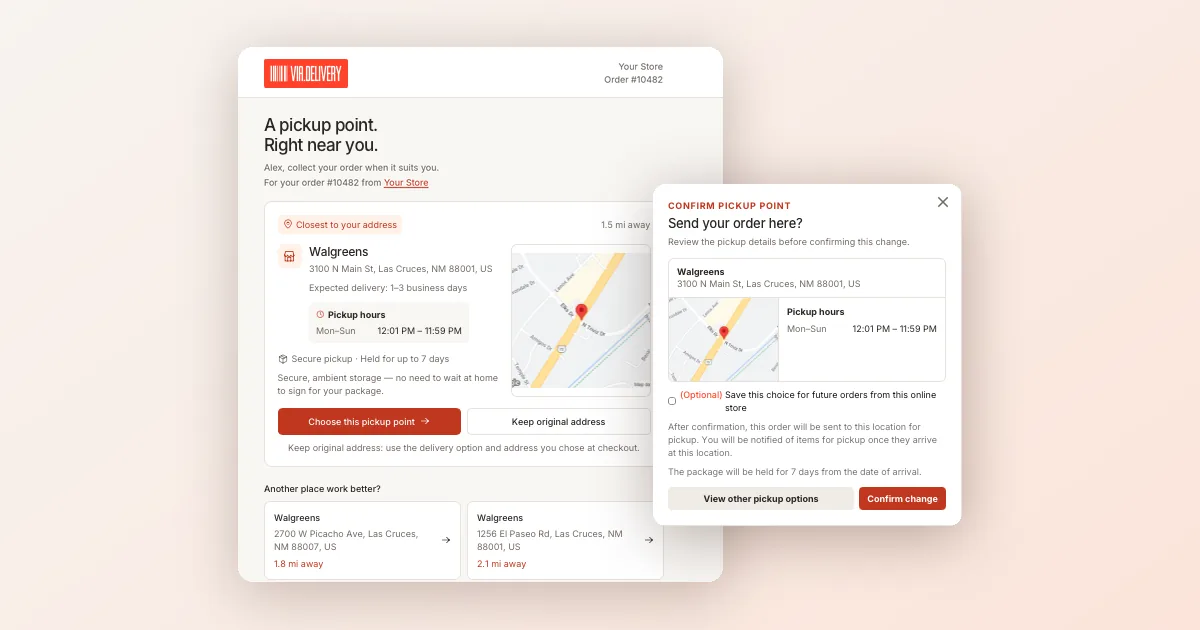
Pickup Redirect (BOPAR) lets your customer move an order to a FedEx Hold at Location or UPS Access Point site after they've placed it, as long as it hasn't shipped yet. We send the offer by email and text in your store's name. The link opens our pickup page, and that page is what we've rebuilt.
The redesign is about one thing: making the decision fast on a phone, since the offer arrives by email and text. The new page puts the most likely answer first, keeps the "no thanks" option one tap away, and moves everything else (alternatives, the full map, search) below it.
The redesign is about one thing: making the decision fast on a phone, since the offer arrives by email and text. The new page puts the most likely answer first, keeps the "no thanks" option one tap away, and moves everything else (alternatives, the full map, search) below it.
How the new page works
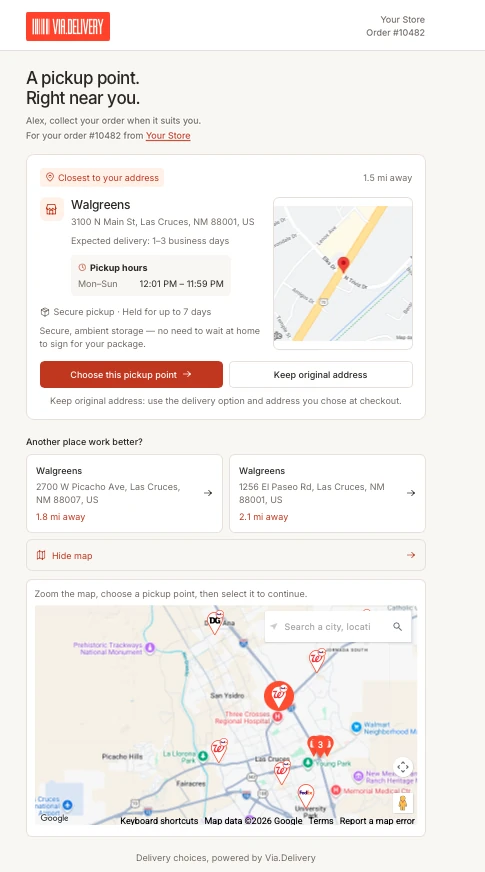
Here's what your customer sees, from top to bottom:
- Your store and the order. The header shows your store name and the order number, and the greeting uses the customer's first name. The customer knows right away which order this is and who it's from.
- The closest location. A card marked "Closest to your address" shows the location's name, address and distance, the expected delivery time, and its pickup hours, with a small map.
- What pickup means. One line explains it: secure, ambient storage, held for up to 7 days, and no need to wait at home to sign.
- Two clear buttons. "Choose this pickup point" or "Keep original address". Keeping the address leaves the order exactly as it was placed at checkout.
- Nearby alternatives. Under "Another place work better?" the customer sees two more locations with their distances, one tap each.
- A full map with search. The customer can open the map, search a city or address, and pick any location on it. Each pin shows the store's logo, so customers can spot the pharmacy or shop they already pass every day.
Confirming the change, and saving it for every future order
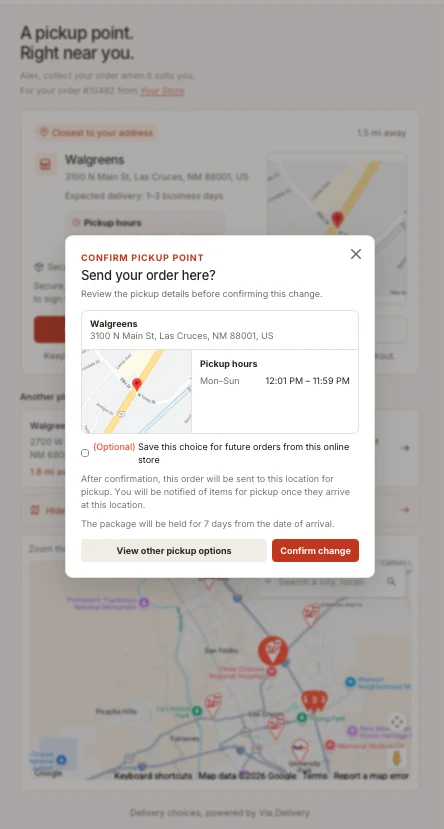
When the customer chooses a location, a confirmation dialog shows the location, its map and its hours again, and explains what happens next: the order is sent there, the customer is notified when it arrives, and it's held for 7 days from arrival. "View other pickup options" takes them back to the list.
The most important part of the dialog is the optional checkbox: "Save this choice for future orders from this online store." When the customer checks it, every new order from your store goes to that pickup location automatically, and the customer gets an email letting them know. About 55% of customers who switch an order to pickup check this box.
If you want an extra check before an order is redirected, you can turn on phone verification. The customer then enters the last 4 digits of the phone number used at checkout.
The most important part of the dialog is the optional checkbox: "Save this choice for future orders from this online store." When the customer checks it, every new order from your store goes to that pickup location automatically, and the customer gets an email letting them know. About 55% of customers who switch an order to pickup check this box.
If you want an extra check before an order is redirected, you can turn on phone verification. The customer then enters the last 4 digits of the phone number used at checkout.
Why wine clubs need pickup after the order is placed
Club shipments are the hardest orders to deliver in wine, for three reasons:
- They never go through checkout. A club release is charged automatically. A pickup option at checkout, however good, never gets a chance to appear on a club order.
- Every bottle needs an adult signature. Someone 21 or older has to sign, and releases arrive on weekdays, when many members are at work. In 2026 the adult signature fee is $10.00 per package on FedEx and $9.35 on UPS, and it's charged again on every reship.
- Carrier rules got stricter. Since June 1, 2026, UPS sends a missed wine delivery to a UPS Access Point after the first failed attempt and returns it to the shipper after 7 days. The member didn't choose that location and may not know the clock is running.
How wineries use it for club releases
A typical club release with Pickup Redirect looks like this:
- The release is processed. Club orders flow from Commerce7, Shopify or your order management system, such as ShipStation, the same way they do today.
- Members get the offer before the boxes ship. Each member receives an email and text in your winery's name with the closest location that accepts wine.
- Members who can't be home switch. They pick a location in a few taps. Members who are happy with home delivery tap "Keep original address" or simply ignore the message.
- Many save it for good. With "save for future orders" checked, the next release goes to their pickup location without another email to answer. One decision covers every future shipment.
- The 3PL ships as usual. The order is switched to a FedEx Hold at Location or UPS Access Point delivery before it ships, and your fulfillment system is updated automatically. The member shows ID at the counter.
What it saves: fewer failed deliveries, fewer cancelled members
Pickup Redirect saves money in two places. The smaller one is fees. Every failed wine delivery that gets reshipped to the same home address repeats at least $16.45 on FedEx Ground: the $10.00 adult signature fee plus the $6.45 residential surcharge, before base rate and fuel. A member who collects at a pickup counter doesn't fail delivery in the first place.
The bigger one is churn. In our article on the hidden cost of adult signature for wine clubs, we worked out what a club loses when a member cancels over delivery problems. With 6 bottles per shipment, 3 shipments a year, $56.78 per bottle, a 60% gross margin (an assumption) and 3 more years of membership, one member is worth about $1,840 in gross profit. Applied to a 1,700-member club (an example; use your own size):
The bigger one is churn. In our article on the hidden cost of adult signature for wine clubs, we worked out what a club loses when a member cancels over delivery problems. With 6 bottles per shipment, 3 shipments a year, $56.78 per bottle, a 60% gross margin (an assumption) and 3 more years of membership, one member is worth about $1,840 in gross profit. Applied to a 1,700-member club (an example; use your own size):
| Members kept who would have cancelled over delivery | Future gross profit protected (3 years each) |
|---|---|
| 1% of the club (17 members) | about $31,300 |
| 2% (34 members) | about $62,500 |
| 5% (85 members) | about $156,400 |
To put the adoption figure in the same terms: if up to 35% of members sign up for pickup, that's up to 595 of 1,700 members whose releases no longer depend on someone being home on a weekday.
We don't yet have data on exactly how many cancellations pickup prevents, so treat the table as a way to size the opportunity, not a forecast. The churn article explains how to measure it for your own club: compare cancellation rates for members whose shipments failed with those whose shipments arrived the first time, before and after you offer pickup.
We don't yet have data on exactly how many cancellations pickup prevents, so treat the table as a way to size the opportunity, not a forecast. The churn article explains how to measure it for your own club: compare cancellation rates for members whose shipments failed with those whose shipments arrived the first time, before and after you offer pickup.
Why subscription brands use it
Subscriptions have the same core problem as wine clubs: the order is created automatically, so there's no checkout where the customer could choose pickup. The customer set an address once, often months ago, and never sees it again.
That causes problems in a few common cases:
That causes problems in a few common cases:
- Customers who aren't home in the day and keep getting boxes left on the porch, or keep missing signature-required deliveries.
- High-value or temperature-sensitive products, where a box sitting outside for hours is a real risk.
- Customers who move, travel or change routines, and don't want to log into a subscription portal to update an address.
Other orders that benefit
Pickup Redirect isn't only for recurring orders. Merchants also use it for:
- Customers who missed the pickup option at checkout, or only realized later that they won't be home on delivery day.
- Apparel and other high-value orders, where a staffed counter is safer than a doorstep.
- Signature-required products other than wine. In our checkout data, 12% to 26% of buyers of signature-required products choose a pickup location when it's offered, 16% on average, the highest share of any category we measure (Via.Delivery data).
Pickup at checkout vs. pickup redirect vs. missed delivery redirect
Pickup Redirect is one of three ways we put a pickup location in front of your customer. Each covers a different moment:
| Pickup at checkout | Pickup Redirect (before shipping) | Missed Delivery Redirect | |
|---|---|---|---|
| When the customer chooses | During checkout | After the order is placed, before it ships | After a failed delivery attempt |
| Club and subscription orders | No, they skip checkout | Yes | Yes |
| Changes to your checkout | Adds a shipping option | None | None |
| Can apply to future orders | Per order | Yes, with "save for future orders" | Per package |
| Best for | New one-time orders | Clubs, subscriptions, customers who missed the option | The safety net for home deliveries |
Many merchants use more than one: pickup at checkout for new orders, Pickup Redirect for club and subscription orders, and Missed Delivery Redirect for anything that still fails at the door.
Built-in safeguards
- Only orders that haven't shipped. We check the order status in ShipStation and the 3PLs we work with. If the order has already shipped, the customer is told it's too late to change it, and nothing is altered.
- One tap to say no. "Keep original address" leaves the order as it was.
- Only locations that can take the package. We check weight and dimensions, and for wine, that the location accepts alcohol. About 20,000 locations across the U.S. accept wine, and ID is checked at pickup.
- Optional phone verification. Require the last 4 digits of the checkout phone number before an order can be redirected.
Via.Delivery's solution
Pickup Redirect is available now for merchants on Shopify, Shopify Plus and Commerce7, and for orders that come straight from an order management system such as ShipStation. It works with the systems wineries and subscription brands already use:
- Store platforms: Shopify, Shopify Plus and Commerce7.
- Subscription apps: ReCharge, Awtomic and others.
- Order management and fulfillment software: ShipStation, ShipHero and Fort Systems.
- Wine fulfillment partners: Wineshipping, WeShipExpress, Copper Peak Logistics, Wine Country Connect, WineCub and BeyondVino.
FAQ
What is a pickup redirect?
It's a way for a customer to move an order they've already placed to a nearby pickup location, such as a FedEx Hold at Location or UPS Access Point site, before the order ships. With Via.Delivery, the customer gets the offer by email and text and confirms it on a single page.
Does it work for wine club orders?
Yes. Club orders don't go through checkout, so this is how club members get a pickup option. They only see locations that accept alcohol, about 20,000 across the U.S., and show ID when they collect the package. Wineries have seen up to 35% of club members sign up for redirects.
Can a subscriber send every future order to pickup?
Yes. When confirming, the customer can check "Save this choice for future orders from this online store." Every new order from your store then goes to that location automatically, and the customer gets an email letting them know.
How much can a pickup redirect save a winery?
Two things: reship fees and lost members. A reshipped wine box on FedEx Ground repeats at least $16.45 in adult signature and residential fees. The larger saving is retention: one club member is worth about $1,840 in future gross profit, so keeping 1% of a 1,700-member club from cancelling over delivery protects about $31,300.
What happens if the order has already shipped?
The customer sees a message that it's too late to change this order, and nothing is changed. If they saved their pickup preference, it applies to their next order.
Do I need to change my checkout?
No. The offer goes out after the order is placed, by email and text. Your checkout and shipping options stay as they are.
How long is the package held?
7 days from arrival at the pickup location. The customer is notified when it's ready.
Sources
- Via.Delivery, Pickup Redirect product page
- Via.Delivery, pickup data by product category
- Sovos ShipCompliant and WineBusiness Analytics, 2026 Direct-to-Consumer Wine Shipping Report (press release, January 27, 2026)
- The Drinks Business, Average price of a bottle of US wine hits $56.78 (January 2026)
- FedEx, 2026 changes to FedEx surcharges and fees
- UPS, revised rates for value-added services, effective December 22, 2025
- WineDirect Fulfillment, UPS carrier notes (June 1, 2026 Access Point change)